


What US clients actually want in 2026 is no longer just talent; it’s outcomes that directly impact business growth.
If you’ve been working with US clients or trying to win them, you’ve probably noticed a shift in expectations. It’s no longer enough to say, “We have skilled developers” or “We provide experienced designers.” That used to work. But in 2026, it no longer stands out.
Now the real question clients are asking is much sharper:
“What result will this actually bring to my business?”
And that small shift changes everything.
Because when we talk about what US clients actually want in 2026, we’re really talking about a mindset change—from hiring people for effort… to hiring partners for impact.
Think about it like this:
- Does the client want more hours worked? Not really.
- Do they want tasks completed? That’s expected.
- What they truly want is growth, more revenue, lower costs, faster delivery, better customer experience.
That’s the real currency now: measurable outcomes.
And this shift didn’t happen overnight. It’s being driven by three major forces reshaping the US market:
- The rise of AI and automation is reducing the value of manual effort
- Increasing pressure on ROI and accountability
- Faster market cycles demand quicker results
So today, even highly skilled teams are not enough on their own. If the outcome isn’t clear, the deal often doesn’t happen. This shift is not just a trend; it is becoming the new standard for how US companies evaluate outsourcing, IT services, and consulting partners in 2026.
Pro Tip: If your proposal starts with “what we offer” instead of “what you gain,” you’re already speaking the old language of business. In 2026, clients respond to outcomes, not activities.
Why the Shift from Talent to Outcomes Is Happening
To really understand what US clients actually want in 2026, we need to look at why this shift is happening in the first place. Because it’s not random—it’s the result of major changes in how businesses operate, compete, and measure success.
A few years ago, companies were primarily focused on hiring talent. If you had skilled developers, designers, or engineers, you were already in a strong position. But today, that’s no longer the differentiator. Everyone has access to talent, globally, instantly, and often at lower cost.
So naturally, the question has changed.
Now businesses are asking:
“What is this talent actually delivering for us?”
That’s where outcomes come in.
According to a McKinsey report on performance transformation, companies that adopt outcome-driven operating models are 1.7 times more likely to outperform peers in profitability and efficiency. This clearly shows that focusing on results, not just effort, creates a competitive advantage.
Similarly, a Deloitte Global Outsourcing Survey (2024) found that 78% of US companies now evaluate external partners based on business outcomes rather than task completion or hourly work. That’s a huge shift in expectations compared to traditional outsourcing models.
So when we talk about what US clients actually want in 2026, it’s important to understand this mindset shift:
- It’s no longer about how many people are working on the project
- It’s about what measurable change those people are creating
Let’s break it down in a simple way:
| Old Model | New Outcome-Based Model |
|---|---|
| Focus on hours worked | Focus on business results |
| Hiring for skills | Hiring for impact |
| Delivery of tasks | Delivery of measurable KPIs |
| Success = completion | Success = transformation |
This shift is also being accelerated by technology. AI tools are now capable of handling tasks that previously required large teams. That means human work is being evaluated differently, not by output, but by value creation.
Old Model vs New Model in 2026:
- Talent-focused hiring → Outcome-focused partnerships
- Task completion → Business transformation
- Hour-based billing → Value-based engagement
- Delivery success → KPI success
Pro Tip: If your services can’t be linked to a measurable business metric (like revenue growth, cost reduction, or efficiency improvement), clients will struggle to justify working with you in 2026.
Even Harvard Business Review highlights that organizations with clearly defined outcome-based KPIs consistently achieve higher customer satisfaction and long-term growth compared to those focused only on execution.
So when we step back and look at the bigger picture, what US clients actually want in 2026 is very simple:
Less activity
More impact
Clear, measurable results
And that expectation is now shaping every hiring decision, outsourcing deal, and partnership model in the US market.
How AI Is Accelerating the Shift Toward Outcomes
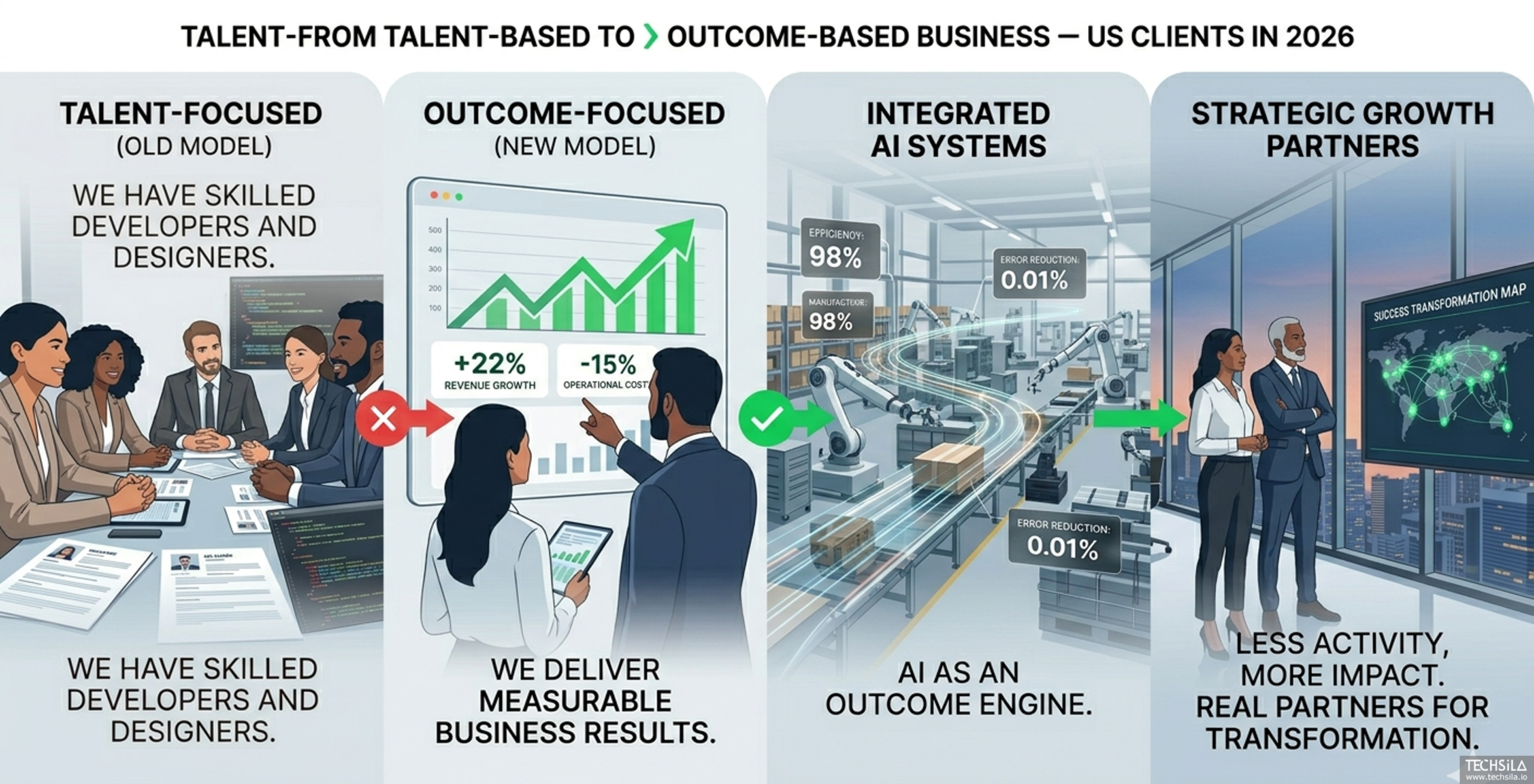
If we want to truly understand what US clients actually want in 2026, we can’t ignore the biggest driver behind this shift, Artificial Intelligence.
AI isn’t just changing how work is done. It’s changing how value is measured.
A few years ago, businesses hired teams to manually handle tasks like coding, testing, reporting, customer support, and design. Today, many of those tasks are either automated or heavily supported by AI tools. That means the value of “just doing the work” is dropping fast.
Now the real question has changed:
What better outcome can this system deliver using AI?
According to a Stanford HAI report (2025), AI-assisted professionals can improve productivity by up to 40%, especially in software development and analytics roles. This doesn’t just increase speed—it changes client expectations entirely.
And this is exactly where what US clients actually want in 2026 becomes clear: they don’t want more manual effort—they want smarter systems that deliver measurable results.
Let’s break it down practically:
- AI writes code → clients expect faster product delivery
- AI analyzes data → clients expect sharper business insights
- AI automates workflows → clients expect lower operational costs
- AI improves customer experience → clients expect higher retention
Every improvement in AI pushes expectations one level higher.
A Gartner report (2024) also predicts that by 2026, over 60% of enterprises will require AI-augmented delivery models from their vendors. That means traditional service-only approaches will struggle to stay relevant.
This is where execution partners need to evolve into outcome-driven solution providers.
For example, instead of just offering AI development, businesses now expect complete systems that directly improve KPIs like efficiency, revenue, or customer experience.
This is exactly where companies like Techsila come in, helping businesses move from basic implementation to AI-driven business transformation. Through solutions like AI Integration Solutions, organizations can connect AI directly to their existing systems and start producing measurable business outcomes instead of just experimenting with tools.
Pro Tip: Don’t position AI as a feature. Position it as a business outcome engine, clients don’t buy AI, they buy what AI improves.
Even more advanced applications like vision systems, automation pipelines, and predictive analytics fall under the same expectation: clear, measurable business impact.
And that brings us back to the core truth: what US clients actually want in 2026 is not just technology or talent, but systems that continuously deliver results without friction.
What US Clients Now Expect from Service Providers in 2026
At this point, we’ve established a clear shift in the market—but let’s make it more practical. Because understanding what US clients actually want in 2026 is not just theory anymore; it directly affects how service providers win or lose deals.
If you’re working with US clients today, one thing becomes very obvious: they are no longer impressed by what you do. They are focused on what changes because of what you do.
That expectation shows up in very specific ways.
1. They Expect Measurable Business Impact
Clients don’t want vague progress updates anymore. They want numbers.
For example:
- How much did revenue increase?
- How much cost was reduced?
- How much faster is the process now?
If you can’t answer that clearly, you’re already at a disadvantage.
According to a PwC Global Digital Trust Insights report, over 72% of US business leaders say they will stop working with vendors who cannot demonstrate measurable ROI within the first project cycle. That’s a strong signal of how serious this shift has become.
2. They Expect Ownership, Not Just Execution
Another big change is responsibility.
Clients don’t just want someone to “complete tasks.” They want partners who take ownership of outcomes end-to-end.
That means:
- Identifying problems proactively
- Suggesting improvements
- Optimizing results continuously
In short, execution is expected, but ownership is what wins trust.
3. They Expect Technology to Be Directly Tied to Outcomes
This is where things get interesting.
Modern clients are no longer interested in technology just because it’s advanced. They care about how it improves business performance.
This is exactly why solutions like AI integration, automation systems, and computer vision are becoming so important in 2026.
For example, businesses using advanced visual AI systems are not just “using AI”—they are improving real operational metrics like:
- Faster quality control in manufacturing
- Reduced human error in logistics
- Better customer experience in retail environments
This is where Techsila’s Computer Vision & Image Recognition services become highly relevant. These solutions are designed specifically to help businesses turn visual data into measurable outcomes instead of just raw insights. You can explore them here:
4. They Expect Integrated AI Ecosystems, Not Isolated Tools
Another major expectation shift is integration.
Clients don’t want 5 different tools that don’t talk to each other. They want one connected ecosystem where AI, data, and operations work together seamlessly.
That’s why companies are increasingly investing in end-to-end transformation instead of point solutions.
To support this need, Techsila’s AI Integration Solutions help businesses connect systems, automate workflows, and align technology directly with business outcomes:
Pro Tip:
If you want to win US clients in 2026, stop selling tools or talent. Start selling outcomes wrapped in systems. That’s what builds long-term trust.
What This Really Means
When we combine all of this, one thing becomes very clear:
What US clients actually want in 2026 is not fragmented services or isolated expertise. They want complete accountability for results.
Not “we built this for you.”
But “this improved your business like this.”
That difference is what defines winners and losers in the market today.
Real-World Outcomes US Clients Actually Care About in 2026

At this stage, it’s no longer enough to talk about expectations in theory. To fully understand what US clients actually want in 2026, we need to look at what they pay attention to in real projects: outcomes that directly affect their business performance.
Because in the end, no client is impressed by effort, they are impressed by the impact they can measure.
Let’s break this down into real-world scenarios.
1. Revenue Growth Is the Ultimate Proof
If a solution doesn’t contribute to revenue growth, it often gets questioned, no matter how advanced it is.
For example, in retail and e-commerce, AI-driven personalization systems have shown measurable impact. According to a McKinsey report on personalization, companies that effectively use AI-based personalization see 5% to 15% revenue increase and up to 10–30% improvement in marketing efficiency.
That’s not a technical win, that’s a business win.
So when we talk about what US clients actually want in 2026, it becomes clear: they want systems that directly influence revenue outcomes.
2. Cost Reduction Through Automation
Another major outcome clients care about is cost efficiency.
A Deloitte insights study found that organizations implementing AI and automation in operations can reduce operational costs by 20% to 30% on average, especially in areas like customer service, logistics, and back-office processing.
This is why automation is no longer seen as a “tech upgrade”, it’s seen as a cost-saving strategy.
Clients don’t ask, “Is it automated?”
They ask, “How much are we saving because of it?”
3. Speed and Time-to-Market Advantages
In competitive markets like the US, speed often determines success.
According to Harvard Business Review, companies that bring products to market faster than competitors can achieve up to 20% higher revenue growth over time.
This is why clients are shifting focus from development effort to delivery speed and business readiness.
So again, what US clients actually want in 2026 is not just work being done faster, it’s business value being delivered sooner.
4. Operational Efficiency and Error Reduction
Let’s take a more technical but highly practical example: operational systems like quality control or logistics.
Businesses using AI-based systems, such as computer vision, have reported:
- Up to 40% reduction in human error in inspection-heavy industries
- Significant improvements in supply chain accuracy and tracking
These improvements don’t just optimize processes, they eliminate costly mistakes.
This is where solutions like Techsila’s Computer Vision & Image Recognition services become highly relevant again. By turning visual data into actionable insights, businesses can directly improve accuracy, efficiency, and operational outcomes:
5. Better Decision-Making Through Data
Another major outcome is decision quality.
According to PwC’s AI Business Value report, organizations using AI-driven analytics are twice as likely to make faster and more accurate decisions compared to those relying on traditional reporting systems.
This is important because clients don’t just want data, they want clarity and direction.
Pro Tip:
If your solution cannot be tied to at least one of these outcomes, revenue, cost, speed, efficiency, or decision quality, it will struggle to stand out in 2026.
What This Really Shows
When we put all of this together, the message becomes very clear.
What US clients actually want in 2026 is not just technical capability, it’s business transformation they can measure and justify internally.
Every project is now judged by one simple question:
Did this improve the business in a way we can see in numbers?
If the answer is yes, the partnership continues. If not, it gets replaced.
How Service Providers Can Align with This Shift in 2026
Now let’s bring everything together in a practical way. Understanding what US clients actually want in 2026 is useful—but the real question is: how should service providers adapt to stay relevant?
Because here’s the truth: most companies are still selling services the 2020 way, while clients are buying outcomes the 2026 way. That gap is where deals are being lost.
So if you’re a service provider, agency, or tech partner, here’s what needs to change.
1. Stop Selling Skills, Start Selling Outcomes
This is the biggest mindset shift.
Instead of saying:
- “We provide developers”
- “We offer AI engineers”
Start saying:
- “We help you reduce operational costs by 25%.”
- “We help you increase conversion rates through AI-driven systems.”
Because when we look at what US clients actually want in 2026, they don’t evaluate talent; they evaluate transformation.
2. Build Outcome-Based Proposals
Traditional proposals focus on deliverables. Modern US clients want impact clarity.
A strong proposal now answers:
- What problem are we solving?
- What measurable KPI will improve?
- How will success be tracked?
According to a Forrester research study, companies that clearly define outcome-based KPIs in proposals are 30% more likely to win enterprise deals compared to those using traditional service descriptions.
That tells us something important: clarity wins contracts.
3. Integrate AI Into Business Impact (Not Just Features)
AI is not a selling point anymore, it’s expected.
What matters now is how AI connects to business outcomes like efficiency, revenue, and accuracy.
For example, instead of saying “we build AI systems,” you should say:
- “We build AI systems that reduce manual workload by 40%”
- “We build automation that improves decision speed by 2x”
This is exactly where what US clients actually want in 2026 becomes very practical: they want AI that produces measurable change, not experimental tools.
4. Focus on End-to-End Ownership
Clients are no longer interested in fragmented delivery models. They want partners who can own the full journey, from strategy to execution to optimization.
This is especially true in AI-driven transformation projects.
For example, companies using integrated solutions like Techsila’s AI Integration Solutions can connect multiple systems and ensure AI is not just implemented, but actually delivering continuous business value:
5. Bring Data Into Every Conversation
One of the strongest signals of maturity in 2026 is data-backed communication.
Clients now expect:
- Performance dashboards
- KPI tracking
- Real-time outcome reporting
Without data, even good work feels invisible.
Pro Tip: If you cannot measure it, your client will assume it didn’t happen.
6. Align Technology With Real Business Use Cases
Technologies like computer vision, AI automation, and analytics only matter when they solve real problems.
For instance, visual AI systems are not just “advanced tools”—they help businesses:
- Improve quality control
- Reduce manual inspection costs
- Increase operational accuracy
This is where Techsila’s Computer Vision & Image Recognition services play a key role in turning visual data into measurable business improvement:
What This Really Means
At the core of all this, the message is simple.
What US clients actually want in 2026 is not a list of services. It’s a reliable path from problem to measurable business outcome.
They don’t want more complexity.
They want clarity, accountability, and results they can trust.
Conclusion
If there’s one thing we’ve learned throughout this discussion, it’s simple: what US clients actually want in 2026 has fundamentally changed how business relationships are defined.
It’s no longer about hiring the most skilled team, collecting the most impressive resumes, or stacking up technical expertise. Those things still matter. But they are no longer enough on their own.
Today, clients are looking for something much more direct and measurable: real business outcomes.
They want to see impact in numbers, not just activity in reports. They want growth, efficiency, speed, and clarity, not just execution.
And this shift is not slowing down. It’s accelerating.
As AI continues to automate execution and reduce manual effort, the value of “doing the work” is decreasing. What is increasing in value is the ability to design systems that consistently produce results.
That’s why companies that adapt to this mindset early will dominate in the coming years. They won’t just be vendors—they will become strategic growth partners.
Let’s quickly recap what this new reality looks like:
- Talent alone is no longer a differentiator
- Execution without measurable impact is not enough
- AI has shifted focus from effort to outcomes
- Clients now evaluate everything through KPIs and ROI
And that brings us back to the core idea:
What US clients actually want in 2026 is not services. it’s transformation they can measure, scale, and trust.
Pro Tip:
If your work cannot be translated into a business metric (revenue, cost, speed, or efficiency), it will struggle to stay relevant in 2026’s competitive US market. Always think in outcomes, not outputs.
Where Techsila Fits Into This Shift
Businesses that want to stay ahead of this transformation need more than just execution, they need systems that connect technology directly to business outcomes. Through AI Integration Solutions, businesses can unify workflows, automate decision-making, and ensure AI delivers real operational value. With Computer Vision & Image Recognition services, organizations can turn visual data into actionable insights that improve accuracy, efficiency, and performance.
And when they are ready to take the next step, they can start building outcome-driven solutions with expert guidance. If your business is ready to move from talent-based delivery to outcome-driven growth, you can get a tailored quote from Techsila for AI consulting, automation, or digital transformation solutions designed around measurable business outcomes.
Final Thought
The companies that will win in 2026 are not the ones doing the most work; they are the ones delivering the most meaningful results.
Because in the end, clients don’t remember effort. They remember impact.
And that is exactly what US clients actually want in 2026: outcomes that move their business forward.
FAQs: Market & Consumer Trends in 2026
1. What are consumers looking for in 2026?
Consumers in 2026 are looking for speed, personalization, and trust. They prefer brands that offer seamless digital experiences, instant solutions, and clear value instead of complex or slow processes.
2. How to get clients in 2026?
To get clients in 2026, businesses need to focus on outcomes rather than services. Clients respond more to measurable results, case studies, AI-driven efficiency, and clear ROI instead of generic service offerings.
3. What do people want in 2026?
People want convenience, personalization, and smarter solutions powered by AI. They expect faster services, better digital experiences, and products that solve problems with minimal effort on their part.
4. What products will trend in 2026?
Products that use AI, automation, personalization, and real-time data will dominate in 2026. This includes AI-powered tools, smart devices, predictive software, and solutions that improve productivity or reduce cost.
