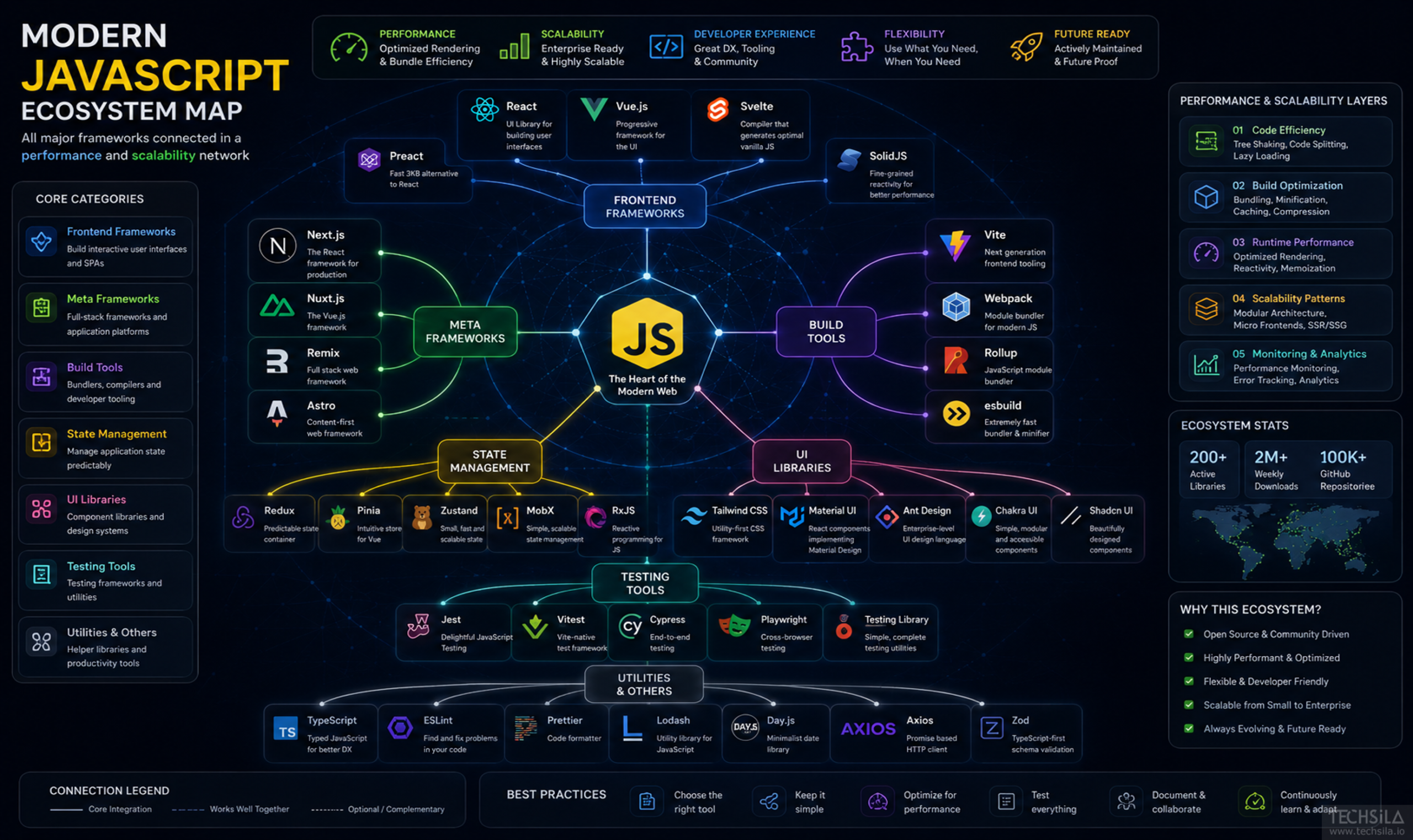
In 2026, JavaScript is still at the heart of modern web development, powering everything from simple websites to complex enterprise applications. As user expectations grow and digital products become more advanced, developers are under increasing pressure to build faster, scalable, and highly interactive applications.
That’s why exploring the Top 10 JavaScript frameworks you should consider in 2026 is more than just keeping up with trends; it’s about making smart technical decisions that directly impact performance, scalability, and long-term maintainability. Over the years, JavaScript frameworks have evolved from simple UI tools into full-fledged ecosystems that handle routing, state management, server-side rendering, and even backend integration. This evolution has accelerated development, but it has also introduced a new challenge: choice overload.
Today, developers are no longer asking whether they should use a framework; they are asking which one fits best for their specific needs. Some frameworks prioritize speed and simplicity, while others focus on scalability, enterprise-level architecture, or seamless full-stack development. This makes 2026 an especially interesting year for JavaScript development. New frameworks are emerging with better performance models, while established ones continue to evolve with improved tooling and developer experience. At the same time, the demand for highly optimized applications has never been higher.
In this guide, we’ll break down the Top 10 JavaScript frameworks you should consider in 2026, based on real-world usability, performance, ecosystem strength, and industry adoption. Instead of focusing on hype, we’ll focus on practical value, what actually works in production environments.
Pro Tip: The best framework is not the most advanced or most popular one it’s the one that aligns with your project’s complexity, team expertise, and long-term scalability goals.
Why JavaScript Frameworks Matter More Than Ever in 2026
If you look at modern web development today, one thing becomes very clear: JavaScript frameworks are no longer just a “developer preference.” They are now a core part of how fast, scalable, and maintainable applications are built. When we talk about the Top 10 JavaScript frameworks to consider in 2026, we’re really talking about tools that shape how digital products perform in real-world conditions.
The demand for better performance, smoother user experiences, and faster development cycles has pushed frameworks into the center of software architecture. Businesses no longer want just functional applications; they expect applications that are optimized, responsive, and scalable from day one. This shift is also backed by industry trends. Modern development teams are increasingly adopting component-based architectures, which allow them to reuse code, reduce redundancy, and speed up deployment cycles. In fact, studies from developer productivity reports show that component-based frameworks can reduce development time by up to 30–40% in medium to large-scale projects.
But this is where the challenge begins. With so many frameworks available, choosing the right one is not just a technical decision; it’s a strategic one. The wrong choice can lead to performance bottlenecks, scaling issues, or long-term maintenance problems. That’s why many businesses now rely on structured development approaches and specialized services to ensure the right technology stack is chosen from the beginning. For example, teams working on advanced frontend and interactive systems often combine frameworks with structured engineering practices like AI-driven optimization and modern UI architecture, such as those offered in solutions like
This helps ensure that frameworks are not just used for development but are aligned with overall business goals, performance requirements, and scalability needs. So when we break down the Top 10 JavaScript frameworks you should consider in 2026, we’re not just listing tools, we’re evaluating ecosystems that support long-term digital growth.
Pro Tip: A framework should never be chosen in isolation. Always evaluate it based on how well it integrates with your backend, scalability goals, and future feature expansion plans.
React in 2026: Still the Dominant Choice or Slowing Down?
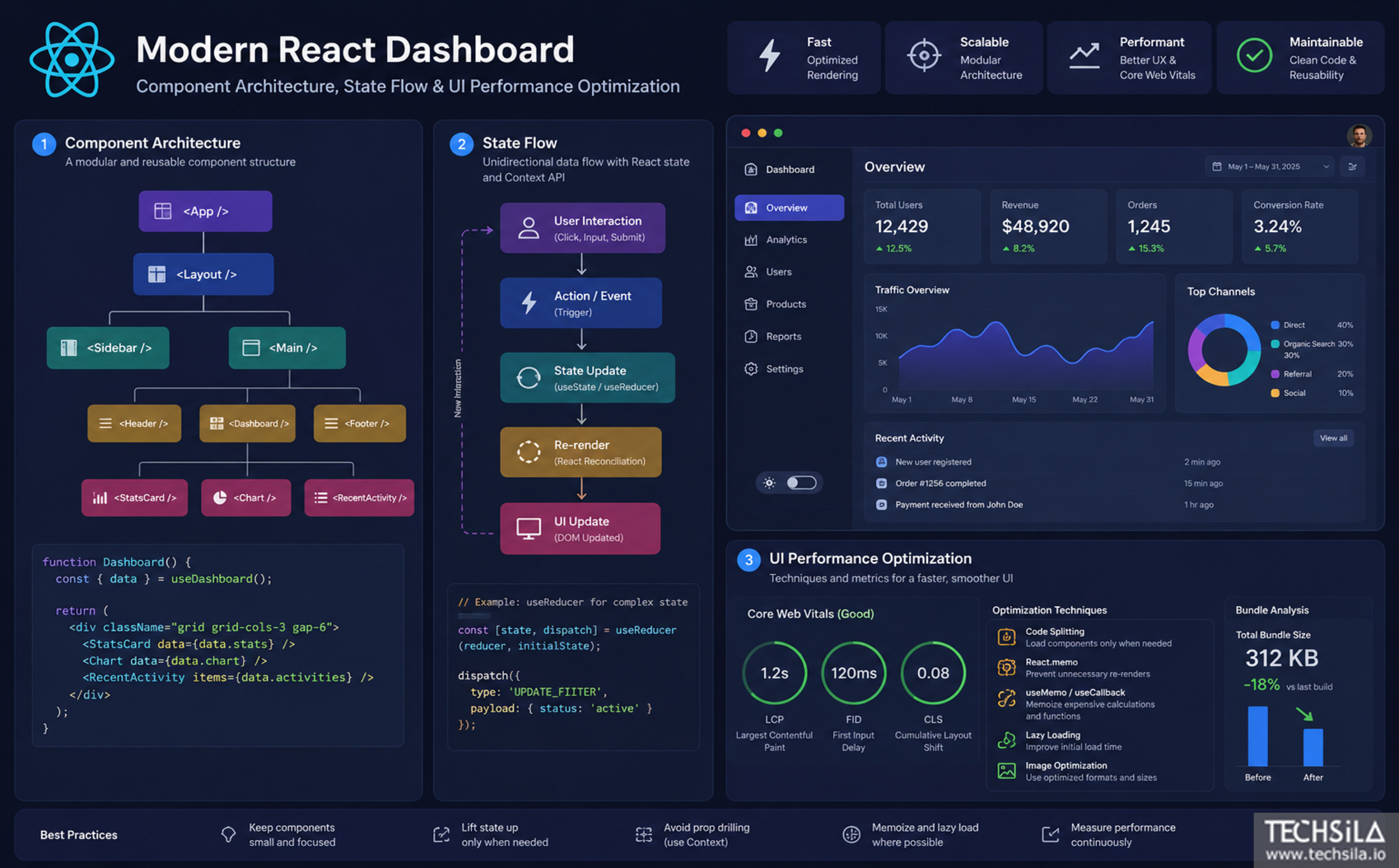
When discussing the Top 10 JavaScript frameworks you should consider in 2026, it’s impossible to ignore React. Even after many years in the ecosystem, React continues to be one of the most widely used frontend libraries in the world. Its component-based architecture, strong ecosystem, and massive community support have kept it relevant even as new frameworks enter the market. React’s ability to build dynamic and highly interactive user interfaces is still one of its biggest strengths.
However, the conversation in 2026 is no longer just about popularity; it’s about efficiency, performance, and developer experience at scale. React remains strong, but modern development challenges have pushed developers to rethink how they use it. Issues like bundle size optimization, rendering efficiency, and state management complexity have led to the rise of meta-frameworks like Next.js and other performance-focused solutions built on top of React.
According to the Stack Overflow Developer Survey 2025, React continues to be one of the most commonly used frontend technologies, used by a significant percentage of professional developers worldwide. This shows that despite growing competition, its adoption is still extremely strong across startups and enterprise applications. At the same time, newer frameworks are challenging React’s dominance by offering simpler reactivity models and improved performance out of the box. This is why many teams in 2026 are not replacing React entirely; they are evolving how they use it.
For example, modern UI development now focuses heavily on server-side rendering, static generation, and edge rendering strategies, which are often implemented using frameworks built around React’s core principles. This evolution shows that React is not fading; it is adapting. Many companies also combine React with backend and system-level optimization strategies to improve performance and scalability. This is especially important in enterprise applications where user experience directly impacts business outcomes. React’s continued dominance is also reflected in industry discussions and documentation, where it is consistently highlighted as a leading UI library for modern web applications.
In production environments, React-based systems often need deeper integration with backend services, automation layers, and AI-driven workflows. This is where structured solutions like AI Integration help businesses ensure their frontend performance aligns with overall system efficiency.
Vue.js in 2026 — Simplicity vs Scalability Balance
When we continue exploring the Top 10 JavaScript frameworks you should consider in 2026, Vue.js naturally stands out as one of the most developer-friendly options in the ecosystem.
Vue has always been known for its simplicity. Unlike heavier frameworks, it offers a gentle learning curve, clean structure, and flexibility that makes it attractive for both beginners and experienced developers. In 2026, that simplicity is still one of its biggest strengths.
What makes Vue particularly interesting today is how it balances simplicity with modern performance features. With tools like Vue 3 and the Composition API, developers now have more control over scalability, reusability, and code organization than ever before.
However, as applications grow in complexity, Vue also presents a common challenge: maintaining structure in large-scale systems. While it performs exceptionally well for small to medium projects, enterprise-level applications often require additional architectural planning to ensure long-term scalability.
This is why Vue is often chosen for projects where speed of development and flexibility matter more than rigid architectural constraints.
According to industry usage insights shared by modern development communities, Vue continues to hold a strong position among frontend frameworks, especially in startups and mid-sized companies where rapid development cycles are critical.
But framework choice in 2026 is no longer just about features it’s about how well it integrates into broader system architecture, including backend services, APIs, and automation layers.
For example, when building scalable applications, Vue is often paired with structured backend and integration strategies to ensure performance and maintainability. This is especially important when systems need to handle complex workflows, real-time data, or AI-powered features Vue’s design philosophy and adoption trends are well documented in its official ecosystem, where it continues to evolve as a progressive framework for modern web development:
Angular in 2026: Enterprise Powerhouse or Overengineered Choice?
As we move further into the Top 10 JavaScript frameworks you should consider in 2026, Angular remains one of the most debated frameworks in the entire ecosystem.
Unlike React or Vue, Angular is not just a UI library; it’s a full-fledged frontend framework with a strong opinionated structure. This means it provides everything out of the box: routing, state management, form handling, HTTP services, and more.
For enterprise-level applications, this all-in-one structure is often a major advantage. Large teams working on complex systems benefit from Angular’s strict architecture because it reduces inconsistencies and enforces maintainable coding standards across projects. However, this structure also comes with a trade-off: complexity.
Angular has a steeper learning curve than lighter frameworks, and its verbosity can sometimes slow development for smaller teams or fast-moving startups. This is why opinions about Angular are often divided: some developers see it as powerful and structured, while others view it as heavy compared to modern alternatives. In 2026, Angular’s strongest position remains in enterprise environments where scalability, maintainability, and long-term support are more important than rapid prototyping.
According to usage insights from enterprise development reports, Angular remains widely adopted in large organizations, especially in industries such as finance, healthcare, and government, where stability and structure are critical requirements. What keeps Angular relevant is not just its features, but the fact that it is backed by Google and continuously updated with performance improvements, better tooling, and improved developer experience. Still, modern architecture trends are pushing Angular projects to integrate more modular and optimized system designs. Companies are now combining Angular frontends with advanced backend systems and intelligent automation layers to improve performance and business outcomes. This is where structured engineering and system integration become essential, especially when Angular applications need to connect with AI-driven workflows, APIs, and scalable backend systems:
Angular’s official documentation highlights its continued focus on scalability, dependency injection, and enterprise-grade architecture, making it a strong choice for large-scale applications:
Pro Tip:
Angular is best suited for large, structured applications, but only when teams are prepared to invest in proper architecture planning and long-term maintainability.
Next.js in 2026: The Full-Stack Evolution of React
When we talk about the Top 10 JavaScript frameworks you should consider in 2026, Next.js deserves a special place because it has completely changed how developers think about React applications. Next.js is not just a frontend framework anymore; it has evolved into a full-stack development platform. It brings together server-side rendering (SSR), static site generation (SSG), API routes, and edge rendering in a single ecosystem. This means developers can build entire production-ready applications without relying heavily on separate backend setups.
In 2026, performance and SEO are no longer optional; they are core requirements. Users expect instant page loads, and search engines reward fast, optimized applications. This is where Next.js stands out. By rendering pages on the server or at build time, Next.js significantly improves loading speed and search visibility. This makes it a strong choice for e-commerce platforms, SaaS products, and content-heavy websites where performance directly impacts business results.
Another reason for its growing adoption is developer experience. Features like file-based routing, built-in API handling, and automatic code splitting reduce development complexity and improve productivity. Teams can focus more on building features rather than managing infrastructure. According to insights shared in modern web performance studies, websites that improve load time by just 1 second can see up to a 7% increase in conversions, showing how critical performance optimization has become in 2026.
However, Next.js is not just about speed. It is also about flexibility. Developers can choose between static, server-rendered, or hybrid rendering approaches depending on the use case. This adaptability is one of the main reasons it has become a default choice for modern React-based applications. In real-world production environments, Next.js is often combined with backend systems, APIs, and automation layers to create scalable digital products that can handle both traffic and complexity.
Pro Tip:
Next.js is best used when both performance and SEO matter, but its real power comes when it is combined with a well-structured backend and scalable architecture.
Svelte & SvelteKit — The Performance-First Revolution
As we move deeper into the Top 10 JavaScript frameworks you should consider in 2026, Svelte stands out as a completely different approach to frontend development.
Unlike traditional frameworks such as React or Vue, Svelte doesn’t rely heavily on a virtual DOM. Instead, it compiles components at build time into highly optimized vanilla JavaScript. This means there is less runtime overhead, faster execution, and significantly improved performance in many cases.
In 2026, performance is no longer just a technical advantage; it directly impacts user behavior, conversion rates, and SEO rankings. This is where Svelte’s architecture becomes especially valuable.
SvelteKit, its official application framework, extends this power by adding routing, server-side rendering, and full-stack capabilities. It allows developers to build modern web applications with minimal complexity while still maintaining excellent performance and scalability.
One of Svelte’s biggest advantages is its simplicity. Developers often find it easier to learn compared to heavier frameworks because it reduces boilerplate code and focuses more on writing clean, reactive logic. This makes it particularly attractive for small teams, startups, and performance-critical applications.
However, Svelte is still growing in terms of enterprise adoption. While its community is strong and expanding, it is not yet as widely used as React or Angular in large-scale corporate environments. That said, its rapid growth signals a strong future. According to developer community trends, Svelte has consistently ranked among the most loved frameworks, largely due to its performance-first design and simplicity in building reactive interfaces.
In modern development environments, Svelte is often chosen for applications where speed and user experience are top priorities, such as landing pages, interactive dashboards, and lightweight SaaS products. As with other modern frameworks, integration with backend systems and APIs is crucial for real-world applications. This is especially important when building scalable products that require automation, data processing, or AI-driven features.
In such cases, structured backend integration and AI-powered systems play a key role in ensuring smooth performance and scalability, especially when combined with modern frontend frameworks like Svelte. Svelte’s design philosophy and compilation-based approach are well explained in its official documentation, highlighting its focus on performance and simplicity:
Pro Tip:
Svelte is ideal when performance and simplicity matter more than ecosystem size—but always evaluate long-term support before choosing it for large enterprise systems.
Vue vs React vs Svelte — Which One Should You Actually Choose in 2026?
At this point in the discussion of the Top 10 JavaScript frameworks you should consider in 2026, one question naturally comes up: If these frameworks are all strong, which one is actually the best?
The truth is, there is no universal “best” framework anymore. In 2026, the right choice depends entirely on your project goals, team structure, and scalability requirements.
Instead of thinking in terms of winners and losers, it’s more useful to think in terms of strengths and use cases.
React — The Ecosystem Leader
React continues to dominate in terms of ecosystem size and industry adoption. It is widely used in startups, enterprise applications, and large-scale platforms.
- Best for: Large ecosystems, scalable apps, enterprise systems
- Strength: Massive community and flexibility
- Challenge: Requires additional tools for full architecture
React is often the default choice when teams want flexibility and long-term ecosystem support.
Vue — The Balanced Approach
Vue offers a middle ground between simplicity and scalability. It is easier to learn than React and more structured than Svelte in larger applications.
- Best for: Medium-sized applications, fast development cycles
- Strength: Simplicity and developer experience
- Challenge: Slight limitations in very large-scale enterprise setups
Vue remains a strong choice for teams that want productivity without overwhelming complexity.
Svelte — The Performance Challenger
Svelte takes a completely different approach by compiling code at build time instead of running heavy runtime logic in the browser.
- Best for: High-performance apps, lightweight interfaces, fast UX
- Strength: Speed and simplicity
- Challenge: Smaller ecosystem compared to React and Vue
Svelte is becoming increasingly popular in 2026, especially for performance-focused projects.
So, How Do You Decide?
Instead of asking “Which framework is best?”, a better question is:
Which framework fits my business goal?
Because when we look at the Top 10 JavaScript frameworks you should consider in 2026, the real decision is not technical—it’s strategic.
- If you need ecosystem power → React
- If you need balance and speed → Vue
- If you need performance-first design → Svelte
Each framework solves a different problem. The mistake many teams make is choosing based on popularity instead of purpose.
Pro Tip:
The best framework is the one that reduces long-term complexity, not the one that looks the most advanced today.
Emerging JavaScript Frameworks in 2026; The New Wave You Can’t Ignore
While established frameworks like React, Vue, and Svelte continue to dominate discussions around the Top 10 JavaScript frameworks you should consider in 2026, the ecosystem is also being reshaped by a new generation of tools focused on performance, partial hydration, and developer efficiency. These emerging frameworks are not necessarily replacing the big players, but they are challenging traditional assumptions about how modern web applications should be built.
1. Qwik — Resumability Over Rehydration
Qwik introduces a completely different rendering model called resumability. Instead of rehydrating the entire application on the client side, it only loads what is needed, when it is needed.
This approach significantly improves initial load performance, especially for content-heavy applications.
- Strength: Ultra-fast initial load times
- Best for: SEO-heavy and performance-critical apps
- Focus: Minimal JavaScript execution on startup
2. SolidJS — Fine-Grained Reactivity
SolidJS has gained attention for its highly efficient reactivity model. Unlike traditional virtual DOM-based frameworks, it updates only the specific parts of the UI that change.
This leads to extremely fast performance with minimal overhead.
- Strength: High performance with simple syntax
- Best for: Interactive dashboards and dynamic UIs
- Focus: Granular reactivity without virtual DOM
3. Astro — Content-First Architecture
Astro is designed around a “zero JavaScript by default” philosophy. It allows developers to build content-focused websites with multiple frontend frameworks inside a single project.
This makes it especially powerful for blogs, marketing sites, and hybrid applications.
- Strength: Performance-first static architecture
- Best for: Content websites and SEO-driven platforms
- Focus: Shipping less JavaScript to the browser
According to modern web performance discussions and developer benchmarks, frameworks like Astro can significantly reduce client-side JavaScript payload, which directly improves page speed and user experience—two critical ranking factors in 2026.
Why These Frameworks Matter in 2026
The rise of these frameworks shows a clear direction in the industry:
less runtime overhead
faster initial load
more optimized user experiences
This evolution is reshaping how developers evaluate the Top 10 JavaScript frameworks to consider in 2026, shifting the focus from popularity to performance efficiency.
Even established frameworks are now adopting similar ideas—server-side rendering, partial hydration, and edge-first architectures—showing how influential this new wave has become.
Pro Tip:
Emerging frameworks are powerful, but they are best used strategically. Always consider ecosystem maturity, community support, and long-term maintenance before adopting them in production systems.
Final Take — Which JavaScript Framework Should You Choose in 2026?
After exploring the Top 10 JavaScript frameworks you should consider in 2026, one thing becomes very clear: there is no single “best” framework anymore.
Instead, there is a best-fit framework based on your goal.
Let’s simplify everything into a quick decision snapshot:
Quick Framework Decision Guide (2026)
| Framework | Best For | Key Strength |
| React | Enterprise + large apps | Massive ecosystem |
| Vue | Mid-sized projects | Simplicity + speed |
| Angular | Enterprise systems | Structured architecture |
| Next.js | SEO + full-stack apps | Performance + SSR |
| Svelte | Lightweight apps | Ultra-fast performance |
| SvelteKit | Modern full-stack apps | Simplicity + speed |
| Qwik | Performance-first apps | Instant loading |
| SolidJS | Reactive UI systems | Fine-grained updates |
| Astro | Content-heavy sites | Minimal JS output |
So What’s the Real Takeaway?
The real message behind the Top 10 JavaScript frameworks you should consider in 2026 is not about picking a trendy tool—it’s about aligning technology with business outcomes.
Modern development is no longer just about building interfaces. It’s about building systems that are:
- Faster
- Smarter
- Scalable
- Business-driven
And that’s where most projects fail—not because of bad code, but because of wrong technology decisions early on.
Ready to Build Something Scalable in 2026?
Choosing the right JavaScript framework is only the first step. The real challenge is turning it into a high-performing, production-ready system that actually delivers results.
If you’re planning a web application, SaaS product, or AI-powered platform, getting an early quote on the right technical direction can save months of rework later.
FAQs
1. What are the Top 10 JavaScript frameworks you should consider in 2026?
They include React, Vue, Angular, Next.js, Svelte, SvelteKit, Qwik, SolidJS, Astro, and other emerging frameworks focused on performance and scalability.
2. Which JavaScript framework is best for beginners in 2026?
Vue and Svelte are often recommended for beginners due to their simplicity, clean syntax, and easier learning curve.
3. Which JavaScript framework is best for large-scale applications?
React and Angular are widely used in enterprise environments because of their scalability, ecosystem support, and structured architecture.
4. Is Next.js better than React in 2026?
Next.js is built on React and adds full-stack capabilities like SSR and API routes, making it better for SEO-driven and production-ready applications.
5. Are new frameworks like Qwik and Astro worth learning?
Yes, especially if performance and SEO are priorities. They represent the next generation of web optimization focused on minimal JavaScript and faster load times.