


SEO Keywords in 2026 remain a fundamental part of how search engines understand and deliver relevant information to users. Every day, millions of people type questions into Google or ask conversational queries through AI assistants like Gemini, making SEO Keywords in 2026 the bridge between user intent and digital content. Regardless of how advanced these platforms become, users still expect one simple outcome: the results should accurately answer their question. This expectation is precisely why SEO Keywords in 2026 continue to matter in modern search.
Consider a simple scenario. If someone searches for “best laptops for students in 2026,” they expect to see comparisons of lightweight, affordable, and high-performance laptops suitable for studying. It would make no sense if the results instead displayed pages about smartphone cameras or gaming consoles. Even if those pages were published on highly authoritative websites such as Apple or Samsung, they would still fail to satisfy the original search intent. This highlights a core principle of search engines: content must align with SEO Keywords in 2026 and the intent behind the query.
The Evolution of Search: Why SEO Keywords in 2026 are Different
How Google Interprets Modern Search Queries
Despite these advancements, keywords have not disappeared from SEO. Instead, their role has evolved. SEO Keywords in 2026 act as signals that help search engines identify the topic of a page, determine how it relates to user queries, and decide whether the content deserves to appear in search results. When used strategically within headings, metadata, and well-structured content, SEO Keywords in 2026 help connect the right audience with the right information.
At the same time, the growth of AI-driven search experiences, voice search, and conversational queries is transforming how people interact with search engines. Users are increasingly asking longer, more natural questions rather than typing short keyword phrases. As a result, modern SEO strategies must focus on topic authority, semantic relevance, and user intent rather than relying solely on traditional keyword placement, while still integrating SEO Keywords in 2026 naturally..
| Search Era | Primary Focus | Key Technology |
| Traditional SEO | Exact Keyword Matching | Boolean Search |
| Semantic SEO | User Intent & Context | Knowledge Graphs |
| AI-Driven SEO (2026) | Topic Authority & Conversational Relevance | Large Language Models (LLMs) |
Measuring the Impact of SEO Keywords in 2026
To understand the importance of SEO Keywords in 2026, it helps to look at how search engines have evolved over time. Even more than a decade ago, search engines had already begun developing the ability to understand relationships between words rather than relying only on exact keyword matches. For example, if someone searched for “cell phone” in 2012, search results would still display pages containing phrases like “mobile phone,” “smartphone,” or “wireless phone.”
This early capability laid the foundation for the modern search systems we see today. Over the years, advancements in machine learning and language processing have enabled search engines to understand context, topic relationships, and semantic similarity much more effectively. As a result, SEO Keywords in 2026 are no longer about repeating one exact phrase throughout a page. Instead, search engines analyze how different related terms work together to describe a topic.
Pro Tip 1: Focus on “Entity-Based SEO.” Instead of just targeting the keyword “SEO Keywords in 2026,” include related entities like “Search Intent,” “Natural Language Processing,” and “AI Overviews” to build topical depth.
Analyzing Long-Tail Search Queries in the AI Era
- Which metrics should be monitored to measure e-commerce performance?
- Is exercising in the morning more beneficial than working out later in the day?
- Do streaming platforms monitor the content users watch when offline?
Each query was executed as a desktop search in the United States using Google, and the analysis focused only on organic results appearing on the first page. Because modern search engine results pages include various features such as featured snippets, AI answers, and knowledge panels, the first page does not always contain the traditional ten organic listings. Across all queries, the study collected 8,703 organic results along with their corresponding page titles.
How Search Engines Measure Keyword Relevance
To understand how SEO Keywords in 2026 influence search results, it is useful to examine how modern search engines evaluate the similarity between user queries and page titles. Modern search engines rely heavily on machine learning and semantic analysis to interpret user queries. According to research from OpenAI, AI models can understand context and relationships between words rather than relying solely on exact keyword matches.
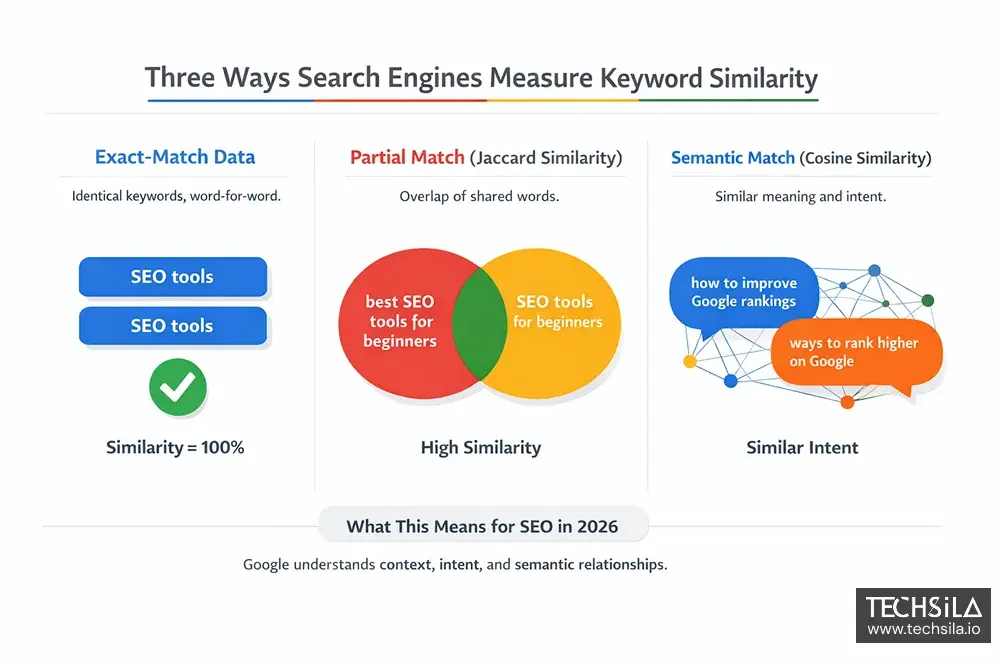
Three Methods of Similarity Measurement
Three different similarity measurements were used to analyze how closely search results aligned with the original queries:
1 Exact Match: The query and the page title contain the same wording.
2 Partial Match (Jaccard Similarity): Measures the overlap of words between the query and the title.
3 Semantic Match (Cosine Similarity): Evaluates the meaning of text using vector embeddings.
The findings were surprising. Out of 8,703 organic result titles, only 43 titles (about 0.49%) contained the complete search query. This means that over 99% of search result titles did not include the exact query phrase. These results clearly demonstrate how much search engine optimization has evolved. In the past, ranking strategies heavily depended on repeating the exact keyword phrase multiple times. However, SEO Keywords in 2026 are no longer about exact phrase repetition.
Pro Tip 2: Use “Semantic Variations.” Instead of repeating your focus keyword, use synonyms and related phrases. Google’s BERT and MUM algorithms are designed to understand these connections perfectly.
The Power of Semantic Matching
Visualizing the Modern SEO Strategy
To succeed with SEO Keywords in 2026, businesses must move beyond simple list-based content. Visual support is crucial for engagement and ranking.
Step-by-Step Illustration: Optimizing for Semantic Search
4 Identify the Core Entity: Determine the main topic (e.g., SEO Keywords in 2026).
5 Map Related Sub-topics: Use tools to find semantically related terms.
6 Analyze Search Intent: Determine if the user wants information, a product, or a specific site.
7 Create Comprehensive Content: Write 1000+ words covering all aspects of the topic.
8 Implement Structured Data: Use Schema markup to help AI understand your content’s context.
Keyword Targeting Strategy for SEO Keywords in 2026
The findings above reinforce an important reality: SEO Keywords in 2026 focus on semantic relevance and topic coverage. Search engines analyze the overall meaning of content, evaluate related phrases, and determine how well a page addresses the user’s intent. Modern keyword strategies therefore emphasize topic clusters rather than isolated keywords.
Pro Tip 3: Optimize for “Zero-Click Searches.” With 60% of searches resulting in zero clicks, ensure your content provides immediate value in snippets while encouraging deeper clicks for detailed insights.
The Future of Keyword Optimization (2026–2030)
As search technology continues to evolve, SEO Keywords in 2026 will increasingly revolve around semantic understanding rather than exact phrase targeting. Modern search systems already rely heavily on vector embeddings and contextual analysis to determine relevance. These technologies have been part of search engine development for more than a decade and are now integrated into AI-driven search experiences.
For marketers and SEO professionals, platforms like Moz regularly analyze search trends and confirm that keyword strategies are evolving toward semantic search and topic authority. As search gradually becomes a hybrid of traditional search results and generative AI responses, keyword targeting strategies must also evolve.
Pro Tip 4: Prioritize “User Experience Signals.” Google’s 2026 updates place heavy weight on how users interact with your content. High dwell time and low bounce rates are as important as your keyword strategy.
Conclusion
The evidence clearly shows that SEO Keywords in 2026 still matter for search visibility and rankings, but their role has shifted dramatically from earlier SEO practices. Search engines now rely on advanced AI systems, semantic analysis, and contextual understanding to determine relevance. Instead of focusing only on exact keyword matches, modern algorithms evaluate the broader meaning of content and how well it satisfies user intent.
For businesses and marketers, the key takeaway is clear: successful SEO today requires a balanced approach that combines keyword strategy with high-quality, meaningful content. Organizations that focus on topic authority, semantic relevance, and user-focused information will be far better positioned to succeed in the evolving search landscape.
If your business wants to rank higher on Google, attract more qualified visitors, and convert search traffic into real customers, then it’s time to upgrade your SEO strategy Techsila experts specialize in modern SEO strategies built for AI-powered search and semantic ranking algorithms.
Ready to dominate the search results? Request a Quote from Techsila today and let our AI-driven SEO team build a sustainable growth strategy for your brand.
Frequently Asked Questions(FAQs)
1. Is SEO dead or evolving in 2026?
SEO isn’t going anywhere. However, for brands to find success with SEO strategies, there are specific things to keep in mind when developing campaigns. We know Google functions more as a discovery engine but here is what else you need to know to dominate SERPs.
2. Do keywords still matter for SEO?
Keywords still matter but only when they’re used in service of better content. They help define topics and guide discovery, but rankings are ultimately earned through relevance, depth, and trust. In modern SEO, content quality does the real work.
How to find the most popular keywords?
3. Is learning SEO worth it in 2026?
SEO is essential for small businesses as it allows them to build brand visibility, credibility, trust, and leads in a cost-effective way. Paid ads require you to continually spend money in order to generate traffic.
4. How to Find Trending Keywords for SEO: 6 Strategies
Discover Keywords Trends on Exploding Topics.
Use SEMrush To Analyze Trending Keywords.
Use Google’s SEO Tools.
Keep a Close Eye on Social Media.
Listen to Your Audience on Reddit.
