Pro Tip:
If you’re building a SaaS product and expect rapid growth, don’t treat your API architecture as an afterthought. The wrong backend structure can cost you months in refactoring later.
Planning to scale your SaaS the right way from day one? Our expert backend engineers design high-performance, scalable API architectures tailored for growth.
What Is GraphQL? (And Why It’s Gaining Popularity)
To truly understand the REST vs GraphQL debate, you need to see what makes GraphQL fundamentally different from REST.
GraphQL is a query language for APIs that allows the client (frontend or mobile app) to request exactly the data it needs, nothing more, nothing less.
Unlike REST, where multiple endpoints return fixed data structures, GraphQL typically uses a single endpoint where the client defines the structure of the response.
In simple terms: REST vs GraphQL
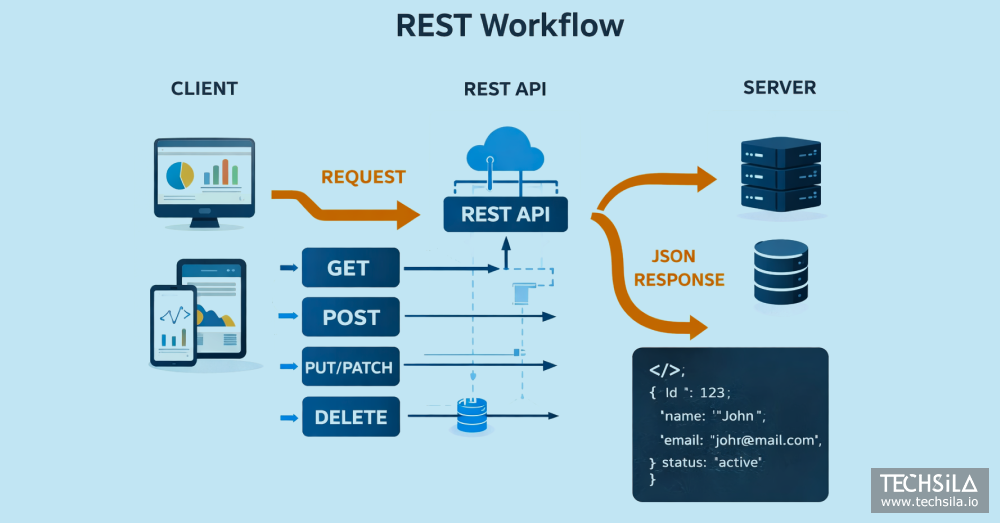
REST gives you a fixed response.
GraphQL lets you shape the response.
How GraphQL Works (Simple Example)
Imagine a SaaS dashboard that needs:
-
User name
-
Subscription plan
-
Last 5 invoices
With REST, the frontend might call multiple endpoints like:
-
/user
-
/subscription
-
/invoices
With GraphQL, a single query can fetch everything in one request:
The server returns exactly this structure, no extra data, no unnecessary fields.
This efficiency is one of the biggest reasons GraphQL adoption has increased among SaaS companies in recent years.
Why GraphQL Is Growing Fast in 2026
GraphQL has moved from being a “trendy” technology to a practical solution for modern products.
Here’s why.
1. Flexible Data Fetching
Frontend teams can request only the fields they need. This reduces payload size and improves performance, especially for mobile apps and dashboards.
2. Faster Frontend Development
Frontend developers don’t have to wait for backend teams to create new endpoints. They can modify queries independently, which speeds up product iteration.
This is especially valuable for SaaS startups that release new features frequently.
3. Better Performance for Complex Applications
Applications with:
-
Real-time dashboards
-
Analytics panels
-
Multi-role user systems
-
Nested relational data
often perform better with GraphQL because it reduces multiple round-trips.
4. Strong Ecosystem and Adoption
Major companies like:
use GraphQL in production environments, proving its reliability at scale.
Advantages of GraphQL
GraphQL offers several key benefits:
-
Fetch only the required data
-
Reduce the number of API requests
-
Strongly typed schema improves reliability
-
Faster iteration for frontend teams
-
Better handling of complex data relationships
These advantages are why the REST vs GraphQL comparison has become a major architectural decision for SaaS products. In fact, the REST vs GraphQL debate now influences product roadmap planning for many scaling SaaS companies.
Limitations of GraphQL
GraphQL is powerful, but not always the best choice.
More Complex to Implement
GraphQL requires schema design, resolvers, and query optimization. For small products, this can feel like overengineering.
Caching Is More Challenging
Unlike REST, which works naturally with HTTP caching, GraphQL often requires additional caching strategies.
Query Complexity Risks
If not managed properly, clients can send expensive queries that impact performance. Rate limiting and query depth control become important.
Pro Tip:
GraphQL shines when your frontend evolves faster than your backend. If your product roadmap includes dynamic dashboards, personalization, or analytics-heavy interfaces, GraphQL can significantly reduce development friction.
REST vs GraphQL Core Differences Explained
Now that you understand how both technologies work, let’s break down REST vs GraphQL in a practical way. For SaaS founders and product teams, the real question isn’t which technology sounds more modern; it’s which one solves real business problems more effectively.
Both REST and GraphQL are capable of powering large-scale systems, but they differ significantly in how data is requested, delivered, and managed.
1. Data Fetching Approach
One of the biggest differences in REST vs GraphQL is how data is fetched.
In REST, the server defines the structure of responses. Each endpoint returns a fixed dataset, whether the frontend needs all of it or not. This often leads to over-fetching, where extra fields are returned unnecessarily.
GraphQL, on the other hand, allows the client to specify exactly what fields it needs. This makes responses lighter and more efficient, especially for mobile apps and dashboards.
According to the official GraphQL documentation, this client-driven query model was specifically designed to solve the problem of inefficient data fetching in applications with complex UI requirements, which is why companies like GitHub adopted it to improve API performance and flexibility. You can explore their explanation of this concept in detail here:
2. Number of API Requests
In REST architectures, complex screens often require multiple API calls. For example, a SaaS analytics dashboard might need separate endpoints for users, reports, and notifications. GraphQL reduces this by allowing multiple datasets to be retrieved in a single query. This can significantly reduce latency in applications where speed matters. This efficiency becomes particularly important in SaaS platforms where users expect dashboards to load instantly.
3. Performance and Bandwidth
When comparing REST vs GraphQL, performance depends heavily on the use case. REST can be extremely fast when endpoints are well-structured, and caching is implemented effectively. CDNs and browser caching work naturally with REST APIs.
GraphQL often reduces bandwidth usage because it avoids unnecessary data transfer. However, poorly optimized GraphQL queries can increase server processing time. Apollo, one of the most widely used GraphQL platforms, explains that performance gains in GraphQL typically come from reducing network requests rather than raw server speed. Their engineering blog provides deeper technical insights into how GraphQL performance behaves in real-world environments:
4. Caching
Caching is another important difference in REST vs GraphQL. REST works seamlessly with HTTP caching mechanisms, making it easier to store and reuse responses. GraphQL requires more advanced caching strategies, often implemented at the application or client level. While powerful, this adds complexity to implementation. For SaaS products with heavy read operations like content platforms or reporting tools, this difference can significantly impact infrastructure costs.
5. Development Speed and Flexibility
REST works best when requirements are stable, and endpoints don’t change frequently. GraphQL provides more flexibility because frontend teams can modify queries without waiting for backend changes. This is particularly valuable in agile SaaS teams shipping updates weekly or even daily. This flexibility is one reason modern SaaS platforms are increasingly evaluating REST vs GraphQL during architecture planning rather than defaulting to REST automatically.
6. Learning Curve and Complexity
REST is easier to learn and implement. Most developers already understand HTTP methods and resource-based design. GraphQL requires understanding schemas, resolvers, and query structures, which adds a learning curve, especially for smaller teams. However, once implemented properly, GraphQL often improves long-term development velocity.
Quick Comparison Table
| Feature |
REST |
GraphQL |
| Data Fetching |
Fixed responses |
Client-defined queries |
| Number of Requests |
Multiple endpoints |
Single endpoint |
| Caching |
Easy |
More complex |
| Flexibility |
Limited |
High |
| Learning Curve |
Low |
Moderate |
| Best For |
Simple and stable APIs |
Complex SaaS platforms |
REST vs GraphQL for SaaS Products in 2026

In 2026, SaaS platforms are more complex than ever. Products are no longer just web dashboards; they include mobile apps, third-party integrations, AI features, analytics panels, and real-time updates. Your API architecture must support all of this without slowing down development or increasing infrastructure costs.
Let’s look at how REST vs GraphQL plays out in practical SaaS scenarios.
1. Early-Stage SaaS Startups
For early-stage startups, speed of development often matters more than architectural perfection.
REST is usually the faster option because:
If your product has a simple dashboard, basic CRUD operations, and limited integrations, REST is often the most practical choice.
This allows startups to launch faster and validate their idea before investing in more advanced architecture.
2. Scaling SaaS Platforms
As SaaS products grow, the API layer becomes more complex.
You may start seeing:
This is where GraphQL often becomes attractive. Its ability to fetch precisely the required data helps reduce unnecessary requests and improve frontend performance. Many scaling SaaS companies adopt GraphQL gradually rather than replacing REST entirely.
3. Mobile-First SaaS Products
Mobile applications operate in environments where bandwidth and latency matter. GraphQL can be beneficial here because it reduces payload sizes and minimizes the number of API calls. This leads to faster load times and smoother user experiences. This is one of the main reasons companies like Shopify use GraphQL to power large portions of their platform. Shopify’s engineering team has shared how GraphQL helps manage complex data relationships and improve performance for storefronts and mobile experiences.
4. SaaS Products with Complex Dashboards
Analytics-heavy SaaS platforms often need nested and relational data:
-
Charts
-
Reports
-
Filters
-
User segmentation
REST can handle this, but it often requires multiple API calls and custom endpoints.
GraphQL simplifies this by allowing complex queries in a single request, reducing frontend complexity and improving performance.
This is why many business intelligence and analytics tools favor GraphQL.
5. Microservices-Based SaaS Architectures
Many SaaS companies in 2026 use microservices.
REST works well between services because it’s simple and predictable.
GraphQL is often used as an API gateway layer that aggregates multiple services into a single endpoint for the frontend.
This hybrid architecture is becoming increasingly common because it combines the reliability of REST with the flexibility of GraphQL.
Pro Tip:
One of the biggest mistakes SaaS startups make is overengineering too early. Start simple, but design your backend so it can evolve. A well-structured backend makes it much easier to introduce GraphQL later if your product demands it.
Building a Scalable Backend Matters More Than the API Style
Whether you choose REST or GraphQL, the real foundation of a scalable SaaS product is a well-architected backend. Database structure, caching strategies, API design, and infrastructure planning all play a major role in performance and scalability. If you’re planning to build or scale a SaaS platform, working with experienced backend engineers can help you avoid costly rebuilds later. Whether you’re still evaluating REST vs GraphQL or ready to implement your API strategy, making the right backend decision today defines your SaaS success tomorrow.
Grab the opportunity to build a backend that’s secure, scalable, and future-ready.
Work with a team that understands SaaS growth, performance optimization, and modern API architecture, and turn your product into a platform built for serious scale. Partner with our Backend Development Experts today:
Performance & Scalability Comparison
When SaaS founders compare REST vs GraphQL, performance is usually the deciding factor. Speed affects user experience. Scalability affects infrastructure costs. And both directly impact revenue. But here’s the truth: neither REST nor GraphQL is automatically “faster.” Performance depends on how they’re implemented and what your product actually needs. Let’s break it down in practical terms.
1. Over-Fetching vs Under-Fetching
One of the core differences in REST vs GraphQL is how data is retrieved.
REST and Over-Fetching
In REST, endpoints return predefined data structures. This often results in over-fetching, where the client receives more data than necessary.
For example:
A SaaS dashboard only needs a user’s name and subscription status.
But the /user endpoint might return:
-
Name
-
Email
-
Phone
-
Address
-
Role
-
Preferences
-
Metadata
All that extra data increases payload size and bandwidth usage.
REST and Under-Fetching
Sometimes REST also causes under-fetching, where multiple API calls are needed to assemble the required data.
For example:
-
/user
-
/subscription
-
/billing-history
More requests = more latency.
GraphQL and Precision Fetching
GraphQL solves this by allowing clients to request exactly what they need. No extra fields. No missing data.
This reduces payload size and minimizes unnecessary round-trip requests, which can significantly improve performance for complex SaaS dashboards and mobile applications.
2. Network Performance
For mobile-first SaaS products, network efficiency matters.
GraphQL reduces the number of API calls, which can improve performance in high-latency environments.
However, REST benefits from built-in HTTP caching. Responses can be cached at:
-
Browser level
-
CDN level
-
Reverse proxy level
This makes REST extremely efficient for content-heavy SaaS platforms.
So when comparing REST vs GraphQL, REST often wins in caching simplicity, while GraphQL wins in request efficiency.
3. Server Load and Processing
Here’s something many teams overlook.
GraphQL shifts some complexity to the server. Since clients can request nested data structures, the server must resolve those queries efficiently.
If queries aren’t optimized, GraphQL can create heavy database calls.
Apollo GraphQL’s engineering documentation explains that poorly controlled query depth and complexity can increase server processing time significantly, which is why production GraphQL systems often implement query cost analysis and depth limiting to protect performance.
REST, by contrast, limits complexity because each endpoint is predefined.
Among REST vs GraphQL, REST is more predictable in high-traffic environments.
4. Scalability in High-Growth SaaS
Scalability isn’t just about handling more users, it’s about handling complexity.
When evaluating REST vs GraphQL for scalability, consider:
-
Number of frontend clients
-
Complexity of data relationships
-
Frequency of feature releases
-
Personalization requirements
GraphQL scales well for products with dynamic and evolving data needs.
REST scales extremely well for systems with stable, well-defined operations and heavy caching.
5. Real-Time Capabilities
Modern SaaS platforms often include:
-
Live notifications
-
Real-time dashboards
-
Collaboration features
GraphQL supports subscriptions, which enable real-time data updates.
REST typically requires WebSockets or polling mechanisms to achieve similar functionality.
If real-time interaction is core to your product, GraphQL may offer a cleaner solution while choosing REST vs GraphQL
Pro Tip:
Before choosing between REST vs GraphQL, analyze your API traffic patterns. If your product relies heavily on dashboards, filters, and relational data, GraphQL may reduce frontend complexity. If your platform is content-heavy with predictable data access, REST may perform better with proper caching.
REST vs GraphQL Performance Verdict
There is no universal winner in REST vs GraphQL.
-
REST is often simpler, predictable, and caching-friendly.
-
GraphQL is flexible, efficient in complex queries, and powerful for modern UI-heavy SaaS products.
The best choice depends on your product architecture, not trends. That’s why understanding REST vs GraphQL deeply is more important than simply following industry hype.
REST vs GraphQL Security Considerations for SaaS