


In 2026, software ecosystems are more dynamic, interconnected, and fast-evolving than ever before. From cloud-native SaaS platforms to AI-driven enterprise systems, applications are continuously updated to meet changing business needs. However, with every code change comes the risk of breaking existing functionality. This is where regression testing complex applications becomes critical.
Regression testing ensures that new updates, bug fixes, or feature enhancements do not negatively impact existing features. In complex applications where multiple modules, APIs, and integrations coexist this process becomes even more essential and challenging.
Organizations that fail to implement effective regression testing strategies often face unexpected bugs, degraded user experiences, and costly downtime. On the other hand, companies that adopt modern regression testing practices gain a competitive advantage by delivering stable, high-quality software faster.
This guide explores the best practices for regression testing complex applications in 2026, helping QA teams, developers, and business leaders build robust testing strategies for scalable digital products.
What is Regression Testing in Complex Applications?
Regression testing complex applications refers to the process of verifying that recent code changes do not adversely affect existing functionalities across interconnected systems.
Unlike simple applications, complex systems include:
- Microservices architecture
- Multiple APIs and third-party integrations
- Cloud-based infrastructure
- AI/ML components
- Cross-platform interfaces
Because of these dependencies, even a small change in one module can cause cascading failures across the system.
Why Regression Testing Complex Applications is Critical in 2026
The increasing complexity of modern software makes regression testing more important than ever.
1. Continuous Deployment Environments
With CI/CD pipelines becoming standard, code is deployed frequently. Without proper regression testing, errors can quickly reach production.
2. Rising System Complexity
Modern applications rely on distributed systems, making it difficult to track the impact of changes.
3. User Experience Expectations
Users expect seamless performance. Even minor bugs can result in lost trust and revenue.
4. Security and Compliance Requirements
Industries like healthcare and finance require strict compliance. Regression failures can lead to serious legal and financial consequences.
Key Challenges in Regression Testing Complex Applications

1. Large Test Suites
As applications grow, test cases multiply, making regression cycles longer and harder to manage.
2. Frequent Code Changes
Rapid development cycles increase the need for continuous testing.
3. Integration Dependencies
Failures in APIs or third-party systems can impact test results.
4. Test Data Management
Maintaining accurate and relevant test data is a major challenge.
5. Performance Bottlenecks
Running full regression suites can slow down development pipelines.
Best Practices for Regression Testing Complex Applications in 2026
1. Prioritize Test Cases Based on Risk
Not all test cases are equally important. Focus on:
- Core business functionalities
- High-risk modules
- Frequently used features
This approach ensures faster feedback and efficient resource utilization.
2. Implement Test Automation at Scale
Automation is no longer optional for regression testing complex applications.
Use automation for:
- Repetitive test cases
- Smoke tests
- API testing
- UI regression scenarios
Automation tools reduce manual effort and improve consistency.
3. Adopt AI-Powered Testing Tools
AI-driven testing tools can:
- Identify impacted test cases
- Predict failure points
- Optimize test execution
These tools significantly improve testing efficiency and accuracy, can identify impacted test cases, predict failure points, and optimize test execution. Companies looking to integrate intelligent testing can explore Techsila’s AI Development Services for advanced AI-powered solutions.
4. Use Continuous Testing in CI/CD Pipelines
Integrate regression testing into your CI/CD workflows to ensure:
- Immediate feedback on code changes
- Faster bug detection
- Reduced release risks
Continuous testing helps maintain software quality in fast-paced environments.
5. Maintain a Modular Test Architecture
Break down test cases into reusable components. This makes it easier to:
- Update tests quickly
- Improve maintainability
- Scale testing efforts
6. Focus on API-Level Testing
Since modern applications rely heavily on APIs, testing at the API level ensures:
- Faster execution
- Better coverage
- Early detection of integration issues
7. Optimize Test Data Management
Use strategies like:
- Synthetic data generation
- Data masking
- Automated data refresh
This ensures accurate and compliant testing environments.
8. Perform Selective Regression Testing
Instead of running the entire test suite:
- Identify impacted areas
- Execute only relevant tests
This significantly reduces testing time.
9. Parallel Test Execution
Run tests simultaneously across multiple environments to:
- Speed up regression cycles
- Improve efficiency
10. Monitor and Analyze Test Results
Use analytics tools to:
- Identify patterns
- Track recurring failures
- Improve test coverage
| Tool Category | Tool Name | Purpose / Description |
|---|---|---|
| Automation Tools | Selenium | Open-source framework for automating web application testing across browsers. |
| Cypress | Fast, reliable end-to-end testing for modern web applications. | |
| Playwright | Automated cross-browser testing for web apps with advanced features. | |
| CI/CD Tools | Jenkins | Open-source automation server to integrate testing in CI/CD pipelines. |
| GitHub Actions | Automate workflows, including testing and deployment, directly from GitHub repositories. | |
| GitLab CI | Continuous integration and deployment tool integrated with GitLab repositories. | |
| AI Testing Tools | Testim | AI-powered testing platform for automated UI testing and self-healing tests. |
| Functionize | Cloud-based AI testing tool for end-to-end automation and regression testing. | |
| Mabl | Intelligent test automation platform with predictive analytics for web apps. | |
| Performance Testing Tools | JMeter | Open-source tool for performance and load testing of web applications. |
| LoadRunner | Enterprise-grade performance testing tool for web, mobile, and cloud applications. |
Role of DevOps in Regression Testing Complex Applications
DevOps practices enhance regression testing by enabling:
- Continuous integration
- Automated testing pipelines
- Faster deployments
Collaboration between development and QA teams ensures better test coverage and faster issue resolution.
How Outsourced QA Teams Improve Regression Testing
Outsourcing regression testing offers several benefits:
1. Access to Expertise
Specialized QA teams bring advanced testing knowledge.
2. Cost Efficiency
Reduce infrastructure and hiring costs.
3. Faster Time-to-Market
Dedicated teams accelerate testing cycles.
4. Scalability
Easily scale testing efforts based on project needs.
Businesses looking to streamline QA processes can explore expert outsourcing solutions through Techsila’s QA and Testing Services for scalable and automated regression testing complex applications
Future Trends in Regression Testing Complex Applications
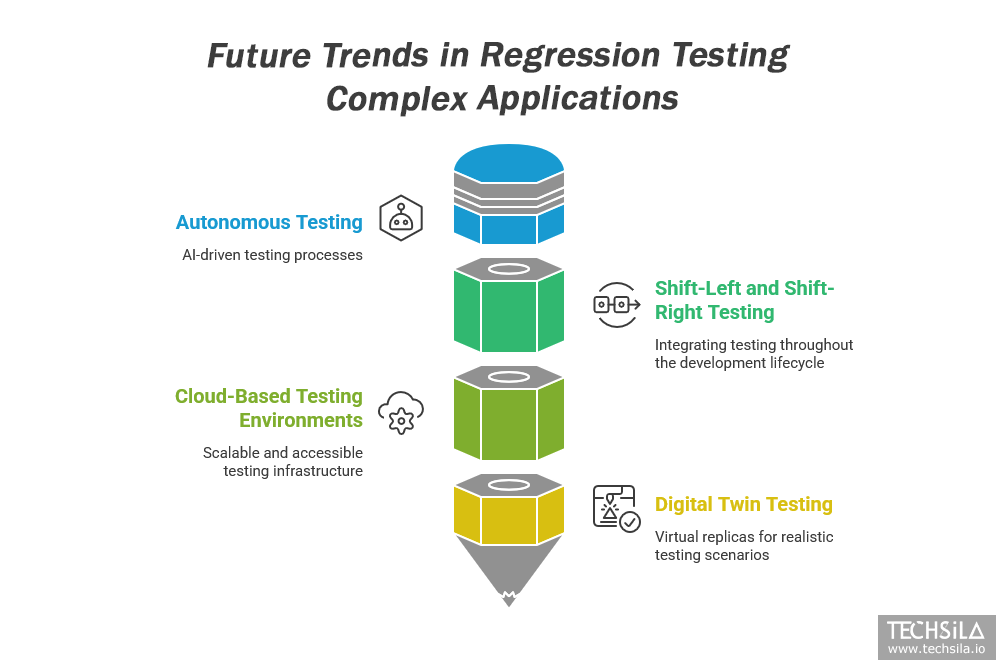
1. Autonomous Testing
AI systems will automatically create and execute test cases.
2. Shift-Left and Shift-Right Testing
Testing will occur earlier and later in the development lifecycle.
3. Cloud-Based Testing Environments
Cloud platforms will enable scalable and flexible testing.
4. Digital Twin Testing
Simulating real-world scenarios for better validation.
Common Mistakes to Avoid
- Ignoring test maintenance
- Over-relying on manual testing
- Running a full regression unnecessarily
- Poor test data management
- Lack of integration testing
Conclusion
Regression testing complex applications is a critical component of modern software development in 2026. As applications become more interconnected and dynamic, traditional testing methods are no longer sufficient.
By adopting best practices such as automation, AI-driven testing, continuous integration, and selective regression strategies, organizations can significantly improve software quality while reducing time-to-market.
Businesses that invest in scalable regression testing frameworks and expert QA solutions will be better positioned to deliver reliable, high-performance applications in an increasingly competitive digital landscape.
Ready to optimize regression testing for your complex applications?
Partner with Techsila to build scalable, automated, and AI-driven testing solutions that ensure software quality and faster releases
FAQs
1. What is regression testing of complex applications?
It is the process of verifying that new updates do not break existing functionality in large, interconnected systems.
2. Why is regression testing important in 2026?
Due to rapid development cycles and complex architectures, regression testing ensures software stability and quality.
3. What tools are best for regression testing?
Popular tools include Selenium, Cypress, Playwright, and AI-based platforms like Testim.
4. How can AI improve regression testing?
AI can automate test case selection, predict failures, and optimize test execution.
5. What are the biggest challenges in regression testing?
Large test suites, integration dependencies, test data management, and performance issues.
