

Are you struggling to manage large-scale applications across multiple environments without breaking your infrastructure? You’re not alone. As businesses scale rapidly in 2026, managing containerized applications has become increasingly complex. From microservice architectures to multi-cloud deployments, organizations are managing thousands of containers running simultaneously. Without the right Kubernetes tools, this complexity can quickly turn into chaos.
Kubernetes has become the backbone of modern application deployment, but Kubernetes alone is not enough. To manage, monitor, and scale applications efficiently, teams rely on a powerful ecosystem of Kubernetes tools that simplify operations.
These tools help with:
- Cluster management and orchestration
- Monitoring and observability
- CI/CD automation
- Security and compliance
- Cost optimization and scaling
In fact, according to the Cloud Native Computing Foundation (CNCF), over 90% of organizations are now using Kubernetes in production, highlighting the growing demand for advanced Kubernetes tools to handle large-scale workloads.
As your infrastructure grows, choosing the right Kubernetes tools becomes critical for:
- Maintaining performance and uptime
- Reducing operational overhead
- Ensuring security and compliance
- Scaling applications seamlessly
In this guide, we’ll explore the top 10 Kubernetes tools in 2026 that help businesses manage large-scale applications efficiently. Whether you’re a startup scaling rapidly or an enterprise handling complex workloads, these tools will help you optimize your Kubernetes ecosystem.
What Makes a Great Kubernetes Tool in 2026?
Not all Kubernetes tools are created equal. With hundreds of options available, choosing the right ones for managing large-scale applications requires a clear understanding of what actually matters in production environments.
In 2026, the expectations for Kubernetes tools have evolved significantly. It’s no longer just about basic cluster management; modern tools must support scalability, automation, observability, and security at an enterprise level.
Scalability and Performance
The primary purpose of using Kubernetes tools is to handle large-scale workloads efficiently. A good tool should:
- Support thousands of pods and nodes
- Handle auto-scaling seamlessly
- Maintain performance under heavy traffic
As applications grow, tools that cannot scale become bottlenecks rather than solutions.
Ease of Integration
Modern infrastructure is rarely isolated. The best Kubernetes tools integrate smoothly with:
- CI/CD pipelines
- Cloud providers (AWS, Azure, GCP)
- Monitoring and logging systems
- DevOps workflows
Seamless integration ensures that teams can automate processes and reduce manual effort.
Observability and Monitoring
Without visibility, managing Kubernetes environments becomes guesswork. Advanced Kubernetes tools provide:
- Real-time monitoring
- Logs and metrics visualization
- Alerts and anomaly detection
Tools like Prometheus and Grafana have set the standard for observability in Kubernetes ecosystems.
For deeper insights into Kubernetes monitoring standards, refer to the CNCF landscape, which showcases widely adopted cloud-native tools.
Security and Compliance
Security is a top priority in 2026. The right Kubernetes tools must help:
- Detect vulnerabilities
- Enforce policies
- Manage access control
- Ensure compliance with industry standards
As cyber threats increase, security-focused tools are becoming essential in every Kubernetes stack.
Automation and CI/CD Support
Automation is the backbone of efficient DevOps. The best Kubernetes tools enable:
- Continuous deployment
- Infrastructure as Code (IaC)
- Automated rollbacks and updates
This reduces human error and accelerates development cycles.
User Experience and Learning Curve
Even the most powerful tool can fail if it’s too complex. Great Kubernetes tools offer:
- Intuitive dashboards
- Clear documentation
- Strong community support
This ensures faster adoption and smoother operations across teams.
Cost Optimization
Managing large-scale applications can be expensive. Efficient Kubernetes tools help:
- Optimize resource usage
- Reduce cloud costs
- Provide cost visibility and insights
This is especially important for startups and scaling SaaS companies.
Why Choosing the Right Tools Matters
Selecting the right Kubernetes tools is not just a technical decision; it’s a business decision. The right stack can:
- Improve system reliability
- Reduce downtime
- Enhance developer productivity
- Lower operational costs
Top 10 Kubernetes Tools to Manage Large-Scale Applications in 2026
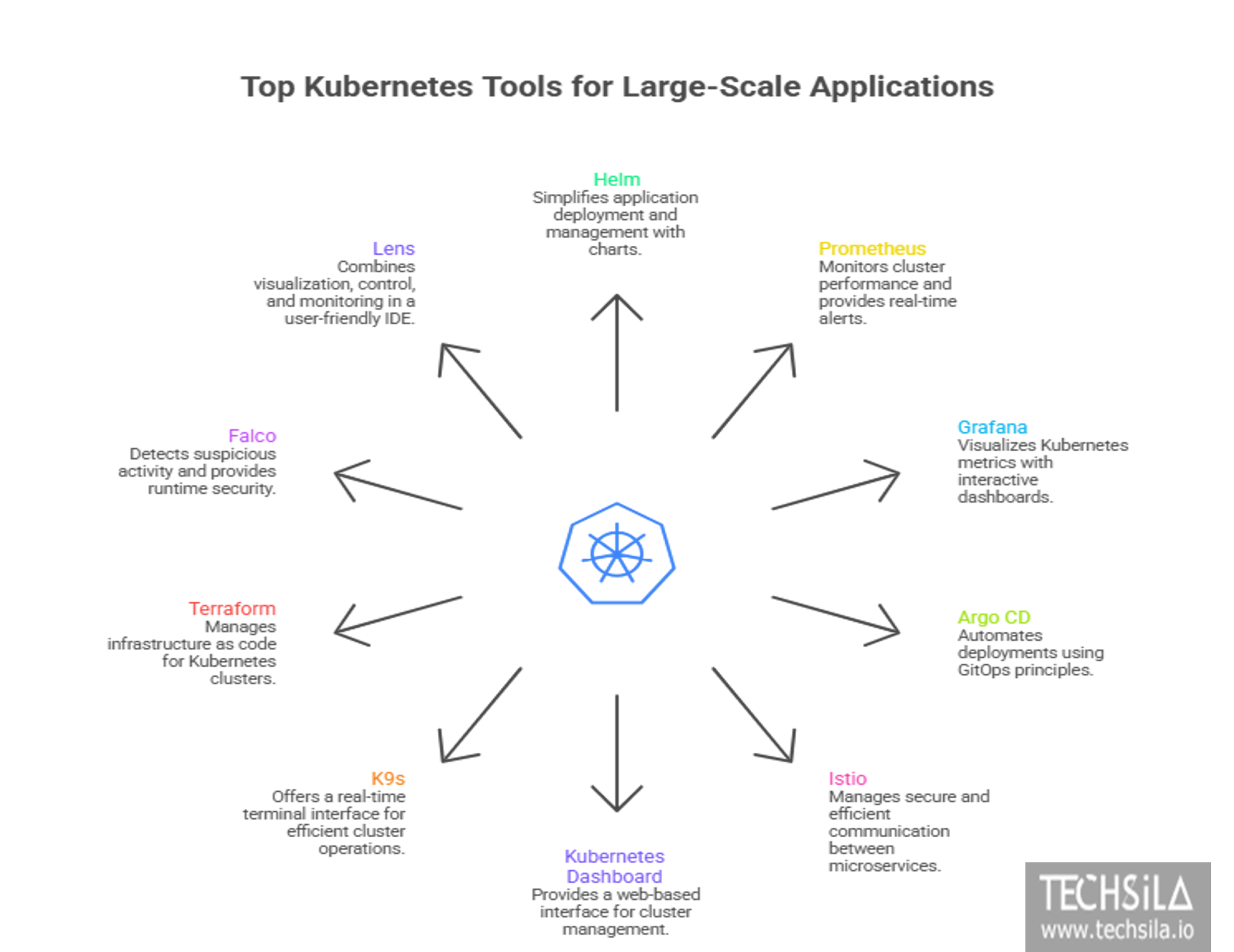
As Kubernetes adoption grows, the ecosystem of Kubernetes tools continues to evolve. The following tools are widely used to manage, monitor, and scale large-scale applications efficiently.
1. Helm – Kubernetes Package Manager
Helm is one of the most popular Kubernetes tools for managing applications using pre-configured packages called charts.
It simplifies deployment by allowing teams to define, install, and upgrade applications with ease.
Key Features:
- Reusable Helm charts
- Easy rollbacks and upgrades
- Version control for deployments
Use Case:
Ideal for teams managing complex microservices architectures with repeated deployments.
To explore official documentation and best practices, refer to the Helm Kubernetes documentation, which provides detailed guidance on managing Kubernetes applications using charts.
2. Prometheus – Monitoring and Alerting
Prometheus is a leading open-source monitoring solution and a must-have among Kubernetes tools.
It collects metrics from Kubernetes clusters and provides powerful querying capabilities.
Key Features:
- Real-time monitoring
- Custom alerts
- Time-series database
Use Case:
Best for tracking performance and detecting anomalies in large-scale environments.
3. Grafana – Data Visualization
Grafana works alongside Prometheus to provide visual dashboards for Kubernetes metrics.
It transforms raw data into actionable insights, making it one of the most essential Kubernetes tools for observability.
Key Features:
- Interactive dashboards
- Multi-source data integration
- Custom visualizations
Use Case:
Used for visualizing infrastructure health and performance metrics.
4. Argo CD – GitOps Continuous Delivery
Argo CD is a powerful GitOps tool that automates deployment using Git repositories as the source of truth.
Among modern Kubernetes tools, it stands out for enabling declarative deployments.
Key Features:
- Git-based deployments
- Automated syncing
- Rollback capabilities
Use Case:
Perfect for teams implementing CI/CD pipelines and GitOps workflows.
5. Istio – Service Mesh
Istio is an advanced service mesh that manages communication between microservices.
It’s one of the most advanced Kubernetes tools for handling traffic management, security, and observability.
Key Features:
- Traffic routing and load balancing
- Mutual TLS security
- Service-to-service monitoring
Use Case:
Best for complex microservices environments requiring secure communication.
6. Kubernetes Dashboard – UI-Based Management
Kubernetes Dashboard provides a web-based interface to manage clusters.
While basic, it remains a useful addition to Kubernetes tools for visibility and control.
Key Features:
- Visual cluster management
- Resource monitoring
- Easy navigation
Use Case:
Helpful for quick insights and manual cluster operations.
7. K9s – Terminal-Based UI
K9s is a lightweight CLI tool that provides a real-time terminal interface for Kubernetes clusters.
It’s a favorite among DevOps engineers using Kubernetes tools for efficiency.
Key Features:
- Fast navigation
- Real-time updates
- Resource management via CLI
Use Case:
Ideal for developers who prefer command-line workflows.
8. Terraform – Infrastructure as Code
Terraform is not Kubernetes-specific but is widely used alongside Kubernetes tools to manage infrastructure.
It allows teams to define infrastructure using code.
Key Features:
- Multi-cloud support
- Infrastructure automation
- Version-controlled configurations
Use Case:
Best for provisioning Kubernetes clusters and cloud resources.
9. Falco – Security Monitoring
Falco is a security-focused tool designed to detect suspicious activity in Kubernetes environments.
Security is critical, and Falco stands out among Kubernetes tools for runtime protection.
Key Features:
- Threat detection
- Real-time alerts
- Policy-based security rules
Use Case:
Used for monitoring and securing containerized environments.
10. Lens – Kubernetes IDE
Lens is a powerful IDE for Kubernetes that simplifies cluster management.
It combines visualization, control, and monitoring, making it one of the most user-friendly Kubernetes tools.
Key Features:
- Multi-cluster management
- Built-in metrics
- User-friendly interface
Use Case:
Perfect for teams needing a centralized platform to manage multiple clusters.
Why These Kubernetes Tools Matter in 2026
These Kubernetes tools are essential because they:
- Simplify complex deployments
- Improve monitoring and observability
- Enhance security and compliance
- Enable automation and scalability
Without the right Kubernetes tools, managing large-scale applications becomes inefficient and error-prone.
How to Choose the Right Kubernetes Tools for Your Business
Choosing the right Kubernetes tools is not just about features; it’s about aligning your tools with your business goals, infrastructure complexity, and scalability needs. With so many options available, selecting the right stack can significantly impact your performance, cost, and operational efficiency.

Understand Your Infrastructure Needs
Before selecting any Kubernetes tools, you need to evaluate your current setup:
- Are you running a single cluster or a multi-cluster environment?
- Do you operate on cloud, hybrid, or on-premise infrastructure?
- How complex are your microservices and workloads?
For example, a startup with a simple deployment may not need advanced tools like Istio, while an enterprise managing thousands of services will require robust service mesh and monitoring solutions.
Prioritize Scalability and Performance
Not all Kubernetes tools can handle large-scale workloads efficiently. As your application grows, your tools must scale with it.
Look for tools that:
- Support auto-scaling and load balancing
- Handle high traffic without performance drops
- Provide efficient resource utilization
If scalability is your goal, investing in the right tools early can prevent costly migrations later.
Focus on Integration and Ecosystem Compatibility
Your Kubernetes environment doesn’t exist in isolation. The best Kubernetes tools integrate seamlessly with:
- CI/CD pipelines
- Monitoring systems
- Cloud platforms
- Security frameworks
If you’re planning to build a scalable cloud-native infrastructure, explore Techsila’s Cloud & DevOps Solutions to integrate the right Kubernetes tools into your workflows.
Evaluate Security Requirements
Security should never be an afterthought. Modern Kubernetes tools must include:
- Role-based access control (RBAC)
- Threat detection and monitoring
- Compliance enforcement
Tools like Falco and Istio are essential for securing large-scale environments.
For secure and scalable backend architectures, check out Techsila’s Backend Development Services to implement Kubernetes solutions with built-in security best practices.
Consider Team Expertise and Learning Curve
Some Kubernetes tools are powerful but complex. Your team’s expertise should influence your decision.
Ask yourself:
- Does your team prefer CLI-based tools or dashboards?
- Do you have experience with GitOps or service mesh tools?
- How quickly can your team adopt new technologies?
Choosing tools that match your team’s skill level ensures faster implementation and better productivity.
Optimize for Cost Efficiency
Managing large-scale applications can be expensive. The right Kubernetes tools help you:
- Monitor resource usage
- Optimize workloads
- Reduce cloud costs
Tools that provide cost visibility can prevent unexpected infrastructure expenses.
Build a Future-Ready Kubernetes Stack
The best approach is not to rely on a single tool but to create a balanced ecosystem of Kubernetes tools that work together.
A typical modern stack may include:
- Helm for deployment
- Prometheus + Grafana for monitoring
- Argo CD for CI/CD
- Falco for security
- Terraform for infrastructure
Want to build a future-ready Kubernetes ecosystem? Get expert guidance and implementation support from Techsila’s AI & DevOps Experts and scale your applications with confidence.
Final Thought on Choosing Kubernetes Tools
Selecting the right Kubernetes tools is a strategic decision that directly impacts your application performance, scalability, and operational efficiency.
The right combination of tools will help you:
- Automate workflows
- Improve system reliability
- Enhance security
- Scale without complexity
Managing large-scale applications in 2026 requires more than just Kubernetes, it requires the right Kubernetes tools to simplify complexity and improve efficiency.
From deployment and monitoring to security and automation, the tools you choose define how well your infrastructure performs under pressure. Solutions like Helm, Prometheus, Grafana, and Argo CD help teams build scalable, reliable, and high-performing systems without unnecessary operational overhead. Instead of relying on a single solution, businesses should focus on building a well-integrated Kubernetes ecosystem that supports:
- Seamless scaling across environments
- Real-time monitoring and observability
- Secure and compliant deployments
- Automated CI/CD workflows
When implemented correctly, Kubernetes tools enable organizations to reduce downtime, optimize resources, and accelerate development cycles. If you’re planning to scale your applications and need expert guidance on implementing the right Kubernetes tools, it’s important to work with a team that understands both infrastructure and business goals. Request a Quote from Techsila and build a scalable, secure Kubernetes ecosystem tailored to your needs.
FAQS
1. What are Kubernetes tools used for?
Kubernetes tools help manage containerized applications by automating deployment, monitoring performance, and scaling workloads efficiently across clusters.
2. Which tools are best for Kubernetes monitoring?
Prometheus and Grafana are widely used for monitoring because they provide real-time metrics, alerts, and visual dashboards for cluster performance.
3. Are Kubernetes tools necessary for scaling applications?
Yes, Kubernetes tools play a key role in scaling applications by enabling auto-scaling, load balancing, and efficient resource management.
4. What is the easiest way to manage Kubernetes clusters?
Using tools like Kubernetes Dashboard, Helm, or Lens makes it easier to manage clusters through visual interfaces and simplified deployment processes.
5. How do I choose the right Kubernetes tools?
Start by evaluating your infrastructure size, scalability needs, and team expertise. Choose tools that integrate well with your existing DevOps workflow.
