

AI bots are changing website traffic in 2026, reshaping the way companies generate visits, interpret analytics, and convert leads on the modern web.
In 2026, AI bots changing website traffic is no longer a niche technical discussion — it’s a mainstream business reality. Website owners, marketers, developers, publishers, and e‑commerce brands are all seeing a dramatic shift in how traffic reaches their platforms. What once relied mostly on human clicks from search engines and social media is now heavily influenced by automated AI systems that crawl, summarize, retrieve, and interact with web content at scale.
AI bots are changing website traffic means your analytics dashboard may look “busy,” but not all visits are from humans. Some are AI assistants fetching information. Others are data‑collection bots training large language models. And some are malicious actors attempting to scrape or exploit data. Understanding this new balance is the key to surviving and thriving online in 2026.
What makes AI bots are changing website traffic such a critical topic today is the speed of transformation. Just two years ago, most digital strategies focused on ranking for human search behavior. Now, AI systems sit between users and websites, acting as intermediaries that decide what information is relevant. This shift means your content may influence decisions even when users never directly visit your site.
Another important factor in AI bots are changing website traffic is behavioral difference. Humans explore pages visually and emotionally, while AI bots process data structurally. They prioritize clarity, headings, schema, and direct answers. Businesses that ignore this structural optimization risk becoming invisible in AI-driven ecosystems.
Additionally, AI Bots Are Now a Significant Source of Web Traffic and are impacting industries differently. News publishers see heavy bot scraping, SaaS companies experience AI tool indexing, and e-commerce platforms face automated price-monitoring bots. This diversity of bot interactions makes a one-size-fits-all traffic strategy obsolete.
Why AI Bots Are Changing Website Traffic in 2026
AI bots are automated systems that crawl, scrape, index, and even interact with web pages without human input. Traditionally, many bots existed — like search engine crawlers — but the rise of advanced AI bots in 2025 and 2026 has turbocharged this trend.
According to recent infrastructure reports, AI bots now account for a growing share of web traffic, with some analyses estimating that 1 in every 31 visits may come from AI scraping bots — a 400% jump year over year.
AI bots have existed for years, but the explosion of generative AI tools has accelerated their presence across the web. These bots no longer just index pages like traditional search crawlers — they read, interpret, and extract value from your content in real time. A deeper layer of AI bots changing website traffic involves how AI systems prioritize authority. Bots favor structured expertise, meaning well-organized, fact-based, and clearly sourced content is more likely to be retrieved and referenced. This pushes websites toward higher quality standards.
Another emerging dimension of AI bots changing website traffic is cost management. Increased bot activity leads to higher server requests, bandwidth consumption, and security monitoring needs. Small businesses, in particular, may feel the financial impact if bot management strategies are not implemented.
Furthermore, AI bots changing website traffic affects competitive intelligence. Companies use AI bots to track competitor pricing, content updates, and market trends automatically. This creates a faster, more reactive digital marketplace where information spreads instantly.
There is also a shift in trust signals. AI systems tend to reference content from websites with strong technical SEO, fast performance, and clear topical authority. This means AI bots changing website traffic indirectly rewards technically sound websites.
Major factors driving AI bots changing website traffic include:
- AI search assistants pulling live website data to answer user questions
- Training bots gathering large datasets to improve AI models
- Monitoring bots scanning for updates, trends, and structured information
- Automated agents performing tasks on behalf of users
This evolution means traffic is no longer purely about “users browsing.” It’s also about machines interacting with your site continuously.
The Impact of AI Bots Changing Website Traffic on Analytics
One of the biggest consequences of AI bots are changing website traffic is distorted analytics. When bot traffic rises, traditional performance metrics become less reliable. One of the most shocking shifts in web analytics is that bots now rival or exceed human traffic on many sites.
According to global internet traffic reports:
Bots now represent nearly half of all internet traffic — and in some data sets they surpass human visits entirely. Automated and malicious traffic rises for a fifth consecutive year
- Bad bots account for 32% of all internet traffic
- 44% of all account takeover attacks target API endpoints
You may notice:
- Higher pageviews but lower engagement
- Increased bounce rates
- Strange spikes at unusual hours
- Lower conversion rates compared to total visits
This happens because bots don’t behave like humans. They don’t scroll emotionally, read stories, or make buying decisions. Without proper filtering, you might think your marketing campaigns are underperforming when in reality your human audience is stable — but bot noise is clouding the data.
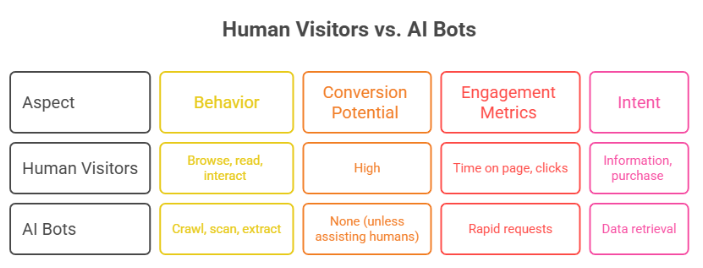
Human Traffic vs AI Bots: A Comparison
Human visitors and automated systems behave very differently online, and AI bots are changing website traffic highlights this contrast clearly. While human users browse with intent — reading content, exploring pages, and making purchase decisions AI bots scan pages rapidly to collect, index, or process data. This means engagement metrics like time on page, clicks, and conversions mostly reflect human behavior, whereas bot visits inflate raw traffic numbers without contributing to revenue or meaningful interaction. Understanding this difference is essential for interpreting performance data accurately.
How AI Bots are Changing Website Traffic for SEO
SEO strategies must evolve because AI bots changing website traffic alters how content is discovered and surfaced. AI‑powered search tools often summarize answers directly, reducing the need for users to click links. This creates “zero‑click” experiences.
However, this doesn’t make SEO irrelevant — it changes the goal. Instead of optimizing only for human readers, websites must also structure content so AI systems understand and reuse it.
Best practices include:
- Clear headings and semantic structure
- Direct answers to common questions
- Authoritative and well‑organized information
- Schema markup and structured data
When AI bots can easily interpret your content, your brand may be cited or referenced in AI‑generated answers — increasing visibility even without direct clicks.
Positive Effects of AI Bots Changing Website Traffic
Despite challenges, AI bots changing website traffic also creates opportunities.
- Faster Content Discovery
AI bots can index new pages almost instantly, helping fresh content surface faster in AI tools.
- Smarter Content Strategy
Bot interactions reveal which topics AI systems find valuable, guiding future content planning.
- Automation & Support
On‑site AI bots like chat assistants improve user experience, answer questions, and increase lead capture.
- Global Reach
AI tools surface your information to users worldwide, expanding reach beyond traditional search traffic.
Negative Effects of AI Bots Changing Website Traffic
There are real downsides that businesses must manage.
- Infrastructure strain from high bot activity
- Content scraping without attribution
- Security threats from malicious bots
- Wasted ad spend if bots trigger impressions
Without protective measures, AI bots changing website traffic can increase costs while reducing clarity in performance data.
How to Adapt When AI Bots Are Changing Website Traffic
Smart adaptation ensures businesses benefit rather than suffer.
Filter and Segment Traffic
Use analytics filters, firewall rules, and bot detection tools to separate human vs AI bot traffic.
Focus on Real Engagement
Measure form submissions, purchases, and conversations — not just visits.
Strengthen Technical SEO
Ensure your site is fast, structured, and easy for AI systems to interpret.
Protect Content
Use rate limiting and bot management systems to prevent harmful scraping.
Conclusion: Turning AI Bot Traffic into Opportunity
AI bots changing website traffic in 2026 represents a massive transformation, not a temporary trend. Businesses that understand this shift can adapt their SEO, analytics, and lead strategies to work with AI systems rather than against them.
The goal is no longer just “get more traffic” — it’s “get meaningful human engagement while staying visible in AI ecosystems.” Companies that invest in structured content, smart analytics, and strong technical foundations will outperform competitors.
The goal moving forward is balance. You must make your content understandable to AI systems while still persuasive and valuable for human users. When handled correctly, AI bots changing website traffic becomes an opportunity — improving discoverability, supporting automation, and feeding AI ecosystems that amplify your brand presence beyond traditional search.
Organizations that take action now will build stronger digital authority, better data clarity, and more predictable lead generation. Those that delay may struggle in a landscape where visibility is increasingly decided by algorithms rather than direct visits.
If you want expert guidance to optimize your website for this AI‑driven era, Techsila can help. From AI‑ready SEO strategies to performance optimization and conversion‑focused design, our team ensures your traffic turns into real business growth.
FAQS
How is AI affecting website traffic?
The result is a sharp decline in traffic: A recent Authorities study found that when AI Overviews appear in search results, clickthrough rates for the top organic link drop by around 79% (The Guardian, 2025).
How will AI impact in the next 5 years?
AI’s greatest impact on businesses over the next five years will reach into several key areas: where AI is currently deployed; where businesses are eagerly waiting for AI to be sufficiently powerful, flexible and reliable; and where AI applications are only speculative and not widely discussed.
How will AI impact in the next 5 years?
AI’s greatest impact on businesses over the next five years will reach into several key areas: where AI is currently deployed; where businesses are eagerly waiting for AI to be sufficiently powerful, flexible and reliable; and where AI applications are only speculative and not widely discussed.
What is the 10 20 70 rule for AI?
A separate report out of BCG urges adoption of the “10/20/70” principle to achieve business success with AI: Devote 10% of your resources to algorithms, and 20% to technology and data. The remaining 70% of your resources go to people and processes.