

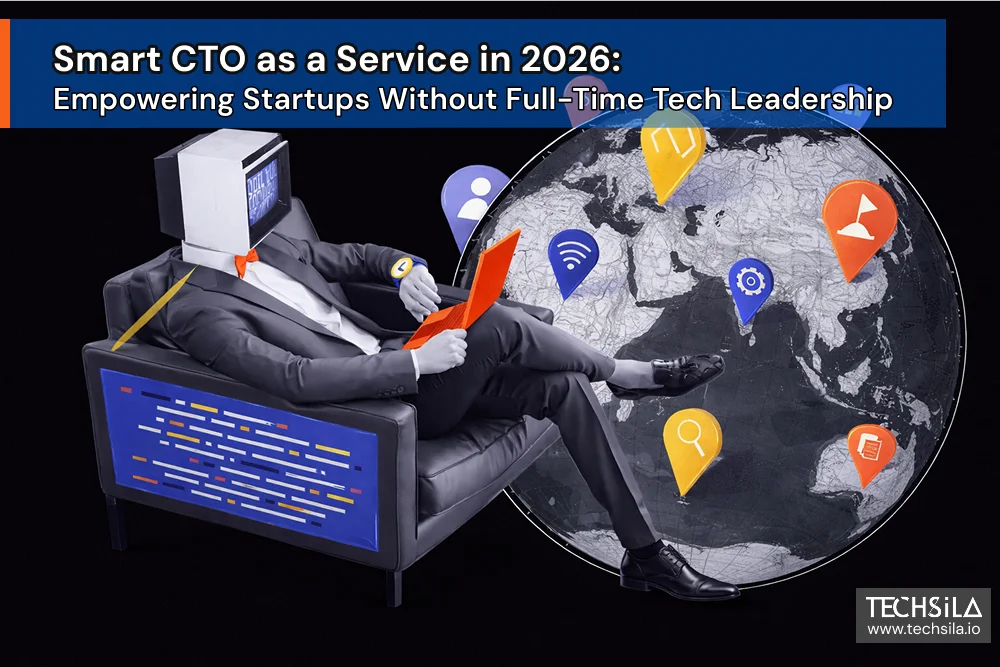
CTO as a Service has become one of the most defining shifts in how startups approach technology leadership in 2026. At a time when speed, scalability, and adaptability determine survival, many founders are realizing that hiring a full-time CTO too early can be just as risky decisions as not having technical leadership at all.
Today’s users are unforgiving. Products must be fast, secure, reliable, and scalable from day one. Investors expect technical clarity. Customers expect seamless digital experiences. Yet most startups operate with limited resources, evolving requirements, and uncertain growth trajectories.
This creates a difficult question for founders:
How do you make high-stakes technical decisions without locking yourself into an expensive executive hire before the business is ready?
This is where CTO as a Service for startups has moved from being an alternative option to a strategic choice.
Many early-stage and growth-focused companies begin addressing this challenge by working with experienced technology partners like Techsila, where leadership, architecture, and execution are aligned from the very beginning.
Why Technology Leadership Matters More Than Ever in 2026
In 2026, the startup landscape looks very different from even a few years ago. Product cycles are shorter, competition is global from day one, and user expectations are shaped by enterprise-grade platforms, even for early-stage tools. A rough MVP is no longer forgiven simply because a company is “early.”
At the same time, founders are operating under tighter constraints. Capital efficiency matters more. Hiring mistakes are more expensive. Technical debt is scrutinized earlier by investors and partners alike. Every architectural decision, from cloud provider to framework choice, is now a signal of long-term thinking or the lack of it.
This environment has exposed a gap in how startups traditionally approach leadership. Many founders either delay technical leadership too long or rush into hiring a full-time CTO before the company has enough clarity to use that role effectively.
CTO as a Service has emerged as a response to this reality. It offers startups a way to introduce senior technical thinking at the moment it matters most, without the financial and operational weight of a permanent executive hire. In doing so, it reshapes how founders think about leadership itself, not as a fixed title, but as a capability that evolves with the business.
As products become more complex and user expectations rise, startups face pressure on multiple fronts:
- Performance issues surface faster
- Security and compliance expectations are higher
- Scaling mistakes are more expensive to fix
- Development teams are increasingly distributed
Without experienced leadership guiding these decisions, startups often move quickly in the wrong direction. CTO as a Service exists to solve this exact problem by embedding senior technical thinking into the startup early, without forcing a permanent leadership commitment.
Pro Tip: If a technical decision cannot be easily reversed in six months, it deserves CTO-level oversight from day one.
What Often Goes Wrong Without CTO-Level Oversight
When startups operate without experienced technical leadership, problems rarely appear immediately. In fact, things often seem to work well at first. Features ship quickly. Costs appear manageable. Teams stay busy.
The issues begin to surface as the product grows.
Architecture that was never designed to scale starts to resist change. Adding new features requires touching fragile parts of the system. Performance issues appear under real-world usage. Security considerations that were postponed become urgent and expensive to address.
Another common issue is misalignment between business goals and technical execution. Development teams may focus on implementation details without fully understanding why certain features matter. Founders may push for speed without realizing the long-term impact of shortcuts. Without a CTO-level perspective to balance these forces, friction builds quietly.
Over time, this leads to a cycle of rework. Roadmaps shift. Teams lose momentum. Confidence erodes, not because the idea is wrong, but because the technical foundation cannot support growth.
CTO as a Service exists to interrupt this cycle early, before these problems harden into structural limitations.
The Problem With the Traditional Full-Time CTO Model
For years, hiring a full-time CTO was considered a milestone for serious startups. In practice, this model often creates friction rather than clarity.
Early-stage companies rarely need a CTO working full-time on executive strategy, people management, and long-term vision. What they need is guidance during critical moments: choosing the right architecture, validating technical trade-offs, setting up scalable infrastructure, and aligning engineering efforts with business goals.
In 2026, the CTO role has expanded dramatically. A modern CTO is expected to manage cloud strategy, security posture, development workflows, team structure, and stakeholder communication. For startups, hiring too early can lead to misalignment, inflated costs, or leadership that outpaces actual needs.
CTO as a Service offers a more flexible alternative by delivering leadership only where it creates the most value.
What CTO as a Service Means for Startups Today
CTO as a Service is not advisory-only and it is not traditional consulting. In 2026, it functions as an embedded leadership model designed to evolve alongside the startup.
A service-based CTO works closely with founders to define technical direction, review architecture, guide engineering teams, and ensure that development decisions support long-term growth. Instead of focusing on day-to-day coding, the emphasis is on clarity, structure, and informed decision-making.
In practice, CTO as a Service also acts as a decision filter. Not every new technology, framework, or architectural trend deserves adoption. A service-based CTO helps founders distinguish between what is genuinely necessary and what is simply fashionable.
This becomes especially important in 2026, where AI tooling, cloud services, and development frameworks evolve rapidly. Without experienced leadership, startups risk building complexity they do not yet need. CTO as a Service introduces restraint where it matters, ensuring that systems remain understandable, maintainable, and adaptable.
Additionally, this leadership model improves accountability. Clear ownership over architectural decisions and technical direction reduces ambiguity across teams. Developers know what standards to follow. Founders know which trade-offs are intentional. This shared understanding significantly reduces friction and miscommunication.
This approach gives startups access to experience that would otherwise be unavailable at early stages. It also creates continuity, ensuring that technical leadership does not disappear after a single engagement or assessment.
Many startups choose to formalize this relationship through offerings like Techsila’s CTO as a Service, where strategic oversight, architectural planning, and delivery governance are combined into a single, scalable engagement.
Why Startups Are Choosing CTO as a Service in 2026
The shift toward CTO as a Service reflects how startups now operate. Teams are leaner. Hiring is global. Products evolve faster. Founders need leadership that adapts to change rather than locking the company into fixed roles too early.
Startups benefit from CTO as a Service because it reduces uncertainty at critical moments. Decisions around infrastructure, stack selection, scalability, and security are made with long-term consequences in mind, not short-term convenience.
This model also allows founders to move faster with confidence. Instead of debating technical options endlessly or relying on trial and error, they gain clear direction backed by experience.
Most importantly, CTO as a Service helps startups avoid the hidden cost of technical debt. Problems are identified early, systems are designed with growth in mind, and teams work within a framework that supports sustainable development.

Pro Tip: The cost of fixing technical debt is lowest before users feel it and highest after growth accelerates.
CTO as a Service During Key Growth Phases
The impact of CTO as a Service becomes most visible during transition points in a startup’s journey.
At the MVP stage, it ensures that speed does not come at the expense of scalability. Architecture is kept lean but intentional. Technology choices are validated against future requirements.
As traction grows, leadership focus shifts toward reliability, performance, and process. CTO as a Service helps teams move from reactive development to structured delivery without slowing innovation.
When preparing for funding, partnerships, or enterprise clients, startups must demonstrate technical maturity. Clear documentation, stable systems, and a coherent technology vision become essential. Service-based leadership helps founders present that confidence without prematurely expanding the executive team.
CTO as a Service and Investor Readiness in 2026
In 2026, investors evaluate startups with a much sharper lens on technology than before. Technical due diligence begins earlier, goes deeper, and influences valuation more directly.
Questions about scalability, security, infrastructure costs, and development velocity are no longer reserved for late-stage rounds. Even early investors want confidence that a product can grow without collapsing under its own complexity.
CTO as a Service plays a critical role in preparing startups for these conversations. With experienced leadership involved early, technical narratives become clearer. Architectural decisions are documented. Risks are identified and addressed proactively rather than defensively.
This preparation changes how startups present themselves. Instead of reacting to investor concerns, founders can explain why specific decisions were made and how the technology supports future growth. This confidence often translates into smoother fundraising discussions and stronger trust.
In many cases, startups using CTO as a Service are not just more prepared for investment, they are more selective. They understand their technical roadmap well enough to evaluate investor expectations realistically and align partnerships accordingly.
Beyond Strategy: Confidence for Founders and Teams
One of the most underestimated benefits of CTO as a Service is the confidence it brings. Founders no longer feel isolated when making complex technical decisions. Engineering teams receive clearer guidance and consistent standards. Communication between business and technology becomes smoother.
This clarity improves execution. Teams spend less time fixing past mistakes and more time building features that matter. Leadership decisions feel deliberate rather than reactive.
Over time, this creates momentum. Technology becomes an enabler of growth instead of a bottleneck that constantly needs attention.
What changes most noticeably is the quality of decision-making across the organization. When founders have access to experienced technical leadership, they stop second-guessing every architectural choice or delivery estimate. Instead of debating possibilities, conversations shift toward priorities, trade-offs, and outcomes. This confidence allows leadership to focus on growth, partnerships, and customer experience rather than constantly revisiting technical concerns.
Engineering teams benefit just as much. Clear direction reduces ambiguity and frustration. Developers understand not only what they are building, but why it matters and how it fits into the broader product vision. This sense of purpose improves morale and encourages ownership, especially in fast-moving startup environments where uncertainty is common.
CTO as a Service also strengthens trust between teams. When technical guidance is consistent and grounded in experience, founders trust engineering estimates, and engineers trust leadership decisions. This mutual confidence reduces friction, speeds up delivery, and creates a healthier working dynamic.
As startups mature, this confidence compounds. Teams move faster because they are aligned. Founders make decisions with greater conviction. Technology stops being a constant source of risk and becomes a foundation that supports experimentation, scaling, and long-term growth.
CTO as a Service and Building High-Performing Remote Engineering Teams
In 2026, most startups are no longer built in a single office or even a single country. Engineering teams are distributed by default, often spanning time zones, cultures, and levels of experience. While this unlocks access to global talent, it also introduces operational complexity that many founders underestimate.
Without strong technical leadership, distributed teams can drift. Coding standards vary. Documentation becomes inconsistent. Decisions are made in isolation. Over time, this fragmentation slows delivery and increases rework.
CTO as a Service provides a stabilizing force in these environments. By setting clear technical standards, defining communication protocols, and aligning engineering practices across locations, a service-based CTO ensures that distributed teams operate as a cohesive unit rather than a collection of individuals.
This leadership is especially valuable for startups working with a mix of in-house developers, contractors, and outsourced teams. A CTO-level perspective helps establish accountability without micromanagement. Teams understand expectations. Founders gain visibility without needing to manage technical details day-to-day.
In many cases, CTO as a Service also supports hiring decisions. Instead of scaling teams blindly, startups receive guidance on when to hire, what roles are actually needed, and how to evaluate technical talent effectively. This prevents overstaffing while ensuring critical skills are covered.
As remote and hybrid work continues to define startup culture, the ability to lead engineering teams without constant proximity becomes essential. CTO as a Service enables startups to build strong, disciplined, and motivated teams, regardless of where those teams are located.
Preparing for the Future Without Rushing It
hoosing a service-based leadership model does not mean postponing long-term planning or avoiding permanent leadership altogether. In many cases, it does the opposite. It creates the conditions that make future leadership hires more successful.
When startups take the time to mature their technology intentionally, they gain clarity about what they truly need from a permanent leader. Instead of hiring based on assumptions, founders can define the role with precision. They understand which responsibilities should remain strategic, which require hands-on involvement, and how leadership should integrate with the existing team.
By the time a company is ready to bring on full-time executive leadership, its technology foundation is stronger. Architecture decisions are documented. Development processes are established. Teams are accustomed to working within clear standards and expectations. This reduces onboarding friction and allows new leadership to focus on growth rather than cleanup.
This approach also prevents one of the most common startup mistakes: hiring too early out of urgency. Leadership decisions made under pressure often lead to misalignment, unrealistic expectations, or rapid turnover. Preparing deliberately allows startups to move forward with confidence instead of reaction.
Pro Tip: The right time to hire a full-time CTO is when leadership gaps are clear, not when pressure is high.
In 2026, flexibility has become a competitive advantage in its own right. Startups that grow into leadership roles, rather than forcing them prematurely, retain agility while building for scale. This balance between readiness and restraint often defines which companies sustain momentum and which struggle under the weight of decisions made too soon.
Conclusion: Why CTO as a Service Is a Smart Leadership Model for 2026
CTO as a Service for startups represents a fundamental shift in how modern companies think about technology leadership. It prioritizes experience over headcount, adaptability over permanence, and long-term clarity over short-term speed.
As startups navigate increasingly complex technical landscapes, the ability to access senior leadership without overcommitting resources has become invaluable.
Looking ahead, CTO as a Service reflects a broader shift in how leadership is defined. Startups are moving away from rigid organizational structures toward models that prioritize expertise, adaptability, and timing.
In this context, leadership is no longer about occupying a seat at all costs. It is about making the right decisions at the right moment, with the right level of experience involved. CTO as a Service allows startups to do exactly that.
As markets become more competitive and technology continues to shape every aspect of product success, founders who treat technical leadership as a strategic capability rather than a fixed role will have a distinct advantage. They will move faster with fewer missteps and build systems designed not just to launch, but to last.
If you are building a startup and questioning whether a full-time CTO is the right move today, exploring a service-based model may be the smarter path forward. When you are ready to align your product vision with experienced technical leadership that grows with your business, you can request a quote and take the next step with confidence.
Frequently Asked Questions (FAQs)
1. What is CTO as a Service for startups?
It provides experienced technical leadership without requiring a full-time CTO hire.
2. When should a startup consider CTO as a Service?
When critical technical decisions arise but the company is not ready for a permanent CTO.
3. How does CTO as a Service help startups grow?
It guides architecture, technology choices, and engineering teams to support scalable growth.
4. Is CTO as a Service better than hiring a full-time CTO early?
