

In 2026, users don’t wait. If a website feels slow, breaks on mobile, or looks inconsistent across screens, users often leave within seconds. For developers and design teams, this means one thing: CSS is no longer just about styling, it’s about speed, responsiveness, and user experience.
As modern web applications grow more dynamic, the demand for faster development cycles and perfectly responsive layouts has pushed CSS tools far beyond basic stylesheets. Today’s frontend teams rely on these tools and libraries to ship clean, scalable, and performance-optimized designs without reinventing the wheel for every project.
But here’s the challenge:
The CSS tools ecosystem is evolving fast. What worked a few years ago may now slow you down, add unnecessary complexity, or fail to meet modern performance standards. In 2026, developers are prioritizing tools that offer utility-first workflows, design consistency, component reusability, and seamless responsiveness across devices.
The right CSS tools can:
-
Cut development time significantly
-
Ensure consistent design systems
-
Improve mobile and cross-browser responsiveness
-
Reduce CSS bloat and performance issues
The wrong ones can have the opposite effect.
That’s why choosing the best CSS tools and libraries for faster, responsive design in 2026 is critical, not just for frontend developers, but for businesses that care about speed, scalability, and user retention.
In this guide, we’ll break down the most effective CSS tools and libraries shaping modern web development in 2026, explain where each one shines, and help you decide which options fit your workflow, whether you’re building SaaS products, marketing websites, or complex web applications.
Why Modern CSS Tools Matter for Performance and Responsiveness in 2026
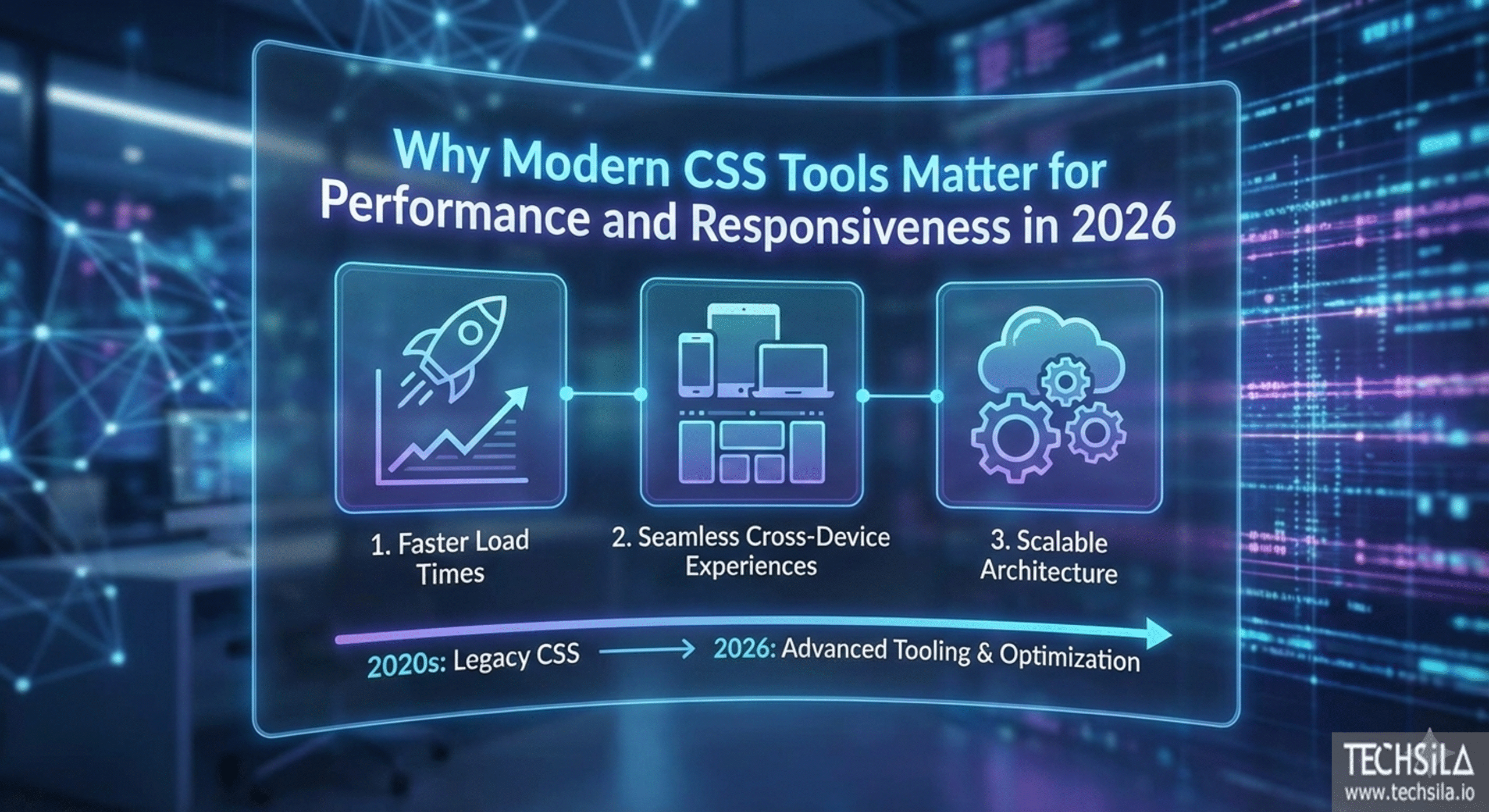
Web performance expectations in 2026 are unforgiving. Users expect interfaces to load instantly, adapt seamlessly to every screen size, and remain visually consistent across browsers and devices. When a layout breaks or a page feels slow, users don’t troubleshoot; they leave.
This shift has made modern CSS tools and libraries essential rather than optional.
Traditional CSS workflows, large stylesheets, custom media queries everywhere, and repeated layout fixes struggle to keep up with today’s demands. As applications become more interactive and design systems more complex, writing and maintaining raw CSS without the right tools quickly turns into a bottleneck.
Modern CSS tools solve this by focusing on speed, scalability, and responsiveness by default.
Performance Is No Longer Just a JavaScript Problem
In the past, performance discussions mostly revolved around JavaScript bundles and API calls. In 2026, CSS plays an equally important role.
Poorly structured stylesheets can:
-
Increase render-blocking time
-
Cause layout shifts (CLS issues)
-
Inflate file sizes with unused styles
-
Slow down mobile experiences
Modern CSS tools address this by generating only the styles you actually use, minimizing bloat and improving rendering performance. Utility-first frameworks, atomic CSS, and build-time optimizations ensure faster load times without sacrificing design flexibility.
When CSS is optimized correctly, pages feel faster, even before JavaScript finishes loading.
Responsive Design Has Become More Complex
Responsive design in 2026 is no longer just about desktop, tablet, and mobile. Developers now design for:
-
Foldable devices
-
Ultra-wide screens
-
High-density displays
-
Embedded web views inside apps
Manually managing breakpoints and layout logic across all these environments is time-consuming and error-prone.
Modern CSS libraries simplify responsiveness through:
-
Predefined responsive utilities
-
Fluid layouts using modern CSS features
-
Consistent spacing and typography scales
This allows teams to build layouts that adapt naturally without rewriting CSS for every new device size.
Design Consistency at Scale Is a Real Challenge
As teams grow and projects scale, maintaining visual consistency becomes harder. Slight differences in spacing, colors, or typography add up quickly, creating fragmented user experiences.
Modern CSS tools are often built around design systems. They enforce consistent tokens for:
-
Colors
-
Font sizes
-
Spacing
-
Component behavior
Instead of relying on documentation alone, these tools bake consistency directly into the codebase. This reduces design debt and makes collaboration between designers and developers far smoother.
Faster Development Cycles Are a Competitive Advantage
In 2026, speed to market matters. Teams that can iterate quickly, ship features faster, and adjust UI without breaking layouts have a clear edge.
Modern CSS tools:
-
Reduce repetitive styling work
-
Enable rapid prototyping
-
Make refactoring safer and faster
-
Improve collaboration across teams
Instead of fighting CSS, developers spend more time building meaningful features.
Why This Sets the Stage for the Right CSS Libraries
Understanding why modern CSS tools matter helps clarify why certain libraries stand out in 2026. The best tools aren’t just popular; they’re built to handle performance optimization, responsiveness, and scalability from day one.
Best CSS Tools and Libraries for Faster, Responsive Design in 2026
Choosing the right CSS tools in 2026 isn’t about trends; it’s about speed, scalability, and consistency. As SaaS platforms, dashboards, and web applications grow more complex, frontend teams need CSS solutions that reduce development time without sacrificing performance or maintainability.
The tools below are not just popular; they are battle-tested in real production environments.
1. Tailwind CSS – Build Production-Ready UIs at Record Speed
Tailwind CSS continues to dominate modern frontend development because it eliminates one of the biggest bottlenecks in UI work: writing and maintaining custom CSS from scratch.
Instead of switching between CSS files and components, developers apply utility classes directly in markup, allowing:
-
Faster UI iteration
-
Consistent spacing, colors, and typography
-
Built-in responsiveness using breakpoint utilities
-
Smaller CSS bundles through just-in-time compilation
In 2026, Tailwind is especially powerful for:
-
SaaS dashboards
-
Design systems
-
MVPs that need rapid iteration
Because Tailwind enforces design consistency at the utility level, it dramatically reduces UI drift as products scale.
2. CSS Modules – Clean, Conflict-Free Styling for Large Codebases
As projects grow, global CSS becomes difficult to manage. CSS Modules solve this problem by scoping styles locally to each component, ensuring predictable behavior across the application.
Why CSS Modules are still relevant in 2026:
-
Prevent class name collisions
-
Improve maintainability in multi-developer teams
-
Make refactoring safer and faster
-
Work seamlessly with React and Next.js
For enterprise SaaS platforms and long-term products, CSS Modules help teams maintain clean styling logic even as UI complexity increases.
This approach works best when combined with experienced frontend engineers who deeply understand component architecture.
3. PostCSS – The Backbone of Modern CSS Pipelines
PostCSS may not be visible to users, but it plays a critical role in high-performance frontend development. In 2026, PostCSS powers many modern CSS workflows behind the scenes.
PostCSS helps teams:
-
Use future CSS features safely
-
Automatically add vendor prefixes
-
Remove unused CSS for faster load times
-
Enforce consistent formatting and standards
It acts as a bridge between cutting-edge CSS features and real-world browser compatibility, making it essential for production-grade applications.
4. Vanilla Extract – Scalable, Type-Safe Styling for Serious Applications
Vanilla Extract is gaining popularity among teams that prioritize long-term scalability and maintainability. It allows developers to write CSS using TypeScript while generating static CSS at build time.
Why it’s powerful in 2026:
-
Type safety reduces styling bugs
-
No runtime performance overhead
-
Strong alignment with component-based architecture
-
Ideal for large design systems
For SaaS products with complex UI logic and shared components, Vanilla Extract brings structure without sacrificing performance.
5. Modern Native CSS, Used the Right Way
By 2026, with improved browser support, features like container queries, cascade layers, and advanced grid systems will be widely available. However, using them effectively still requires tooling and experience.
Modern CSS tools help:
-
Apply new features consistently
-
Avoid breaking older browsers
-
Maintain readable and structured styles
The best frontend teams don’t rely on raw CSS alone; they combine native features with proven tooling for stability and speed.
Why the Right CSS Stack Makes or Breaks Your Product
Fast, responsive UI isn’t optional anymore. Users expect instant feedback, smooth layouts, and consistent experiences across devices.
When CSS tools are chosen correctly:
-
Development speed increases
-
Bugs decrease
-
Performance improves
-
Design systems stay consistent
This is where having the right development partner matters.
Advanced Tips for Using CSS Tools Effectively in 2026
Even after choosing the right CSS tools, using them efficiently is key to building fast, responsive, and maintainable frontends. In 2026, the best teams don’t just rely on frameworks—they optimize workflows, automate repetitive tasks, and leverage modern CSS features strategically.
1. Automate Responsiveness With Utility Classes
Tools like Tailwind CSS allow you to apply responsive behavior directly in your markup using prebuilt utility classes. In practice:
-
Use responsive prefixes (
sm:,md:,lg:) to adjust layouts for specific breakpoints -
Apply consistent spacing and typography scales across components
-
Combine with PostCSS to automatically purge unused CSS for optimized load times
This approach drastically reduces manual media query management and ensures designs adapt flawlessly to foldable devices, ultra-wide screens, and high-density displays. Learn more about responsive best practices on Web.dev.
2. Enforce Component-Level Styling
Large teams often face CSS conflicts. Scoped solutions like CSS Modules or type-safe libraries like Vanilla Extract help maintain clean, collision-free styling:
-
Isolate component styles to avoid unexpected overrides
-
Use design tokens for colors, fonts, and spacing to enforce consistency
-
Integrate with React or Next.js for component-driven architecture
For complex SaaS projects, having component-level CSS discipline improves collaboration and speeds up feature delivery. Techsila’s React developers excel in building scalable, maintainable frontends using the best approaches. Techsila helps businesses build high-performance, responsive frontends using the best CSS tools and frameworks for 2026—ensuring speed, scalability, and long-term maintainability from day one.
3. Optimize CSS Output With Build Tools
Modern CSS tooling isn’t just about writing styles, it’s about efficient delivery:
-
PostCSS and its plugins allow autoprefixing, linting, and minification
-
Remove unused styles automatically to reduce render-blocking time
-
Generate static CSS at build time using tools like Vanilla Extract
Following these practices ensures your frontend loads faster, performs better on mobile, and keeps Core Web Vitals within optimal ranges. For more technical guidance on CSS performance, visit MDN Web Docs.
4. Combine Native CSS Features With Frameworks
Even in 2026, native CSS features like container queries, cascade layers, and advanced grid layouts are critical for responsive design. The trick is combining them with tools for maximum efficiency:
-
Use Tailwind or utility-first frameworks for fast prototyping
-
Layer native CSS features to handle unique layouts or edge cases
-
Maintain fallback styles for older browsers if needed
This hybrid approach ensures both speed and flexibility while avoiding unnecessary bloat or complexity.
5. Leverage Expert Guidance for Complex Projects
Choosing tools and best practices is one thing; implementing them effectively at scale is another. Partnering with experienced frontend teams ensures:
-
Clean architecture and consistent design system implementation
-
Faster development cycles with minimal CSS debt
-
Scalable solutions for SaaS platforms, enterprise apps, and marketing websites
For companies looking to accelerate frontend development with expert guidance, Techsila provides full-scale support for modern CSS stacks and responsive design: Web Development Outsourcing.
Future-Proofing Your CSS Stack in 2026
As the web evolves, frontend development is no longer just about looks; it’s about performance, scalability, and adaptability. Choosing the right CSS tools today can save your team months of refactoring tomorrow.
1. Keep an Eye on Emerging CSS Features
New CSS capabilities are rolling out rapidly in 2026:
-
Container queries for truly modular, responsive components
-
Cascade layers for better style management
-
Subgrid & advanced flex layouts for complex UI structures
Pairing these native features with proven tools like Tailwind, CSS Modules, and PostCSS ensures your designs remain future-proof. For detailed technical guidance, check MDN Web Docs.
2. Focus on Performance First
Frontends are judged by speed. Modern CSS tools allow teams to:
-
Generate only the CSS that’s used
-
Remove unused styles with PostCSS plugins
-
Minimize render-blocking CSS
Optimizing CSS at build time and leveraging modern frameworks ensures your pages load quickly, improving both user experience and SEO. Learn more about best performance practices at Web.dev.
3. Integrate With a Component-Based Workflow
The future of responsive design is component-driven:
-
Scoped CSS or type-safe solutions prevent style conflicts
-
Utility-first frameworks accelerate iteration
-
Combined, these approaches reduce technical debt and make large-scale projects manageable
For practical tips and patterns, CSS-Tricks is an excellent resource for modern CSS strategies.
4. Partner With Experts Who Understand Modern CSS
Even with the best tools, execution matters. Techsila specializes in modern CSS and responsive design for 2026, helping businesses:
-
Build fast, scalable SaaS frontends
-
Maintain visual consistency across devices
-
Avoid costly CSS refactoring later
Conclusion: Mastering CSS Tools for Responsive Design in 2026
In 2026, CSS tools for responsive design are no longer optional; they’re critical for delivering fast, scalable, and visually consistent frontends. The right combination of tools, frameworks, and workflows enables teams to build UIs that adapt seamlessly across devices, from foldable phones to ultra-wide desktops.
By leveraging utility-first frameworks like Tailwind CSS, scoped or type-safe styling through CSS Modules or Vanilla Extract, and modern build-time optimizations with PostCSS, you can:
-
Accelerate frontend development without compromising quality
-
Ensure pixel-perfect responsiveness across all screen sizes
-
Reduce CSS bloat and improve page load performance
Even with the most modern CSS tools for responsive design, native CSS features like container queries, cascade layers, and advanced grid layouts remain invaluable. Combining these features with proven tooling gives your team flexibility, maintainability, and a performance edge. For more technical guidance.
Partner With Experts to Maximize Results
The smartest teams don’t just pick tools; they implement them effectively. Techsila helps businesses harness the full power of CSS tools for responsive design, delivering:
- Scalable, maintainable frontends for SaaS and enterprise platforms
-
Fast-loading, responsive interfaces across all devices
-
Reduced technical debt and faster development cycles
Ready to future-proof your frontend? Don’t settle for slow or inconsistent UIs. Get a custom solution tailored to your project today. Get a Quote from Techsila Now and start building responsive, high-performance interfaces that keep your users engaged and satisfied.
