

What if your SaaS platform could detect a cyber threat, stop it instantly, repair itself, and continue operating—without waking up your security team at 2 AM? In 2026, this level of resilience is no longer futuristic; it’s becoming essential. As SaaS platforms scale across cloud environments, process sensitive customer data, and rely heavily on APIs and integrations, the cost of slow security response keeps rising. A single missed vulnerability can now lead to downtime, compliance violations, and lasting damage to customer trust.
This is where autonomous cybersecurity for SaaS steps in. Traditional security systems depend on alerts, dashboards, and human intervention. Teams investigate incidents after they begin, patch vulnerabilities under pressure, and hope attackers haven’t already moved laterally across the system. Modern threats don’t wait. They adapt, automate, and exploit weaknesses in minutes.
Self-healing systems change the game entirely. Autonomous cybersecurity continuously monitors system behavior, detects anomalies in real time, isolates compromised components, and automatically repairs vulnerabilities often before users notice anything went wrong. Each response strengthens the system, making future attacks harder to execute. For SaaS companies, autonomous cybersecurity doesn’t start with tools—it starts with knowing exactly where your platform is vulnerable. That’s where our expert security team steps in. Our specialists help SaaS businesses uncover hidden risks, strengthen defenses, and prepare their systems for self-healing security by delivering advanced Web Security & Penetration Testing backed by real-world SaaS attack scenarios. From APIs and cloud workloads to multi-tenant environments, we identify weaknesses before attackers ever get the chance. Let our cybersecurity experts secure your SaaS platform before threats become incidents:
In 2026, customers expect uninterrupted service, regulators demand airtight protection, and competitors capitalize quickly on security failures. Autonomous cybersecurity isn’t just about defense; it’s about building SaaS platforms that protect themselves, recover automatically, and earn long-term trust.
What Is Autonomous Cybersecurity for SaaS and How It Works
Autonomous cybersecurity is more than just advanced monitoring, it’s a system that can protect, detect, respond, and recover automatically without constant human intervention. For SaaS companies in 2026, this is becoming a strategic necessity. Platforms are growing increasingly complex, with microservices, APIs, multi-tenant architectures, and cloud-native infrastructures. Each layer expands the attack surface, creating more opportunities for hackers. Traditional, reactive security systems simply can’t keep up.
Instead, autonomous cybersecurity systems continuously monitor your SaaS environment for anomalies, detect threats as they emerge, isolate compromised components, and automatically repair vulnerabilities. They don’t just prevent damage, they learn from every incident, improving future defenses and creating a self-healing ecosystem.
How Autonomous Systems Work
Autonomous systems rely on AI and machine learning to process massive amounts of real-time data. They consider:
-
User behavior: Login patterns, unusual access attempts, and API usage anomalies.
-
System performance metrics: Unexpected spikes in CPU, memory, or database requests that could indicate a breach.
-
Configuration and patching status: Automatically detecting outdated components or misconfigurations.
-
Historical threat intelligence: Comparing current anomalies to past attacks to predict potential breaches.
By connecting all these layers, AI-driven autonomous systems can predict threats before they escalate, trigger automatic mitigation, and restore services seamlessly. Autonomous systems rely on AI and machine learning to process massive amounts of real-time data. According to MIT Technology Review, AI is reshaping how systems predict and prevent cyberattacks before they occur.
Why SaaS Needs Self-Healing Systems
In SaaS, even minor downtime can result in lost revenue, customer churn, and reputational damage. Manual intervention often delays response and increases exposure. Self-healing systems ensure that your platform remains secure and operational, even during off-hours or high-volume incidents. This not only protects sensitive customer data but also strengthens trust and long-term customer retention.
How Our Expert Team Can Help
Our expert cybersecurity team helps SaaS companies implement autonomous, self-healing security frameworks tailored to their platforms. We provide advanced Web Security & Penetration Testing to identify vulnerabilities before attackers exploit them, and we ensure that your systems maintain Data Encryption & Compliance at all times.
Whether your SaaS application is expanding into new markets, integrating multiple APIs, or handling highly sensitive customer data, our specialists design security workflows that detect, isolate, and remediate threats automatically, helping you stay secure, compliant, and competitive in 2026.
Why Traditional Cybersecurity Falls Short for SaaS
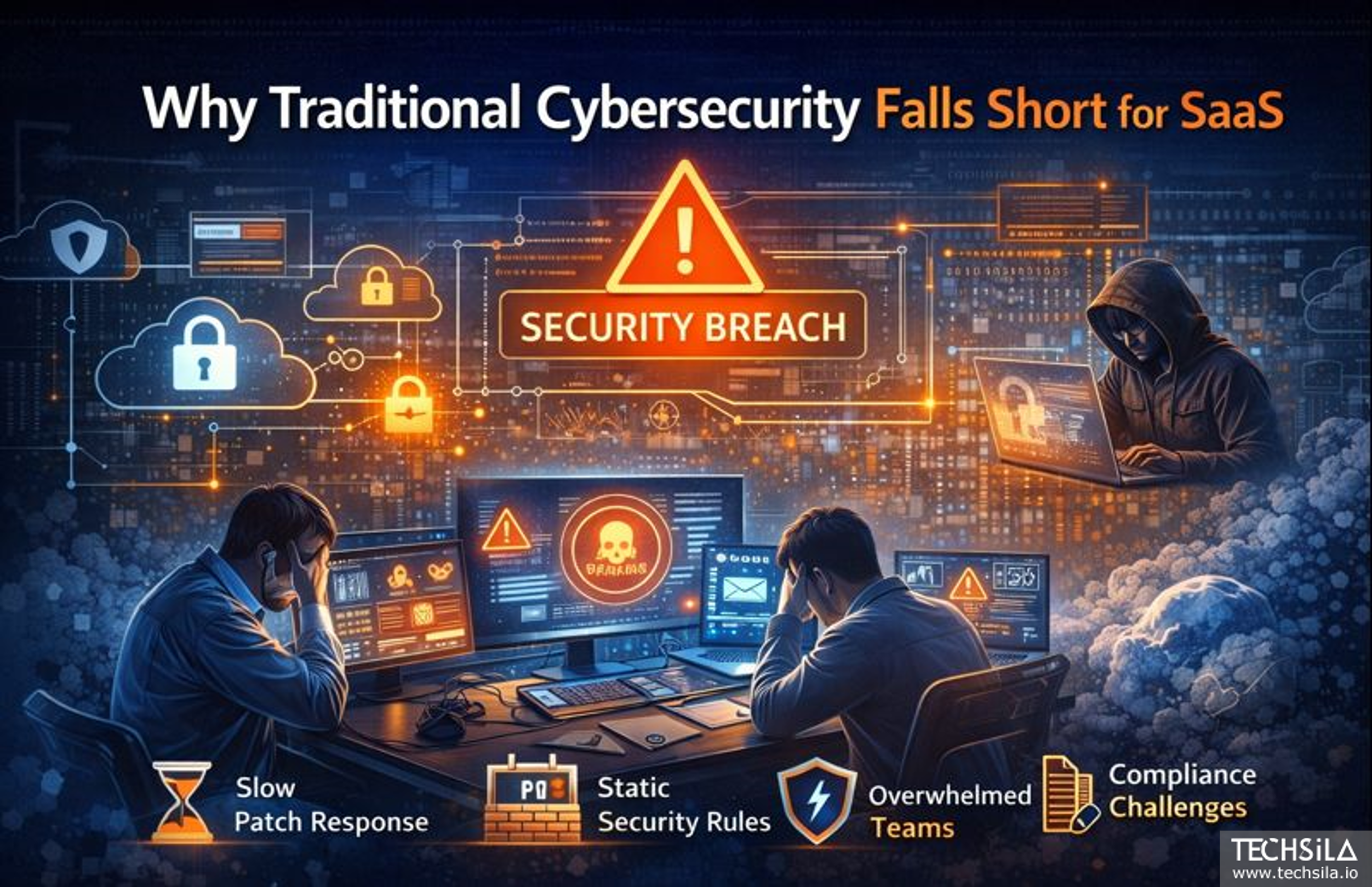
As SaaS platforms evolve in 2026, the old ways of protecting applications just aren’t enough. Traditional cybersecurity approaches—firewalls, static intrusion detection systems, and manual patching—were designed for predictable environments. SaaS, however, is dynamic: multi-tenant architectures, cloud-native services, continuous deployment, and frequent integrations create an attack surface that’s constantly shifting.
Relying on manual monitoring and reactive security means threats can slip through unnoticed, leaving businesses exposed to downtime, data breaches, and compliance failures. For SaaS companies, the consequences aren’t just technical; they’re financial and reputational.
1. Security Teams Can’t Keep Up With Scale and Complexity
Modern SaaS platforms often handle thousands of simultaneous users, multiple environments, and complex interdependencies between services. Security teams are forced to monitor multiple dashboards, analyze logs manually, and respond to alerts in real time. Even the most skilled teams can be overwhelmed.
Autonomous cybersecurity, powered by AI and machine learning, removes this bottleneck. Systems continuously scan for anomalies, detect suspicious patterns, and take corrective action without waiting for human intervention. This reduces reaction times from hours to seconds and ensures your SaaS platform stays protected 24/7.
2. Manual Patching and Response Is Too Slow
In traditional models, identifying vulnerabilities, issuing patches, and applying updates can take days or even weeks. During that time, attackers exploit known weaknesses. Self-healing systems in autonomous cybersecurity detect and fix vulnerabilities automatically, ensuring your SaaS platform is always up-to-date and resilient.
Our team supports SaaS companies by integrating these systems and providing Data Encryption & Compliance services, ensuring sensitive information remains protected even as your platform scales. Secure your SaaS infrastructure with expert guidance at Techsila.
3. Static Security Rules Fail Against Adaptive Threats
Traditional rules-based security treats every incident the same. It cannot adapt to evolving attack methods or sophisticated AI-driven threats. SaaS environments require intelligent systems that can distinguish normal activity from a real attack, adjust automatically, and respond without human input.
Autonomous cybersecurity systems continuously learn from each event. Over time, they improve detection accuracy, reduce false positives, and ensure that high-priority threats are addressed first, without slowing down your business.
4. Compliance Requirements Add Extra Pressure
SaaS platforms often operate across multiple regions, each with its own regulatory requirements, such as GDPR, SOC 2, or HIPAA. Traditional security approaches struggle to enforce consistent compliance at scale. Autonomous systems can automate encryption, auditing, and policy enforcement, making compliance a seamless part of daily operations rather than a reactive chore. SaaS platforms often operate across multiple regions, each with its own regulatory requirements, such as GDPR, SOC 2, or HIPAA. To understand how to align security with compliance frameworks, check out the ISACA COBIT framework.
Why SaaS Businesses Need Autonomous Cybersecurity in 2026
Simply put, manual or semi-automated security strategies are too slow, too rigid, and too error-prone for modern SaaS operations. Autonomous cybersecurity is not just a technological upgrade; it’s a strategic shift that ensures your platform remains available, secure, and compliant.
SaaS companies that embrace self-healing systems gain:
-
Faster threat detection and response
-
Reduced risk of downtime and breaches
-
Enhanced compliance and audit readiness
-
Continuous improvement of security posture
With the right expert guidance, integrating autonomous cybersecurity into your SaaS stack isn’t just achievable, it’s essential for staying competitive in 2026.
How Self-Healing Systems Transform SaaS Security in 2026
By 2026, self-healing systems will no longerbe a futuristic concept; they’re becoming a strategic advantage for SaaS businesses. These autonomous cybersecurity systems don’t just detect threats—they respond, repair, and adapt, reducing risk and downtime while improving customer trust.
SaaS platforms today face multiple challenges that traditional security cannot address efficiently: constantly changing APIs, frequent software updates, cloud scaling, and multi-tenant environments. Any single vulnerability can quickly escalate into a system-wide breach. Self-healing systems solve this problem by combining real-time monitoring, AI-driven threat detection, and automated remediation.
1. Automatic Threat Detection and Response
The core strength of self-healing systems lies in instant, automated response. These platforms continuously analyze system behavior, detect anomalies, and predict potential attacks before they occur. For example:
-
Unusual login patterns or IP addresses trigger automated isolation of the affected session
-
Suspicious API calls are blocked and quarantined immediately
-
Misconfigured permissions are corrected without human intervention
By acting instantly, self-healing systems prevent small issues from becoming major breaches, ensuring SaaS applications remain available and secure.
2. Reduced Downtime and Faster Recovery
Downtime is costly for SaaS companies. Every minute offline can result in lost revenue, customer dissatisfaction, and reputational damage. Self-healing cybersecurity reduces downtime by automatically patching vulnerabilities and restoring affected components.
Unlike manual response systems, these autonomous platforms learn from each incident, gradually improving their ability to restore systems faster and more efficiently. This proactive recovery approach ensures business continuity, even under sophisticated attacks.
3. Adaptive Security That Improves Over Time
Traditional security models often rely on static rules that can quickly become outdated. In contrast, self-healing systems continuously adapt, learning from past incidents to identify new threat patterns.
For SaaS platforms, this adaptive approach means:
-
Evolving protection against emerging threats
-
Reduced manual monitoring and intervention
-
Increased confidence for developers and security teams
As threats grow more complex in 2026, adaptive self-healing becomes a key differentiator for SaaS companies that want to stay ahead of attackers.
4. Compliance and Data Protection Made Simpler
Regulatory compliance is a major challenge for SaaS providers. Autonomous systems can enforce data encryption, monitor access controls, and ensure regulatory standards are met automatically. This helps SaaS companies maintain GDPR, SOC 2, or ISO compliance without extensive manual audits, reducing risk and improving customer confidence.
With self-healing cybersecurity, companies can protect sensitive data while scaling operations, without sacrificing speed or usability.
5. Why SaaS Leaders Should Invest in Self-Healing Systems Now
By integrating self-healing security into their platforms, SaaS companies can:
-
Detect and resolve threats faster than competitors
-
Maintain uptime and avoid costly downtime
-
Build customer trust with proven security resilience
-
Reduce reliance on manual security interventions
Autonomous cybersecurity is not just a protective tool; it’s a strategic growth lever. SaaS businesses that implement self-healing systems now will have a clear advantage in speed, reliability, and trust by 2026.
Real-World Use Cases of Autonomous Cybersecurity in SaaS
Implementing autonomous cybersecurity isn’t just a theoretical exercise; it produces measurable results for SaaS companies across multiple industries. Self-healing systems transform the way platforms operate, protect data, and respond to threats. Here are some key use cases that demonstrate why SaaS leaders are investing heavily in these solutions in 2026.
1. Multi-Tenant SaaS Platforms
Multi-tenant environments are notoriously challenging to secure. A vulnerability in one tenant’s environment can quickly impact others, creating cascading risk. Autonomous cybersecurity systems continuously monitor all tenants for unusual behavior, isolate affected components, and automatically patch threats without affecting other users.
For SaaS companies with hundreds or thousands of tenants, this means:
-
Continuous uptime even during attacks
-
Reduced manual intervention
-
Faster recovery from incidents
This proactive approach prevents small vulnerabilities from escalating into system-wide outages, giving both the SaaS provider and customers peace of mind.
2. API-Driven SaaS Ecosystems
Modern SaaS applications rely heavily on APIs for integrations, third-party apps, and internal automation. Unfortunately, these APIs are a common attack vector. Autonomous cybersecurity systems monitor API traffic in real time, detect anomalous requests, and block suspicious activity automatically.
The result is:
-
Prevention of data exfiltration
-
Reduced downtime from API misuse
-
Protection of sensitive customer data
By combining these automated protections with Web Security & Penetration Testing, SaaS providers can continuously harden API endpoints, ensuring integrations remain safe without slowing innovation.
3. Cloud-Native SaaS Deployments
Cloud-native architectures offer speed and scalability but also introduce dynamic security challenges, such as container vulnerabilities, misconfigured services, and zero-day exploits. Autonomous systems track every component, detect unusual activity, and repair compromised nodes automatically, without human intervention.
Benefits include:
-
Minimized downtime and operational risk
-
Continuous compliance adherence
-
Reduced burden on DevOps and security teams
In 2026, SaaS companies adopting these self-healing systems gain a competitive advantage by ensuring reliability and trust—key factors for retaining enterprise clients.
4. Data Compliance and Encryption Enforcement
With regulations like GDPR, CCPA, and SOC 2 tightening, SaaS companies must enforce data encryption and compliance standards continuously. Autonomous cybersecurity platforms automatically verify encryption at rest and in transit, audit access controls, and remediate violations in real time.
This guarantees:
-
Regulatory compliance without manual monitoring
-
Reduced risk of penalties and fines
-
Confidence for customers handling sensitive data
Data encryption and compliance are no longer optional; they are fundamental requirements, and autonomous systems make enforcement seamless.
5. Early Threat Detection and Insider Threat Prevention
Some of the most damaging breaches come from subtle insider threats or minor configuration errors that go unnoticed. Autonomous systems continuously learn normal patterns of behavior and detect anomalies, alerting teams or automatically isolating affected areas before they escalate.
This helps SaaS businesses:
-
Stop threats before they cause damage
-
Reduce human error in security operations
-
Maintain system stability under pressure
The combined effect of early detection, automated response, and continuous learning is what makes self-healing systems revolutionary.
6. Scaling Security with Business Growth
Finally, as SaaS businesses grow, manual security becomes a bottleneck. Autonomous cybersecurity scales alongside the platform, handling thousands of events per second, updating defenses automatically, and ensuring consistent protection across every new feature, tenant, or deployment.
This scalability ensures:
-
Security keeps pace with rapid product innovation
-
Teams focus on strategic improvements instead of firefighting
-
Customers experience uninterrupted, secure service
By adopting autonomous cybersecurity, SaaS companies can scale confidently without compromising safety or reliability.
Preparing Your SaaS Platform for Autonomous Cybersecurity in 2026
The rise of autonomous cybersecurity isn’t just a trend; it’s a necessity for any SaaS business that wants to stay competitive in 2026. But adopting self-healing systems isn’t as simple as flipping a switch. It requires careful preparation, strategy, and alignment between technical teams and business goals.
Here’s how SaaS companies can get ready:
1. Map Your Critical Assets and Vulnerabilities
Before any automation can protect your platform, you need to know exactly what’s at risk. Identify:
-
Sensitive customer data
-
API endpoints and integrations
-
Multi-tenant architectures
-
Cloud infrastructure and microservices
This audit allows autonomous systems to focus on high-value targets and prioritize threats that matter most. Without a clear map of your critical assets, self-healing systems may either overreact to minor issues or miss significant risks.
2. Implement Continuous Monitoring
Autonomous cybersecurity depends on real-time insights. Implement monitoring for:
-
Network traffic anomalies
-
Unusual login behavior
-
API abuse or misconfigurations
-
Unexpected data access patterns
Continuous monitoring ensures that self-healing systems have accurate, up-to-date information to detect threats before they escalate.
3. Layer Proactive Web Security & Penetration Testing
Self-healing systems work best when they are combined with human-led proactive testing. Our expert team helps SaaS companies identify hidden vulnerabilities through Web Security & Penetration Testing, uncovering weaknesses that automated systems may miss. This ensures that your platform isn’t just reacting it’s prepared for the attacks most likely to target your SaaS environment. Layering autonomous cybersecurity with human-led testing is crucial. Our experts perform Web Security & Penetration Testing following best practices outlined by OWASP to identify vulnerabilities before attackers exploit them.
4. Ensure Data Encryption & Compliance
Autonomous systems cannot replace compliance responsibility. SaaS businesses must maintain strict data encryption, access controls, and regulatory alignment. By implementing Data Encryption & Compliance frameworks, self-healing systems can automatically enforce policies and repair misconfigurations without compromising security or regulatory standards.
5. Train Teams and Align Processes
Even fully autonomous cybersecurity systems work best when teams understand how to respond and trust the system’s prioritization. Align your security, development, and operations teams around:
-
Automated alerts and responses
-
Incident reporting protocols
-
Integration with CI/CD pipelines
-
Risk scoring and escalation logic
Training ensures that your team can make the most of autonomous systems, leveraging both AI-driven efficiency and human judgment.
6. Choose the Right Expert Partner
Implementing autonomous cybersecurity requires both technical expertise and real-world SaaS experience. Our team works with SaaS companies to:
-
Design self-healing security workflows
-
Integrate AI-driven monitoring and response
-
Conduct ongoing penetration testing and compliance audits
By combining automated systems with human expertise, SaaS businesses can achieve a resilient, always-on security posture that keeps customer trust intact and operational downtime at zero.
The Business Impact of Autonomous Cybersecurity for SaaS in 2026
In 2026, security is no longer just a technical concern; it’s a business-critical differentiator. For SaaS companies, adopting autonomous cybersecurity and self-healing systems can directly influence growth, customer trust, and revenue.
Autonomous cybersecurity doesn’t just detect and respond to threats; it prevents downtime, ensures regulatory compliance, and protects brand reputation. These outcomes translate to measurable business benefits.
1. Minimized Downtime and Continuous Operations
Downtime is costly for SaaS platforms. Every minute a system is offline can mean lost subscriptions, frustrated customers, and reputational damage.
Self-healing systems allow your platform to:
-
Detect anomalies immediately
-
Isolate affected services automatically
-
Restore normal operations without human intervention
By preventing extended outages, SaaS companies maintain always-on availability, which is crucial in a competitive 2026 marketplace.
2. Stronger Customer Trust and Retention
Security incidents are more than technical failures; they are customer trust events. Breaches can drive users to competitors overnight.
Autonomous cybersecurity ensures:
-
Data protection is proactive, not reactive
-
Self-healing systems fix vulnerabilities before customers are impacted
-
Compliance standards like SOC 2, ISO, and GDPR are continuously enforced
This reassures customers, strengthens retention, and builds a reputation for reliability that directly impacts revenue.
3. Reduced Operational Costs
Manual incident response requires dedicated teams, on-call rotations, and extended remediation efforts. These costs grow with scale.
By integrating self-healing systems, SaaS companies can:
-
Reduce the need for 24/7 human monitoring
-
Minimize expensive post-incident fixes
-
Optimize security operations across multiple environments
Over time, AI-driven protection lowers operational costs while improving system resilience, freeing teams to focus on innovation and growth.
4. Scalable Security for Rapid Growth
As SaaS products expand across regions, cloud environments, and integrations, maintaining consistent security manually becomes impossible. Autonomous cybersecurity scales automatically:
-
New instances or services are automatically protected
-
Updates and patches deploy without delays
-
Threat intelligence feeds continuously improve the system
This scalability ensures your SaaS platform remains secure even as your customer base and product complexity grow.
5. Strategic Advantage Over Competitors
Companies still relying on manual security models are exposed to slower response times and higher breach risks. In contrast, businesses leveraging autonomous cybersecurity gain a strategic edge:
-
Faster response to threats
-
Increased reliability and uptime
-
Stronger compliance and audit readiness
This differentiation can be the deciding factor for prospects choosing between competitors in 2026.
Conclusion: Secure Your SaaS with Autonomous Cybersecurity in 2026
In 2026, the stakes for SaaS security have never been higher. Traditional, reactive systems can’t keep up with fast-moving cyber threats. Autonomous cybersecurity powered by self-healing systems is the future of resilient, always-on SaaS protection. By implementing self-healing security, your platform can detect, respond to, and repair threats automatically, ensuring uninterrupted service, regulatory compliance, and customer trust. Whether it’s multi-tenant cloud infrastructure, APIs, or critical data, these systems minimize risk while maximizing uptime and confidence in your SaaS product. Our expert team at Techsila helps SaaS businesses integrate advanced Web Security & Penetration Testing and Data Encryption & Compliance strategies into their platforms, preparing them to thrive securely in 2026. Don’t wait for a breach to force change; secure your SaaS platform today. Request a personalized security assessment and get a quote.
5 FAQs: Autonomous Cybersecurity for SaaS
-
What is autonomous cybersecurity for SaaS?
Autonomous cybersecurity uses AI-driven, self-healing systems to detect, respond, and repair threats automatically without human intervention. -
How do self-healing systems protect SaaS platforms?
They continuously monitor system behavior, identify anomalies, isolate compromised components, and repair vulnerabilities in real time. -
Why is autonomous cybersecurity important for SaaS in 2026?
With increasing cloud complexity, APIs, and multi-tenant environments, manual security can’t keep up. Autonomous systems ensure faster response and reduced risk. -
Does this help with compliance?
Yes. Autonomous systems support Data Encryption & Compliance, helping SaaS companies meet GDPR, SOC 2, and other regulatory standards. -
How can Techsila help implement these systems?
Our expert team provides Web Security & Penetration Testing, encryption strategies, and self-healing security integration tailored for SaaS platforms.
