


In 2026, cybersecurity is no longer a reactive necessity; it is a strategic business imperative. SaaS platforms handle vast amounts of sensitive customer data, operate across complex cloud environments, and integrate countless APIs. A single overlooked vulnerability can lead to downtime, regulatory fines, and irreversible damage to customer trust. AI-powered cybersecurity offers a transformative solution. By combining artificial intelligence, machine learning, and predictive analytics, these systems detect threats in real-time, respond autonomously, and continuously adapt to evolving attack strategies.
For SaaS businesses aiming to operate with the resilience and security of a Fortune 500 company, implementing AI-powered cybersecurity is no longer optional; it is critical. Advanced security frameworks ensure that threats are neutralized before they escalate, compliance standards are automatically enforced, and your platform maintains uninterrupted performance and reliability. Companies leveraging AI-powered cybersecurity gain not only protection but also a strategic advantage: faster response to threats, minimized downtime, and increased customer confidence. In 2026, SaaS leaders who embrace intelligent, proactive security will set the standard for industry excellence.
What Is AI-Powered Cybersecurity?
AI-powered cybersecurity is a proactive, intelligent approach to protecting SaaS platforms from evolving cyber threats. Unlike traditional security systems that rely on static rules, manual monitoring, and reactive patches, AI-powered cybersecurity leverages machine learning, behavioral analytics, and predictive algorithms to identify and neutralize threats in real time.
Key Components of AI-Powered Cybersecurity:
-
Behavioral Analysis
AI algorithms continuously learn what “normal” activity looks like for your platform. Unusual login patterns, excessive API requests, or unexpected file access are flagged instantly, preventing breaches before they escalate. -
Threat Prediction
Machine learning models forecast potential attacks using historical data and global threat intelligence, giving your platform a predictive defense edge. -
Automated Response
AI-powered cybersecurity systems respond autonomously, blocking malicious traffic, quarantining compromised accounts, and applying patches—reducing dependence on human intervention. -
Continuous Learning
Every detected incident feeds back into the AI system, improving detection and response over time.
For SaaS companies seeking enterprise-grade protection, combining AI-powered cybersecurity with expert Web Security & Penetration Testing ensures vulnerabilities are discovered before attackers can exploit them. For a deep dive into AI-driven threat detection, MIT Technology Review on AI in cybersecurity explains how artificial intelligence is transforming enterprise protection.
Why SaaS Businesses Need AI-Powered Cybersecurity in 2026
The SaaS landscape in 2026 demands security solutions that are fast, adaptive, and intelligent. AI-powered cybersecurity offers tangible business benefits:
-
Reduced Downtime and Service Disruption
Autonomous threat detection and response minimize system interruptions, ensuring continuous service for users. -
Enhanced Customer Trust
AI-powered systems proactively protect sensitive customer data, strengthening user confidence and brand reputation. -
Regulatory Compliance Made Easy
Integrating Data Encryption & Compliance ensures GDPR, SOC 2, HIPAA, and other standards are continuously enforced, reducing legal risk. -
Cost Efficiency
Automated monitoring and threat mitigation reduce the need for large, round-the-clock security teams, lowering operational costs while improving protection. -
Competitive Advantage
Businesses that implement AI-powered cybersecurity can respond faster to threats, maintain uninterrupted service, and offer enterprise-level security, positioning themselves ahead of competitors. The World Economic Forum’s insights on AI cybersecurity highlights how AI is revolutionizing threat detection and enterprise resilience.
How AI-Powered Cybersecurity Works in SaaS
AI-powered cybersecurity transforms the way SaaS platforms defend themselves. Traditional security systems react to attacks after they happen, but AI-driven systems act proactively predicting, detecting, and neutralizing threats automatically.
Here’s how it works in practice:
1. Real-Time Monitoring
AI-powered cybersecurity continuously scans your SaaS environment, including servers, APIs, user interactions, and cloud workloads. This real-time monitoring detects anomalies such as unusual login attempts, abnormal API usage, or sudden spikes in system activity.
2. Threat Intelligence Integration
Machine learning models are trained on global threat intelligence datasets, allowing AI to recognize new attack patterns before they impact your platform. This predictive capability gives SaaS businesses a defensive advantage similar to Fortune 500 companies.
3. Autonomous Threat Mitigation
Once a threat is detected, AI-powered cybersecurity systems can respond immediately, isolating affected components, blocking malicious IPs, and applying patches without waiting for human intervention.
4. Continuous Improvement
Every detected attack is analyzed to enhance future threat detection. Over time, the AI system learns from every incident, reducing false positives and increasing the accuracy of threat mitigation. For SaaS platforms looking to strengthen their defenses further, combining AI-powered cybersecurity with expert Web Security & Penetration Testing ensures vulnerabilities are proactively identified and resolved. The Gartner report on AI in cybersecurity highlights how AI-driven solutions are increasingly essential for modern enterprise security.
Implementation Strategies for AI-Powered Cybersecurity
Adopting AI-powered cybersecurity in your SaaS platform requires careful planning, technical expertise, and alignment with business goals. Here are key strategies:
-
Map Critical Assets and Risks
Identify sensitive data, APIs, and high-value infrastructure. AI-powered systems perform best when focused on the most critical areas, reducing risk exposure. -
Layer Proactive Security Measures
Integrate AI-powered cybersecurity with Data Encryption & Compliance frameworks to enforce regulatory standards automatically, ensuring your SaaS remains compliant at all times. -
Integrate AI Across Infrastructure
AI should cover cloud workloads, APIs, multi-tenant architectures, and endpoints. Seamless integration ensures holistic protection. -
Continuous Testing and Monitoring
Combine AI monitoring with regular penetration testing and audits. Continuous evaluation ensures vulnerabilities are detected before attackers can exploit them. -
Train Teams for AI-Driven Security
While AI handles real-time detection and mitigation, human oversight remains important. Security teams should understand AI outputs and escalation protocols to respond effectively to complex scenarios. CSO Online on AI cybersecurity adoption highlights practical steps for integrating AI into enterprise security systems.
Key Benefits of AI-Powered Cybersecurity for SaaS in 2026
AI-powered cybersecurity is not just a technical upgrade; it is a strategic advantage for SaaS platforms aiming to operate at Fortune 500 standards. Implementing AI-driven security systems brings tangible benefits that impact reliability, customer trust, operational efficiency, and long-term business growth.
1. Proactive Threat Detection
Unlike traditional security that reacts after an attack occurs, AI-powered cybersecurity identifies threats before they escalate. By continuously analyzing patterns in user behavior, API calls, network activity, and system anomalies, AI predicts potential breaches. This proactive approach reduces downtime, prevents data loss, and ensures that your SaaS platform remains operational even during targeted attacks.
2. Reduced Operational Costs
Maintaining a 24/7 security team is expensive and can be inefficient. AI-powered systems automate monitoring, threat detection, and even remediation, significantly reducing labor costs. Teams can focus on strategic initiatives rather than firefighting incidents. Over time, this results in substantial operational savings while increasing security coverage across your platform.
3. Faster Response Times
AI-powered cybersecurity systems respond to threats in real time, often neutralizing attacks in seconds. Automated quarantine, patching, and mitigation ensure that vulnerabilities are addressed immediately, minimizing exposure and potential impact. This is especially critical for SaaS platforms where even a few minutes of downtime can lead to revenue loss and diminished customer trust.
4. Continuous Learning and Adaptation
AI continuously learns from every attempted attack and system anomaly. With each incident, the system improves its understanding of threat patterns, reducing false positives and enhancing detection accuracy. Over time, this creates a self-healing security environment that becomes smarter and more resilient with every challenge.
5. Enhanced Compliance and Regulatory Alignment
Maintaining compliance with GDPR, SOC 2, HIPAA, and other standards is complex. Integrating Data Encryption & Compliance with AI-powered cybersecurity ensures that encryption, auditing, and policy enforcement are automated and consistent, reducing legal risk and audit burdens.
6. Increased Customer Trust
SaaS customers expect reliable and secure services. Platforms that can demonstrate proactive, AI-driven security gain a competitive advantage. Customers feel confident that their sensitive data is protected, which drives retention, reduces churn, and strengthens brand reputation.
7. Scalability for Growing Platforms
As SaaS platforms grow, traditional security systems struggle to scale. AI-powered cybersecurity can automatically handle thousands of events per second, protecting new users, features, and integrations without manual intervention. This scalability ensures that your security posture evolves alongside your business. According to Forbes, AI-driven security solutions dramatically reduce breaches, improve response times, and increase operational efficiency for enterprise platforms.
Common Cyber Threats SaaS Platforms Face in 2026
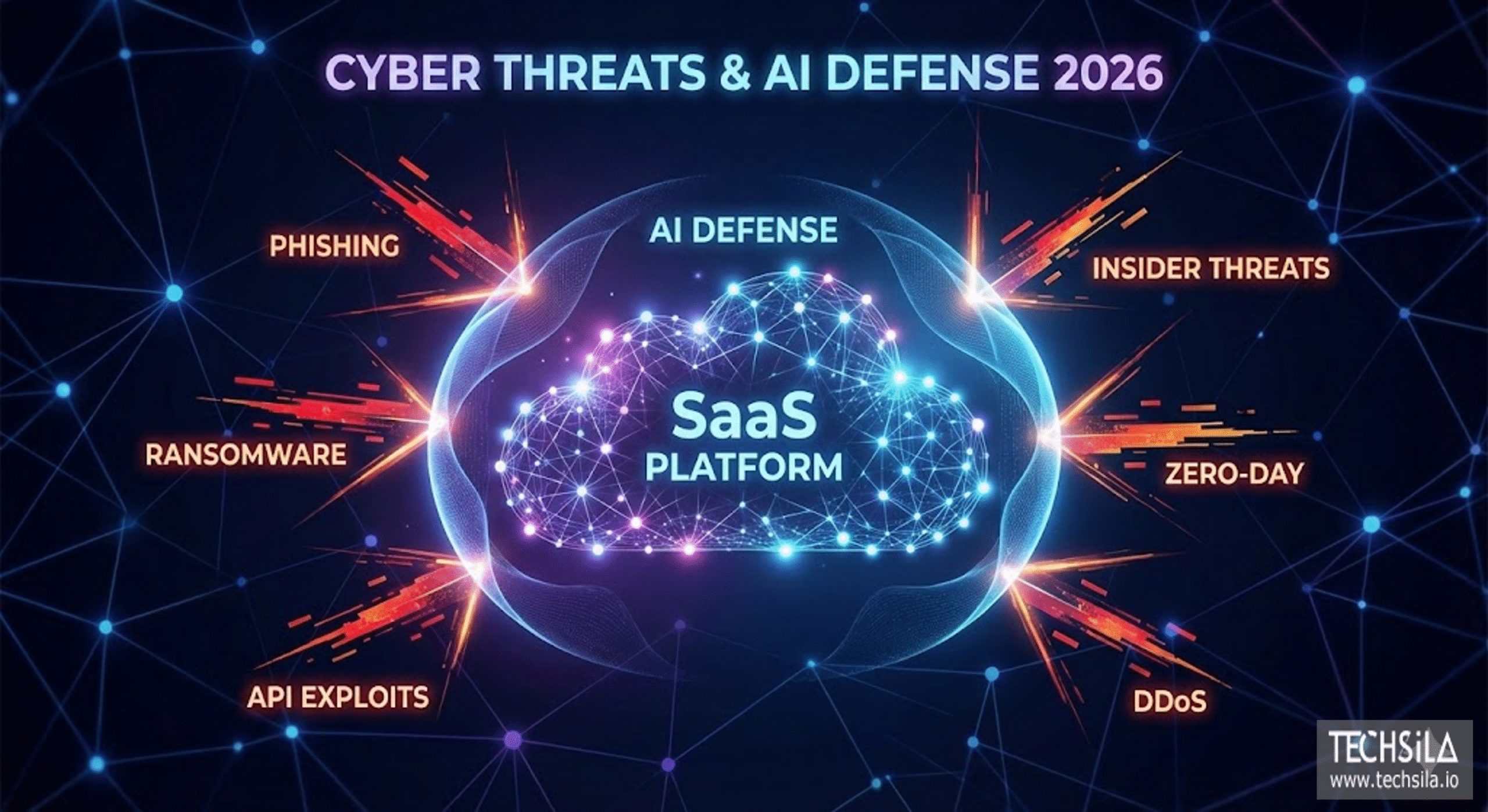
Even the most robust SaaS platforms are vulnerable to sophisticated cyberattacks if they rely solely on traditional security methods. AI-powered cybersecurity provides protection, but understanding the types of threats your platform faces is essential for strategic defense.
1. Phishing and Social Engineering Attacks
Attackers often target employees or users through deceptive emails, messages, or fake websites to steal credentials or sensitive data. Even a single compromised account can grant access to critical systems. AI-powered systems detect unusual login patterns and alert security teams, reducing the likelihood of successful attacks.
2. Ransomware and Malware Attacks
Ransomware attacks can lock your SaaS platform or compromise databases, demanding a ransom to restore access. Malware may silently exfiltrate data over time. AI-powered cybersecurity continuously monitors system activity for anomalies, isolates infected components, and mitigates risks before significant damage occurs.
3. API Exploits
Modern SaaS platforms rely heavily on APIs for integrations and internal workflows. Vulnerabilities in APIs can allow attackers to bypass traditional security layers. AI-driven systems analyze API behavior in real time, blocking suspicious requests and preventing unauthorized data access.
4. Insider Threats
Not all threats come from outside the organization. Employees or contractors with access to critical systems can inadvertently or maliciously compromise data. AI-powered cybersecurity detects unusual activity, such as abnormal file downloads or configuration changes, protecting your SaaS platform from insider risks.
5. Zero-Day Attacks
Zero-day vulnerabilities are flaws in software that attackers exploit before developers release a fix. AI systems can detect suspicious behaviors associated with zero-day exploits, providing early warning and automatic containment even before a patch is applied.
6. DDoS Attacks (Distributed Denial of Service)
DDoS attacks flood servers with traffic, disrupting service and potentially causing downtime. AI-powered cybersecurity identifies unusual traffic spikes, mitigates the attack automatically, and ensures uptime for users. Combining AI-powered cybersecurity with Web Security & Penetration Testing helps SaaS platforms uncover hidden vulnerabilities that may otherwise be exploited. The Cybersecurity & Infrastructure Security Agency (CISA) provides comprehensive insights into common SaaS threats and modern mitigation strategies, highlighting the importance of intelligent, adaptive cybersecurity systems.
Case Studies: Real-World Examples of AI-Powered Cybersecurity in SaaS
Seeing theory in action is one of the best ways to understand the impact of AI-powered cybersecurity. Across industries, SaaS platforms are leveraging AI to protect sensitive data, ensure uptime, and maintain customer trust. Here are some real-world examples and lessons:
1. A Global CRM Platform
A leading CRM SaaS serving millions of users faced frequent phishing attacks and API abuse attempts. By implementing AI-powered cybersecurity:
-
Suspicious login attempts were detected and blocked in real time.
-
Automated threat mitigation reduced manual intervention by 70%.
-
Continuous monitoring of API behavior prevented unauthorized access.
Outcome: The platform maintained 99.99% uptime, reduced security incidents, and strengthened customer confidence.
2. An Enterprise HR SaaS
This HR management platform handled sensitive employee data across multiple countries. With AI-powered cybersecurity:
-
Insider threat patterns were identified early, preventing potential breaches.
-
Data Encryption & Compliance frameworks ensured GDPR and SOC 2 adherence automatically.
-
Ransomware attempts were contained immediately using autonomous threat isolation.
Outcome: The SaaS company avoided costly breaches, remained compliant across regions, and reduced its security team’s workload significantly.
3. A Cloud-Native Finance SaaS
A financial SaaS with real-time transactions integrated AI-driven monitoring across all services:
-
Zero-day exploit attempts were detected and mitigated before any data loss.
-
DDoS attacks were automatically countered with minimal service disruption.
-
AI continuously learned from attack patterns, improving future defenses.
The platform achieved enterprise-grade security comparable to Fortune 500 standards while scaling rapidly. Combining AI-powered cybersecurity with expert Web Security & Penetration Testing ensured vulnerabilities were identified and fixed proactively before attackers could exploit them.
According to McKinsey & Company, companies adopting AI-driven cybersecurity report faster threat detection, improved compliance, and reduced operational costs compared to traditional approaches.
Future Trends in AI-Powered Cybersecurity for SaaS
The cybersecurity landscape is evolving rapidly, and AI-powered systems are at the forefront of this transformation. In 2026 and beyond, SaaS platforms that adopt intelligent, adaptive security solutions will stay ahead of cybercriminals while enabling growth and innovation. Here are the key trends shaping the future of AI-powered cybersecurity:
1. Autonomous Security Systems
AI-powered cybersecurity is moving toward fully autonomous systems that require minimal human intervention. These systems will detect, isolate, and remediate threats automatically, creating self-healing SaaS environments. This approach reduces response times from hours to seconds and ensures continuous uptime.
2. Integration with Generative AI
Generative AI will play a larger role in cybersecurity, helping identify potential vulnerabilities by simulating attack scenarios. SaaS companies will use AI to predict complex threat patterns and prepare defenses in advance, transforming security from reactive to predictive.
3. Behavioral Biometrics and Adaptive Authentication
Future SaaS platforms will leverage behavioral biometrics patterns in typing, mouse movement, and device usage to detect unusual activity. AI-powered systems will adjust authentication requirements in real-time, providing frictionless security without impacting user experience.
4. Cross-Platform Threat Intelligence Sharing
AI systems will increasingly collaborate across platforms, sharing anonymized threat intelligence to identify new attack methods. SaaS platforms connected to these intelligence networks will gain predictive insights, preventing attacks before they reach their environment.
5. Regulatory Compliance Automation
With regulations constantly evolving, AI-powered cybersecurity will automatically enforce encryption, audit logs, and access controls, keeping SaaS platforms compliant across regions. Integration with frameworks like Data Encryption & Compliance will ensure regulatory adherence is seamless and consistent.
6. AI-Augmented Security Teams
Even as AI becomes more capable, human oversight will remain critical. AI-powered cybersecurity will augment security teams, providing actionable insights, automating routine tasks, and enabling professionals to focus on complex threat scenarios. According to Gartner’s 2025 cybersecurity predictions, AI-driven systems will be central to enterprise cybersecurity strategies, with autonomous and predictive solutions replacing manual monitoring and traditional approaches.
Conclusion: Secure Your SaaS with AI-Powered Cybersecurity in 2026
In 2026, the stakes for SaaS security have never been higher. Traditional, reactive approaches are no longer enough to protect sensitive data, maintain uptime, and meet regulatory standards. AI-powered cybersecurity offers intelligent, autonomous protection that detects threats in real time, responds automatically, and continuously adapts to evolving attacks.
By adopting AI-driven systems, SaaS platforms can prevent downtime, minimize breaches, ensure compliance, and build lasting customer trust. Combining AI-powered cybersecurity with expert Web Security & Penetration Testing or Data Encryption & Compliance ensures your platform is protected at every layer from APIs and cloud workloads to multi-tenant environments.
Don’t wait for a security incident to force your hand. Secure your SaaS platform like a Fortune 500 company today—request a personalized AI-powered cybersecurity assessment and get a quote now: Request a Quote. Take the proactive step toward uninterrupted service, regulatory compliance, and the ultimate peace of mind for your business and customers.
FAQs: AI-Powered Cybersecurity for SaaS
1. What is AI-powered cybersecurity for SaaS?
AI-powered cybersecurity uses artificial intelligence and machine learning to detect, prevent, and respond to threats automatically. It goes beyond traditional security by predicting attacks, mitigating risks in real-time, and continuously learning from incidents.
2. How does AI-powered cybersecurity protect SaaS platforms?
It monitors user behavior, API activity, system performance, and network traffic in real-time. Suspicious activity triggers automatic responses such as isolation, patching, or alerts, reducing downtime and minimizing potential breaches.
3. Can AI-powered cybersecurity help with regulatory compliance?
Yes. By integrating AI systems with Data Encryption & Compliance frameworks, SaaS platforms can enforce GDPR, SOC 2, HIPAA, and other regulations automatically, ensuring consistent compliance without manual effort.
4. What types of threats can AI-powered cybersecurity prevent?
AI-driven security protects against phishing, ransomware, API exploits, insider threats, DDoS attacks, and zero-day vulnerabilities. It adapts to new threats, providing proactive defense that evolves with your platform.
5. How can Techsila help implement AI-powered cybersecurity for my SaaS?
Our expert team offers advanced Web Security & Penetration Testing and AI-driven security integration tailored for SaaS platforms. We help implement autonomous threat detection, real-time mitigation, and compliance automation.
