

The Future of Web Development Is Already Here
What if building a website in 2026 no longer started with static wireframes, endless revisions, and weeks of manual frontend work? What if your web application could adapt its interface in real time, optimize performance on its own, and ship features faster than traditional development ever allowed?
This is not a futuristic concept. It is the reality of AI-enhanced web development in 2026.
The web is no longer just a collection of pages and components. Modern websites and web applications are intelligent systems that learn from user behavior, adapt interfaces dynamically, and accelerate delivery through AI-driven workflows. As user expectations rise and digital products grow more complex, traditional development approaches are struggling to keep up. Static frontends, rigid design systems, and slow release cycles are becoming liabilities rather than assets.
AI is changing that equation.
From smarter frontends that personalize content and interactions automatically, to development pipelines that detect issues before users ever see them, AI-enhanced web development in 2026 is redefining how websites are designed, built, and delivered. Instead of reacting to problems after launch, teams are using AI to predict user needs, optimize performance continuously, and ship updates at unprecedented speed.
This shift is not about replacing developers or designers. It is about augmenting human expertise with intelligence. AI is helping teams move faster without sacrificing quality, build experiences that feel more intuitive and human, and deliver web products that scale effortlessly across devices, users, and markets.
In this blog, we will explore how AI-enhanced web development in 2026 is transforming frontend experiences, accelerating delivery timelines, and reshaping the way businesses approach web projects. We will break down what smarter frontends really mean, how AI speeds up development without cutting corners, and what organizations need to consider when adopting AI-driven web strategies for the future.
The web is evolving quickly. The question is no longer whether AI will play a role in web development, but how well teams are prepared to use it.
What Is AI-Enhanced Web Development?
AI-enhanced web development is the evolution of traditional web development powered by artificial intelligence across design, frontend behavior, backend logic, and delivery workflows. Instead of treating AI as a separate add-on or experimental tool, this approach embeds intelligence directly into how websites and web applications are planned, built, tested, and optimized.
At its core, AI-enhanced web development in 2026 combines human expertise with machine learning models, predictive systems, and automation to create web experiences that are adaptive, efficient, and continuously improving. Developers still define architecture and logic, designers still shape user experience, but AI accelerates decisions, reduces friction, and handles patterns at a scale humans cannot manage alone.
In practical terms, this means websites that adjust layouts based on user behavior, recommend interface changes automatically, and optimize performance without waiting for manual intervention. It also means development teams that rely on AI to assist with code generation, identify potential issues early, and streamline release cycles from weeks to days.
How AI Changes the Web Development Lifecycle
Traditional web development follows a linear process: design, build, test, deploy, and maintain. AI transforms this into a feedback-driven loop where insights continuously inform every stage.
During planning, AI analyzes historical data, user behavior, and performance trends to guide architectural decisions. In development, intelligent tools assist with repetitive coding tasks, suggest optimizations, and flag inconsistencies before they become technical debt. In testing and deployment, AI detects anomalies, predicts failures, and helps teams release updates with greater confidence.
The result is not just faster development, but smarter development.
Smarter Frontends, Not Just Smarter Code
One of the most visible outcomes of AI-enhanced web development is the rise of intelligent frontends. These are interfaces that respond dynamically to users instead of presenting the same experience to everyone.
AI enables personalization at the UI level by adapting content, layout, and interaction patterns based on context. A returning user may see a different navigation structure than a first-time visitor. A mobile user on a slow connection may receive a performance-optimized interface automatically. Accessibility adjustments can happen in real time based on usage patterns rather than static settings.
This shift moves frontend development away from fixed designs and toward responsive systems that evolve with users.
Beyond Automation: Intelligence Over Speed Alone
It is important to distinguish AI-enhanced web development from simple automation. Automation focuses on doing the same tasks faster. AI focuses on learning, predicting, and improving outcomes over time.
In AI-enhanced web development in 2026, intelligence is applied to decision-making, not just execution. AI helps teams understand which features matter most, where users struggle, and how to optimize experiences continuously. This reduces guesswork and aligns development efforts more closely with real user needs and business goals.
Why This Matters Now
As web platforms grow more complex and competition intensifies, speed alone is no longer enough. Businesses need web solutions that adapt quickly, scale efficiently, and deliver consistently strong user experiences. AI-enhanced web development makes this possible by combining human creativity with machine precision.
This approach is becoming the foundation for modern web projects, especially for organizations building data-driven platforms, SaaS products, and high-traffic digital experiences.
Why Web Development Is Changing in 2026
Web development is undergoing a fundamental shift in 2026, driven by rising complexity, evolving user expectations, and the growing demand for speed without sacrificing quality. What once worked for building and maintaining websites is no longer enough in a digital landscape shaped by real-time data, personalization, and continuous delivery.
One of the biggest forces behind this change is user behavior. Modern users expect websites to feel responsive, intuitive, and tailored to their needs from the moment they arrive. Static layouts and one-size-fits-all interfaces no longer meet expectations. Users interact across devices, locations, and contexts, and they expect web experiences to adapt instantly. This pressure has pushed teams to move beyond fixed designs toward intelligent frontends that evolve dynamically.
At the same time, the scope of web projects has expanded dramatically. Websites today are often full-fledged platforms, integrating APIs, third-party services, analytics layers, personalization engines, and cloud infrastructure. Managing this complexity manually slows teams down and increases the risk of errors. Traditional workflows struggle to keep pace with frequent updates, performance demands, and security requirements.
Delivery speed is another major factor reshaping web development. Businesses can no longer afford long release cycles. Features must be tested, refined, and deployed continuously to remain competitive. However, faster delivery without intelligence often leads to technical debt, unstable releases, and inconsistent user experiences. This tension between speed and quality has made it clear that automation alone is not enough.
AI enters this landscape as a practical response to these pressures, backed by broader industry research. By analyzing patterns across user behavior, codebases, and performance data, AI enables teams to make better decisions earlier in the process. Instead of reacting to problems after launch, development teams can anticipate bottlenecks, optimize interfaces proactively, and streamline delivery pipelines.
Another critical driver of change is accessibility and inclusivity. In 2026, web accessibility is no longer optional. Users expect interfaces that accommodate different abilities, preferences, and contexts without manual configuration. AI helps enable adaptive interfaces that respond intelligently, making accessibility part of the core experience rather than an afterthought.
Finally, competition has intensified. Businesses are no longer competing only on features but on experience, speed, and reliability. Companies that adopt AI-enhanced web development in 2026 gain an advantage by delivering smarter interfaces faster, maintaining consistency at scale, and responding to user needs in real time.
This convergence of user demand, technical complexity, and competitive pressure explains why web development is changing so rapidly. AI-enhanced approaches are becoming the foundation for building modern web experiences that are resilient, adaptive, and ready for continuous evolution.
Smarter Frontends Powered by AI
The most visible impact of AI-enhanced web development in 2026 is happening at the frontend. Interfaces are no longer static layers that simply display content. They are becoming intelligent systems that observe, learn, and adapt in real time. This shift is redefining how users experience websites and how businesses think about frontend development.
Traditional frontends are built around predefined layouts, fixed user journeys, and assumptions made during design time. While responsive design improved adaptability across devices, it did not address behavioral differences, context changes, or evolving user intent. AI changes this by enabling frontends to respond dynamically instead of relying on rigid rules.
AI-Driven Personalization at the Interface Level
Personalization has existed for years, but in 2026 it operates much deeper than content recommendations. AI-enhanced frontends adjust layouts, navigation patterns, and interaction flows based on how users behave in real time.
For example, an AI-powered frontend can detect that a returning user consistently skips certain sections and prioritize the information they engage with most. A first-time visitor may see guided prompts and simplified navigation, while an experienced user is presented with faster access to advanced features. These adjustments happen automatically, without manual redesigns or duplicated interfaces.
This level of personalization improves engagement while reducing friction. Users spend less time searching and more time completing tasks, which directly impacts conversion, retention, and satisfaction.
Predictive and Context-Aware User Experiences
AI-enhanced frontends do not wait for users to act. They anticipate intent. By analyzing interaction patterns, device type, location signals, and historical behavior, AI predicts what a user is likely to do next. A web application might preload relevant data before a user clicks, surface contextual actions at the right moment, or simplify workflows during peak usage times.
Context awareness also allows frontends to adapt to constraints related to performance and accessibility, aligning closely with modern accessibility standards. A user on a slow network may receive a lightweight interface optimized for performance, while a user accessing the same platform from a large screen may see more detailed visualizations. These decisions are made automatically, improving usability without requiring separate builds.
Pro tip: When designing AI-driven frontends, start by adapting one user flow based on context rather than personalizing the entire interface at once. This keeps behavior predictable while still delivering measurable UX improvements.
Intelligent Accessibility Built Into the Frontend
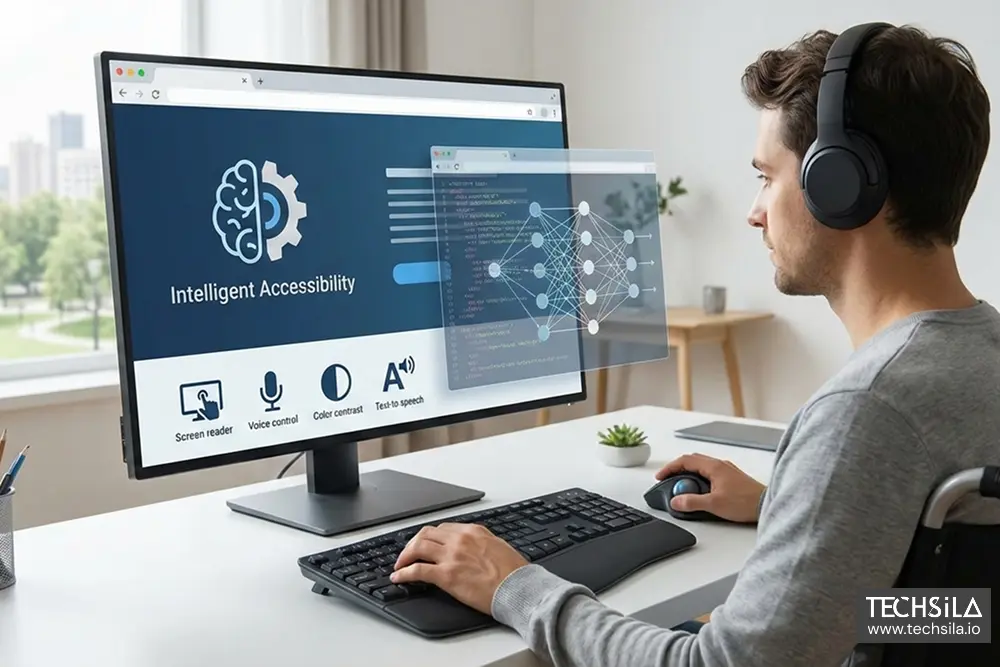
Accessibility is becoming an integral part of intelligent frontend design. AI-enhanced web development in 2026 allows interfaces to adjust based on user needs rather than forcing users to configure settings manually.
AI can detect patterns that suggest accessibility requirements and adapt accordingly. Text contrast, font sizing, interaction spacing, and input methods can adjust dynamically. Voice assistance, keyboard navigation support, and simplified interaction flows can activate when needed, creating inclusive experiences without isolating users into separate accessibility modes.
This approach makes accessibility proactive rather than reactive, helping organizations meet compliance requirements while delivering better user experiences for everyone.
Continuous Frontend Optimization Without Manual Redesigns
One of the most powerful advantages of AI-powered frontends is continuous optimization. Instead of relying on periodic redesigns or A/B tests that take weeks to evaluate, AI systems learn continuously from user behavior.
Layouts, component placements, and interaction flows can evolve gradually based on performance data. Underperforming elements are adjusted or deprioritized, while successful patterns are reinforced. This reduces the need for disruptive redesign cycles and keeps interfaces aligned with user expectations as they change over time.
For teams building complex platforms, this approach significantly reduces maintenance overhead while improving results.
Why Smarter Frontends Matter for Businesses
Smarter frontends are not just a design improvement. They are a business advantage.
AI-enhanced web development in 2026 enables organizations to deliver interfaces that feel intuitive, adaptive, and responsive without increasing development complexity. Teams can focus on building core functionality while AI handles personalization, optimization, and behavioral adaptation at scale.
This is especially valuable for businesses managing content-heavy websites, SaaS platforms, and customer-facing applications where experience quality directly impacts growth.
Faster Delivery With AI-Driven Development Pipelines
While smarter frontends shape how users experience the web, the real acceleration in AI-enhanced web development in 2026 happens behind the scenes. AI is fundamentally changing how websites are built, tested, and delivered, turning development pipelines into intelligent systems rather than manual assembly lines.
Traditional web delivery relies on human coordination at every step. Planning, coding, testing, deployment, and monitoring often happen in silos, which slows releases and increases risk. AI-driven pipelines break this pattern by introducing intelligence across the entire lifecycle, allowing teams to move faster without compromising stability or quality.
AI in Planning and Requirement Analysis
Speed starts before a single line of code is written. AI-assisted planning tools analyze historical project data, user behavior, and performance metrics to help teams scope work more accurately. Instead of relying solely on estimates and assumptions, development teams can identify potential bottlenecks early and prioritize features based on real impact.
For web projects with evolving requirements, this reduces rework and keeps delivery timelines predictable. Teams spend less time correcting course later because smarter decisions are made upfront.
Pro tip: Teams see the fastest results from AI when it is applied early in planning and testing, not just during coding. Improving decisions upstream often saves more time than automating development tasks downstream.
AI-Assisted Coding and Frontend Assembly
AI-powered development tools are now deeply embedded in everyday workflows. These tools assist developers by generating repetitive code, suggesting optimized patterns, and flagging inconsistencies as code is written. This does not replace developers. It removes friction.
For frontend teams, AI accelerates component creation, enforces design consistency, and helps align implementation with evolving UX logic. As a result, teams can iterate faster and maintain cleaner codebases even as applications grow more complex.
Struggling to scale frontend delivery without increasing risk? Techsila provides website development expertise designed to support AI-assisted workflows and complex platforms.
Intelligent Testing and Quality Assurance
Testing has traditionally been one of the biggest causes of delivery delays. Manual testing cycles and late-stage bug discovery slow releases and increase risk. AI changes this by shifting testing earlier and making it continuous.
AI-driven testing systems monitor code changes in real time, predict where failures are most likely to occur, and automatically generate test cases based on usage patterns. Performance issues, accessibility gaps, and regressions can be detected long before they reach production.
This proactive approach allows teams to release updates more frequently with greater confidence, reducing the need for large, risky deployments.
Smarter Deployment and Continuous Optimization
Deployment in AI-enhanced web development is no longer a single event. It is an ongoing, adaptive process.
AI monitors application performance after release, detects anomalies, and recommends or triggers optimizations automatically. If a deployment causes unexpected issues, intelligent rollback mechanisms can restore stability instantly. Over time, AI systems learn from each release, improving deployment decisions and reducing downtime.
This makes continuous delivery sustainable rather than exhausting. Teams can ship faster because risk is managed intelligently, not manually.
Why Faster Delivery Matters More Than Ever
In 2026, speed is not just about releasing features quickly. It is about responding to users, markets, and data in near real time. Businesses that rely on slow or rigid pipelines struggle to keep up with changing expectations.
AI-enhanced web development in 2026 enables faster delivery without sacrificing quality by aligning planning, development, testing, and deployment into a single intelligent workflow. This balance between speed and stability is what allows modern web teams to scale confidently.
Combining Smarter Frontends and Faster Delivery
The real power of AI-enhanced web development in 2026 emerges when intelligent frontends and AI-driven delivery pipelines work together as a unified system. When experience intelligence and delivery intelligence are tightly connected, web platforms stop behaving like static products and start operating like adaptive, living systems.
In traditional web projects, frontend experience and backend delivery often evolve independently. Design updates may lag behind development cycles, and performance optimizations are frequently reactive. AI removes this disconnect by allowing insights from real user behavior to flow directly into development and delivery decisions.
From User Behavior to Real-Time Optimization
AI-enhanced frontends continuously collect behavioral signals. These signals include navigation paths, interaction patterns, device constraints, performance bottlenecks, and engagement metrics. Instead of storing this data for periodic analysis, AI-driven systems use it immediately.
When a frontend detects friction points or underperforming components, AI can surface these insights directly into the development pipeline. Teams receive actionable feedback while features are still evolving, not after issues escalate. This shortens feedback loops dramatically and allows improvements to be deployed faster and with greater precision.
For example, if users consistently abandon a specific flow on mobile devices, AI can flag the issue, recommend interface adjustments, and help prioritize fixes in the next release cycle. This tight connection between experience and delivery keeps web platforms aligned with real user needs.
Continuous Alignment Between Design and Development
AI-enhanced workflows also improve collaboration between design and development teams. Instead of relying on static specifications, AI systems help translate design intent into implementation guidance that evolves over time.
As interfaces adapt dynamically, AI ensures consistency across components, layouts, and interaction patterns. When delivery pipelines push updates, frontends adjust seamlessly without breaking experience continuity. This reduces the friction that often arises during frequent releases and keeps user experience stable even as features evolve rapidly.
This alignment is especially valuable for complex platforms where frequent updates are necessary but consistency is critical.
Scaling Without Sacrificing Experience
Scalability is one of the biggest challenges for modern web platforms. As traffic grows and feature sets expand, maintaining performance and experience quality becomes increasingly difficult. AI-enhanced web development in 2026 addresses this by scaling intelligence alongside infrastructure.
Smarter frontends adapt to load conditions, device constraints, and user contexts automatically. Faster delivery pipelines ensure optimizations are deployed continuously rather than bundled into disruptive updates. Together, they allow platforms to grow without degrading usability or stability.
This approach is particularly effective for organizations building customer-facing platforms, content-heavy websites, and SaaS products where experience quality directly impacts business outcomes.
Business Impact of Unified Intelligence
When smarter frontends and faster delivery pipelines operate as a single system, businesses gain measurable advantages. Release cycles shorten, user satisfaction improves, and operational overhead decreases. Teams spend less time fixing issues after launch and more time innovating.
AI-enhanced web development in 2026 enables organizations to respond to change quickly while maintaining a high standard of quality. This balance is becoming a defining factor for successful digital platforms.
How to Implement AI-Enhanced Web Development in Practice
Moving to AI-enhanced web development in 2026 is not about replacing existing workflows overnight. It is about layering intelligence into the right parts of your web strategy so that design, development, and delivery evolve together. Successful implementation depends on clarity, discipline, and a strong foundation.
Start With Clear Goals and Use Cases
Before introducing AI into web development, teams need to define what they want to improve. Faster releases, better frontend personalization, improved performance, or reduced maintenance effort all require different applications of AI.
Clear goals help determine where AI delivers the most value. For some organizations, intelligent frontend personalization may be the priority. For others, AI-driven testing and deployment may solve the biggest bottlenecks. Starting with focused use cases prevents unnecessary complexity and ensures measurable results.
Build on a Strong Web Architecture
AI amplifies both strengths and weaknesses. If the underlying web architecture is fragile or inconsistent, adding AI will magnify those issues rather than solve them. Modular frontend components, clean APIs, and scalable backend services are essential prerequisites.
This is why organizations often align AI initiatives with modern website development practices that emphasize performance, scalability, and maintainability. A solid foundation allows AI systems to integrate smoothly and operate effectively at scale.
Introduce AI Incrementally Into the Workflow
AI-enhanced web development works best when introduced gradually. Teams can begin by integrating AI-assisted coding tools, intelligent testing systems, or performance monitoring solutions. These early wins build confidence and familiarity while delivering immediate efficiency gains.
As teams mature, AI can expand into more advanced areas such as frontend personalization, predictive performance optimization, and automated deployment decisions. This phased approach reduces risk and ensures adoption feels natural rather than disruptive.
Use Data as a Strategic Asset
AI systems rely on data to learn and improve. User behavior analytics, performance metrics, error logs, and historical release data all contribute to smarter decisions. Organizations that treat data as a strategic asset gain more value from AI-enhanced web development.
This also requires responsible data practices. Privacy, security, and transparency must be built into AI workflows from the start. Trust is essential when AI systems influence user experience and delivery decisions.
Invest in Cross-Functional Collaboration
AI-enhanced web development blurs traditional boundaries between design, development, and operations. Designers influence how AI adapts interfaces. Developers guide how AI integrates with code and infrastructure. Operations teams oversee performance and reliability.
Successful teams treat AI as a shared capability rather than a siloed tool. Collaboration ensures that intelligence serves real user needs while aligning with technical and business goals. Organizations with strong cross-functional expertise, such as those delivering end-to-end digital solutions through platforms like Techsila, are better positioned to implement AI effectively.
Measure, Learn, and Refine Continuously
Implementation does not end at launch. AI-enhanced systems improve through continuous feedback. Teams should monitor how AI-driven changes affect user behavior, performance, and delivery outcomes. Insights from real usage help refine models, adjust workflows, and improve results over time.
This continuous learning loop is what turns AI-enhanced web development from a short-term experiment into a long-term advantage.
Challenges and Considerations in AI-Enhanced Web Development
While AI-enhanced web development in 2026 offers clear advantages, it also introduces new challenges that organizations must address carefully. Adopting AI without thoughtful planning can create complexity, risk, and unintended consequences. Understanding these challenges early helps teams build intelligent systems that are sustainable, secure, and trusted.
Managing Complexity Without Losing Control
AI introduces additional layers of logic into web systems. Frontends adapt dynamically, pipelines automate decisions, and models evolve over time. Without clear governance, this complexity can become difficult to manage.
Teams must maintain visibility into how AI-driven decisions are made and ensure there are safeguards in place. Human oversight remains critical, especially when AI influences user experience or deployment behavior. Clear documentation, version control, and monitoring help prevent systems from becoming opaque or unpredictable.
Avoiding Over-Automation
Automation is powerful, but too much automation without context can lead to poor outcomes. AI should assist decision-making, not override it blindly. Automatically generated code, interface adjustments, or deployment actions still require validation.
In AI-enhanced web development in 2026, successful teams strike a balance. They allow AI to handle patterns and repetition while keeping humans responsible for strategy, quality, and creative direction. This balance preserves flexibility and ensures long-term maintainability.
Data Quality and Bias Risks
AI systems are only as effective as the data they learn from. Inconsistent data, incomplete analytics, or biased datasets can lead to inaccurate predictions and uneven user experiences. For example, personalization models trained on limited user segments may unintentionally exclude or misrepresent others.
Organizations must invest in clean data practices and continuously audit AI outputs. This includes monitoring how AI-driven interfaces behave across different users, devices, and contexts to ensure fairness and consistency.
Privacy, Security, and Compliance
AI-enhanced web development often relies on user behavior data, performance telemetry, and real-time analytics. This raises important privacy and security considerations. Users expect transparency around data usage, and regulations increasingly demand it.
Teams must ensure compliance with data protection standards and adopt secure data handling practices. AI models should be designed with privacy in mind, limiting data exposure and protecting sensitive information. Trust is essential when intelligence shapes digital experiences.
Skill Gaps and Team Readiness
AI-enhanced workflows require new skills and ways of thinking. Designers need to understand how adaptive interfaces behave. Developers must learn how to work alongside intelligent tools. Operations teams need visibility into AI-driven systems.
Without proper training, teams may struggle to trust or effectively use AI. Investing in education and cross-functional alignment ensures that AI becomes an enabler rather than a source of friction.
Long-Term Maintainability
AI models evolve, but web platforms must remain stable. Teams need strategies for updating, retraining, and retiring AI components without disrupting core functionality. This includes planning for fallback behaviors when AI systems fail or behave unexpectedly.
Addressing these challenges does not diminish the value of AI-enhanced web development. Instead, it ensures that intelligence is applied responsibly and sustainably.
Future Outlook: AI-Enhanced Web Development Beyond 2026
By 2026, AI-enhanced web development is no longer an emerging advantage. It is becoming the baseline expectation for modern digital products. What differentiates leading platforms is not whether they use AI, but how deeply intelligence is embedded into experience design, delivery workflows, and long-term optimization strategies.
Looking ahead, several shifts are shaping what comes next.
From Reactive Interfaces to Predictive Experiences
The next evolution of AI-enhanced web development moves beyond adaptation toward anticipation. Frontends will increasingly predict user intent before actions are taken. Interfaces will surface relevant options, data, or workflows proactively, reducing cognitive load and decision friction.
Instead of waiting for users to search, scroll, or click, AI-driven interfaces will guide interactions intelligently. This shift transforms websites from tools users operate into systems that actively assist them.
Autonomous Optimization as a Standard Practice
Today, optimization is often manual and periodic. In the near future, optimization becomes continuous and autonomous. AI systems will monitor performance, accessibility, engagement, and conversion signals in real time and make incremental improvements without human intervention.
Layouts, content density, loading behavior, and interaction timing will adjust automatically based on live data. Human teams will focus less on maintenance and more on strategic direction, experimentation, and innovation.
Deeper Integration Between UX, Data, and Delivery
AI-enhanced web development beyond 2026 will further dissolve boundaries between design, development, and analytics. UX decisions will increasingly be informed by real-time data rather than assumptions. Delivery pipelines will respond directly to experience signals rather than fixed release schedules.
This convergence allows teams to validate ideas faster, refine experiences continuously, and align technical decisions more closely with business outcomes. Research from organizations like the Nielsen Norman Group consistently highlights how adaptive, data-informed UX improves usability and long-term engagement, reinforcing the direction web platforms are moving toward.
Human Creativity Remains Central
Despite growing automation, the future of web development is not about removing humans from the process. AI excels at pattern recognition, prediction, and scale. Humans excel at empathy, strategy, and creativity.
The most successful teams will use AI to remove friction and amplify human strengths rather than replace them. Designers will shape intent and vision. Developers will architect resilient systems. AI will support both by handling complexity that would otherwise slow progress.
A Competitive Divide Becomes Clearer
As AI-enhanced web development matures, the gap between platforms that adopt it thoughtfully and those that rely on traditional methods will widen. Faster iteration, smarter interfaces, and more reliable delivery will become visible differentiators.
Organizations that treat AI as a long-term capability rather than a short-term experiment will be better positioned to scale, adapt, and lead in increasingly competitive digital environments.
Pro tip: Start with real user or delivery friction, not tools. Apply AI to one clear problem first, measure the impact, and expand only where it genuinely simplifies the experience.
Conclusion: Building the Next Generation of the Web
Web development in 2026 is defined by intelligence, adaptability, and speed. Static interfaces and slow delivery cycles are no longer enough to meet rising user expectations and competitive pressure. AI-enhanced web development in 2026 offers a new path forward, one where frontends respond intelligently to users and delivery pipelines evolve continuously without sacrificing quality.
Smarter frontends allow websites and applications to personalize experiences, improve accessibility, and optimize performance in real time. Faster delivery pipelines ensure teams can release updates confidently, respond to feedback quickly, and scale without accumulating technical debt. When these capabilities work together, web platforms become more resilient, more efficient, and more aligned with real user needs.
The shift toward AI-enhanced web development is not about automation for its own sake. It is about enabling better decisions, stronger experiences, and sustainable growth. Organizations that adopt this approach thoughtfully will be better equipped to navigate complexity, adapt to change, and deliver meaningful digital experiences at scale.
As the web continues to evolve beyond 2026, intelligence will no longer be optional. It will be the foundation on which modern web experiences are built.
Ready to Build Smarter, Faster Web Experiences?
AI-enhanced web development in 2026 represents a fundamental shift in how digital platforms are designed, built, and evolved. The web is no longer static or reactive. It is becoming intelligent by design, capable of adapting to user behavior, optimizing performance continuously, and supporting faster delivery without sacrificing stability. Smarter frontends and AI-driven pipelines are not just improving efficiency, they are redefining what users expect from modern web experiences.
As digital products grow more complex and competitive pressure increases, the cost of building on rigid, short-term foundations becomes clearer. Platforms that lack intelligence at their core often require constant redesigns and rework just to remain usable. In contrast, AI-ready architectures are built to learn, adjust, and improve over time, making them far more resilient to change.
The most important takeaway is not that every platform needs the same level of AI, but that every team benefits from understanding what an AI-enhanced approach means for their specific goals, timelines, and constraints. Clarity at this stage influences architecture decisions, delivery speed, and long-term scalability.
If you are evaluating the future of your web platform and want a clear, realistic view of what an AI-enhanced build would look like for your project, the next step is to get a tailored estimate.
FAQs: AI-Enhanced Web Development in 2026
1. How is AI changing web development in 2026?
AI is transforming web development in 2026 by making websites adaptive and data-driven. Frontends personalize experiences in real time, while AI-powered pipelines speed up development, testing, and deployment.
2. What are AI-powered frontends?
AI-powered frontends dynamically adjust layouts, navigation, and interactions based on user behavior, device type, and context, creating more intuitive and responsive web experiences.
3. Can AI speed up web development without hurting quality?
Yes. AI accelerates development by assisting with coding, predicting bugs earlier, automating testing, and improving deployment decisions, all while maintaining code quality.
4. How is AI-enhanced web development different from traditional approaches?
Traditional web development relies on static designs and manual workflows. AI-enhanced web development introduces continuous optimization, smarter interfaces, and faster delivery cycles driven by real data.
5. Is AI-enhanced web development suitable for small businesses?
Yes. Modern AI tools are accessible and scalable, allowing small teams to build and iterate faster without significantly increasing development resources.
