

Artificial Intelligence is no longer a futuristic concept; it’s actively transforming industries across the United States. From enhancing customer service with AI-powered chatbots to automating workflows and predicting business outcomes with predictive analytics, AI is redefining how organizations operate. However, understanding AI development costs in the U.S. is crucial before committing to an AI project. Costs vary widely: simple chatbots may cost a few thousand dollars, while enterprise-grade predictive analytics platforms can exceed $100,000. Strategic planning ensures maximum ROI while minimizing unexpected expenses.
This guide provides a detailed breakdown of AI development costs across three major categories: chatbots, automation, and predictive analytics, so that businesses can make informed investment decisions.
You’ll learn:
-
Key drivers of AI development cost across different AI models
-
Strategies to optimize spending without sacrificing quality
-
How to maximize ROI with the right AI development approach
-
Ways a trusted AI partner can reduce overall development cost
Factors Affecting AI Development Costs
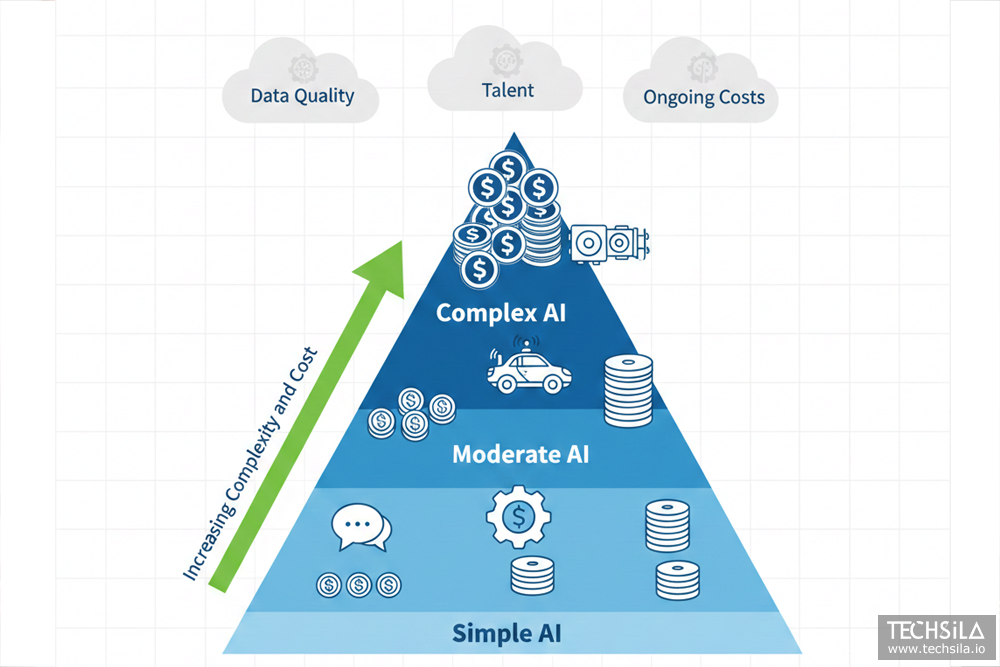
Understanding the main drivers of AI development costs in the U.S. is critical for effective budgeting. AI solutions are never one-size-fits-all, and several factors directly influence total investment:
1. Project Complexity
The complexity of your AI project is a major determinant of AI development cost.
-
Simple AI: Rule-based chatbots, straightforward workflows, minimal data dependency. Cost-effective and fast to deploy.
-
Moderate AI: Incorporates machine learning, basic automation, and analytics dashboards.
-
Complex AI: Multi-layered predictive analytics, NLP chatbots, voice-enabled assistants, or full enterprise automation.
Example: A retail startup built a simple AI chatbot for FAQs at ~$8,000, while a global e-commerce company invested over $120,000 in an AI-powered voice assistant integrated with CRM and inventory systems.
Start with a Minimum Viable Product (MVP) to validate your AI approach. For insights on managing project complexity and costs, check Forbes Technology Council.
2. Data Requirements
Data is the fuel for AI, but also a significant contributor to cost. Consider:
-
Volume: Larger datasets require more storage, cloud computing, and preprocessing.
-
Quality: Cleaning, labeling, and formatting data is labor-intensive but essential for accuracy.
-
Accessibility: Proprietary or siloed data may require additional integration efforts.
Investing in structured and clean data upfront reduces long-term costs and improves model accuracy. Learn more about the importance of data quality in AI projects from Harvard Business Review.
3. Integration Needs
Integrating AI with existing systems like ERP, CRM, cloud platforms, or IoT devices directly impacts AI development cost:
-
Low Integration: Standalone applications with minimal dependencies.
-
Moderate Integration: AI connects to one or two existing systems.
-
High Integration: Multi-system AI with real-time data flows and enterprise-grade reliability.
Example: A logistics company integrated AI-driven predictive maintenance into its IoT infrastructure, with the integration alone accounting for 35% of total costs. For best practices in AI integration, refer to Gartner.
Ensure seamless AI integration with Techsila’s AI Solutions that fit effortlessly into your existing systems.
4. Technology Stack
The choice of tools and frameworks also affects AI development cost:
-
Open-Source AI Frameworks: TensorFlow, PyTorch, or spaCy reduce licensing costs but require skilled developers.
-
Proprietary Platforms: Faster deployment but higher fees.
-
Cloud AI Services: AWS SageMaker, Google Cloud AI, and Azure AI offer pay-as-you-go pricing but can accumulate costs with heavy usage.
-
On-Premise Solutions: Higher upfront cost but better long-term control for large-scale deployments.
For a detailed comparison of cloud AI platforms and pricing, see TechCrunch’s Cloud AI Analysis.
Optimize your budget and speed with Techsila’s Custom AI Development, leveraging the latest AI frameworks.
5. Team Expertise
AI development is talent-intensive, particularly in the U.S.:
-
Hiring in-house AI engineers, data scientists, and NLP specialists is expensive.
-
Outsourcing to experienced AI firms can save costs while maintaining quality.
Summary of Key Cost Factors
| Cost Factor | Impact on Budget | Tips to Optimize |
|---|---|---|
| Project Complexity | High | Start with MVP |
| Data Requirements | High | Invest in clean, structured data |
| Integration Needs | Medium-High | Plan APIs and workflows upfront |
| Technology Stack | Medium | Use cloud or hybrid solutions |
| Team Expertise | Medium-High | Outsource strategically |
Chatbot Development Costs in the U.S.
Chatbot Development Costs in the U.S.AI-powered chatbots are among the most widely adopted AI solutions in the U.S., helping businesses streamline customer support, increase engagement, and reduce operational costs. However, understanding the AI development cost for chatbots is essential to plan budgets effectively. The cost of chatbot development varies depending on complexity, features, and technology choices. Below is a detailed breakdown:
Types of Chatbots and Associated Costs
| Chatbot Type | Complexity Level | Features Included | Estimated U.S. Cost |
|---|---|---|---|
| Rule-Based | Low | Basic FAQs, menu-driven flows | $5,000 – $15,000 |
| AI/NLP Chatbot | Medium-High | Natural language understanding, context handling, and small-scale integrations | $25,000 – $100,000+ |
| Voice-Enabled | High | Speech recognition, multi-language support, CRM integration | $50,000 – $120,000+ |
Start with a rule-based or simple NLP chatbot to validate your idea before investing in complex voice-enabled systems.
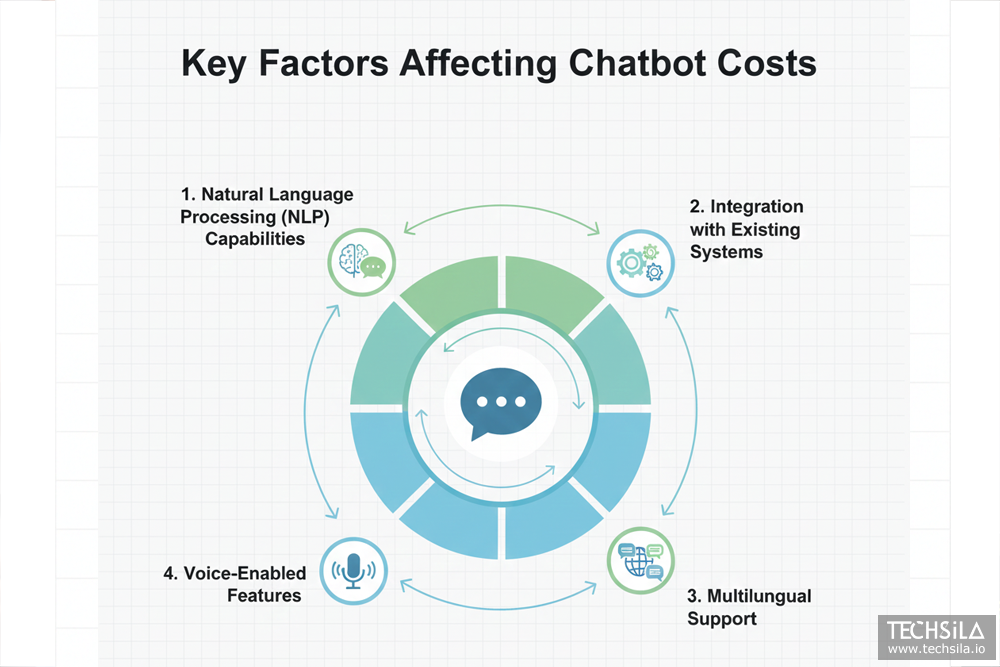
Key Factors Affecting Chatbot Costs
- Natural Language Processing (NLP) Capabilities
Advanced NLP allows chatbots to understand context, sentiment, and even slang, making interactions feel human-like. Sophisticated NLP models significantly increase AI development cost. - Integration with Existing Systems
Connecting the chatbot to CRM, e-commerce platforms, or helpdesk systems requires custom development and testing, adding to overall costs. - Multilingual Support
Chatbots serving global audiences must handle multiple languages, which increases both development and ongoing training costs. - Voice-Enabled Features
Adding speech recognition and voice response functionality significantly increases complexity and cost.
 Transform your customer support instantly explore Techsila’s Conversational AI & NLP Chatbot Solutions and see how we can build a chatbot tailored for your business.
Real-World Example: Cost vs. ROI
Case Study: Retail Chain Chatbot
- Problem: High call volume and delayed response times.
- Solution: Implemented an AI-powered NLP chatbot for FAQs and order tracking.
- Investment: ~$45,000
- Results:
- Automated 60% of support queries
- Reduced operational costs by ~$120,000 annually
- Increased customer satisfaction by 25%”
Tips to Optimize Chatbot Development Costs
- Define Clear Goals: Identify exactly what tasks the chatbot should handle to avoid unnecessary features.
- Start Small: Begin with a minimum viable chatbot and scale features over time.
- Leverage Prebuilt AI Frameworks: Open-source NLP libraries can reduce development costs.
- Plan for Training & Maintenance: AI chatbots require ongoing training to stay accurate budget for long-term support.
Why U.S. Chatbot Development Costs Are Higher
- Talent Costs: AI engineers and NLP specialists are expensive in the U.S.
- Infrastructure Costs: Hosting AI chatbots on cloud platforms or maintaining enterprise servers adds to expenses.
- Compliance Requirements: Data privacy laws like CCPA or HIPAA may require additional development and security measures.
Cut costs without compromising quality. Partner with Techsila’s AI experts to build scalable, compliant, and high-performing chatbots.
Automation AI Development Costs
Automation AI is transforming the way businesses operate in the U.S., reducing manual labor, increasing operational efficiency, and improving decision-making. From Robotic Process Automation (RPA) to intelligent workflow optimization and predictive maintenance, automation AI can save companies both time and money. However, understanding the cost of implementing AI automation is essential for proper budgeting and ROI planning.
Types of AI Automation Solutions
| Automation Type | Complexity Level | Features Included | Estimated U.S. Cost |
|---|---|---|---|
| Basic RPA | Low | Automates repetitive, rule-based tasks | $20,000 – $50,000 |
| Workflow Automation | Medium | Decision-making automation, reporting, and dashboards | $50,000 – $150,000 |
| Predictive Maintenance | High | Sensor-driven predictive analytics, machine learning | $100,000 – $500,000+ |
Start with high-impact repetitive tasks first to achieve quick ROI before scaling to complex predictive automation.
Key Factors Affecting Automation Costs
- Task Complexity
- Simple repetitive tasks are cheaper to automate.
- Complex workflows or integration with multiple systems increase development costs.
- Data Availability and Quality
- High-quality data is critical for predictive maintenance and intelligent automation.
- Cleaning and labeling data adds to the upfront cost but improves accuracy.
- Integration with Existing Systems
- Connecting AI automation to ERPs, CRMs, or IoT devices requires custom development.
- Technology and Infrastructure
- Cloud-based AI reduces upfront infrastructure costs.
- On-premise deployments may increase costs but offer long-term control.
Unlock operational efficiency with AI automation. Discover Techsila’s Custom AI & ML Solutions that integrate seamlessly into your workflows.
Real-World Example: AI Automation in Action
Case Study: Logistics Company
- Problem: Inefficient inventory tracking and manual shipment processing.
- Solution: Implemented AI-driven automation for inventory management and real-time shipment tracking.
- Investment: ~$180,000
- Results:
- 35% faster operations
- $250,000 annual cost savings
- Improved operational accuracy and reduced human error
Tips to Optimize Automation AI Costs
- Prioritize High-Impact Processes: Focus on tasks that consume the most time and resources.
- Leverage Prebuilt Automation Tools: RPA platforms and AI libraries reduce development costs.
- Phased Implementation: Roll out automation in stages to control cost and minimize disruption.
- Combine Human Oversight: A hybrid model ensures accuracy while limiting expenses.
- Expertise Costs: Hiring AI engineers and RPA specialists is expensive.
- Regulatory Compliance: Industries like healthcare and finance require additional security measures.
- Infrastructure & Cloud Usage: AI automation often relies on cloud services with variable usage costs.
Predictive Analytics Costs and ROI
Predictive analytics uses historical data and AI models to forecast future outcomes, helping businesses make informed decisions, reduce risk, and optimize resources. In the U.S., predictive analytics is widely used in finance, healthcare, retail, and logistics. While the benefits are clear, the development costs can be high, depending on model complexity, data requirements, and integration needs.
Types of Predictive Analytics Solutions
| Solution Type | Complexity Level | Features Included | Estimated U.S. Cost |
|---|---|---|---|
| Basic Predictive Models | Low | Regression, forecasting for small datasets | $30,000 – $70,000 |
| Intermediate Predictive Systems | Medium | Machine learning models, moderate data integration | $70,000 – $150,000 |
| Advanced Predictive Analytics | High | Deep learning, real-time data processing, enterprise integration | $150,000 – $500,000+ |
Begin with smaller predictive models to validate your approach and ensure ROI before scaling to enterprise-level analytics.
Key Factors Affecting Predictive Analytics Costs
- Data Volume and Quality
- Larger datasets require more storage, preprocessing, and computing power.
- Data cleaning, labeling, and normalization are crucial for accurate predictions.
- Algorithm Complexity
- Simple regression models are cost-effective.
- Complex AI models like deep learning, neural networks, or ensemble methods increase both time and cost.
- Integration Needs
- Predictive analytics often needs to connect to ERP, CRM, or other operational systems.
- Real-time analytics requires robust infrastructure and custom development.
- Cloud vs On-Premise Deployment
- Cloud AI solutions (AWS, Azure, Google Cloud) reduce upfront costs but may incur ongoing usage fees.
- On-premise deployments require higher upfront costs but offer long-term control and data security.
Unlock actionable insights with predictive analytics. Discover how Techsila, helps businesses transform raw data into actionable insights with Predictive Analytics & Forecasting.
Real-World Example: Predictive Analytics in Action
Case Study: Healthcare Provider
- Problem: High patient no-show rates are causing revenue loss and operational inefficiency.
- Solution: Implemented a predictive analytics engine to forecast patient attendance.
- Investment: ~$120,000
- Results:
- Reduced missed appointments by 25%
- Saved ~$150,000 annually
- Improved resource allocation and patient satisfaction
Case Study: Retail Inventory Optimization
- Problem: Overstocking and understocking led to lost sales and wasted storage costs.
- Solution: Predictive models forecast inventory needs based on historical sales, seasonal trends, and customer behavior.
- Investment: ~$200,000
- Results:
- 20% reduction in overstock
- 15% increase in inventory turnover
- ROI achieved within 12 months
Tips to Optimize Predictive Analytics Costs
- Focus on High-Impact Use Cases: Target areas where predictions drive measurable revenue or cost savings.
- Start Small and Scale: Validate your predictive models on a limited dataset before enterprise deployment.
- Leverage Prebuilt Models and Cloud Tools: Using frameworks like TensorFlow, PyTorch, or Azure ML can reduce development time and cost.
- Prioritize Data Quality: Accurate predictions depend on clean, structured, and relevant data.
Why Predictive Analytics Can Be Expensive in the U.S.
- Expert Talent Costs: Hiring data scientists, AI engineers, and ML specialists is costly.
- Data Infrastructure Requirements: Cloud computing, storage, and processing for large datasets can be significant.
- Integration & Compliance: Compliance Requirements: Laws like CCPA and HIPAA may require additional security measures.
Maximize your data’s potential with predictive analytics partner with Techsila’s AI experts to implement tailored solutions that deliver measurable ROI.
Ways to Optimize AI Development Costs
AI development in the U.S. can be a significant investment, but with the right strategy, businesses can maximize ROI while controlling expenses. By understanding where costs arise and implementing smart approaches, companies can deploy AI effectively without overspending.
1. Start Small with an MVP
Why it helps:
Building a Minimum Viable Product (MVP) allows businesses to validate AI concepts before committing to full-scale deployment. It helps identify potential issues early, saves money on unnecessary features, and provides actionable insights for scaling.
Example:
- A retail startup built a simple AI chatbot MVP for FAQs. After six months, the company validated high customer engagement before investing in a full NLP chatbot integrated with CRM and voice capabilities.
2. Leverage Prebuilt AI Frameworks
Why it helps:
Open-source AI frameworks like TensorFlow, PyTorch, and spaCy reduce development time and costs. Prebuilt models can handle NLP, computer vision, or predictive analytics tasks without starting from scratch.
Example:
- A logistics company reduced its predictive maintenance development time by 40% by using prebuilt machine learning models for sensor data analysis.
3. Adopt a Phased Implementation
Why it helps:
Rolling out AI in phases allows you to manage costs, test performance, and optimize models iteratively. Start with critical workflows or processes that offer the highest ROI.
Example:
- A healthcare provider implemented AI for predicting patient no-shows first, then expanded to resource allocation optimization after proving ROI.
4. Combine Human Oversight with AI
Why it helps:
A hybrid model reduces errors and ensures that AI decisions are accurate, especially in sensitive domains like healthcare, finance, or customer service. It also reduces the need for overly complex AI models initially, cutting costs.
Example:
- A financial firm used AI to flag potential fraudulent transactions but kept final approval with human analysts. This hybrid approach reduced false positives and development complexity.
5. Outsource Strategically
Why it helps:
Hiring in-house AI teams in the U.S. can be very expensive. Partnering with experienced AI development firms provides access to specialized talent and expertise without the overhead costs of full-time employees.
Example:
- A mid-sized e-commerce company outsourced AI chatbot development to an expert firm, achieving enterprise-level capabilities at 60% of the in-house development cost.
Reduce overhead without compromising quality. Partner with Techsila’s AI experts for tailored, cost-efficient solutions.
6. Optimize Data Management
Why it helps:
Data preparation often accounts for 60–70% of AI project costs. Investing in clean, structured, and well-labeled datasets upfront reduces model errors and the need for extensive retraining.
Example:
- A retail company cleaned and structured its sales and inventory data before implementing predictive analytics. The model achieved 95% accuracy on the first iteration, reducing ongoing development costs.
Choosing the Right AI Development Partner
Selecting the right AI development partner is crucial for controlling costs, ensuring quality, and accelerating ROI. With AI projects, the wrong partner can lead to budget overruns, delayed timelines, and suboptimal performance. Here’s what to consider when choosing a partner in the U.S. market.
1. Look for Proven Expertise
Why it matters:
AI development is highly specialized. A partner with proven experience in chatbots, automation, and predictive analytics is more likely to deliver solutions that work.
Example:
- A retail company partnered with a specialized AI firm to build an NLP chatbot. The project was completed 30% faster than initial estimates, with higher user satisfaction.
2. Check Engagement Models
Why it matters:
Flexible engagement models like fixed-cost, milestone-based, or time & material allow businesses to control spending and align payment with deliverables.
Example:
- A healthcare provider used a milestone-based model for predictive analytics development, paying for each validated module rather than upfront. This approach reduced financial risk.
3. End-to-End SupportWhy it matters:
AI isn’t a one-time project it requires maintenance, updates, and optimization. A partner offering end-to-end support ensures your AI solutions remain effective and ROI-driven.
Example:
- A logistics company partnered with Techsila for full lifecycle AI automation support, resulting in continuous improvements and reduced downtime.
4. Transparency in Costs and Deliverables
Why it matters:
Hidden costs can derail budgets. Choose a partner who provides clear cost estimates, scope, and ROI projections upfront.
Example:
- A finance firm avoided overspending by partnering with a transparent AI development company that provided a detailed breakdown of predictive analytics costs.
5. Validate References and Case Studies
Why it matters:
Check the partner’s track record through client testimonials, case studies, or sample projects. This helps ensure the partner can deliver industry-specific AI solutions.
Example:
- A retail chain reviewed Techsila’s case studies in chatbot and automation projects, confirming their ability to handle large-scale deployments before signing a contract.
Summary
Choosing the right AI development partner ensures your investment delivers maximum ROI. Look for experience, flexibility, transparency, and proven results. By partnering strategically, businesses can reduce costs, accelerate deployment, and achieve measurable outcomes.
Conclusion
Unlock the full potential of AI for your business today. Partner with Techsila’s Custom AI & ML Experts to build chatbots, automation, and predictive analytics solutions tailored to your needs. Request your personalized quote now and start achieving measurable ROI with AI!”This conclusion section reinforces the value of AI, summarizes the key points from all sections, and ends with a strong, action-oriented CTA to guide readers toward Techsila services.
