

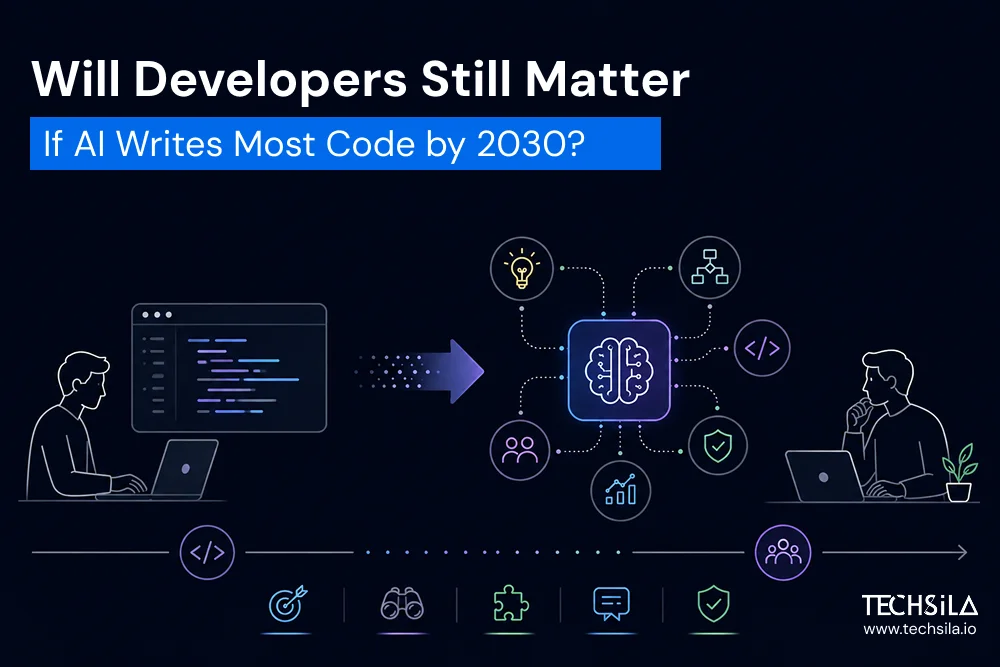
The AI Coding Revolution is no longer a future prediction. It is happening right now.
Just a few years ago, artificial intelligence tools could only generate small snippets of code. Today, AI-powered coding assistants can write functions, debug applications, generate documentation, create test cases, and even help design software architectures.
This rapid evolution has sparked a major question across the technology industry: Are developers at risk?
The answer is more complex than many headlines suggest.
While the AI Coding Revolution is changing how software is built, it is not necessarily eliminating the need for developers. Instead, it is transforming what software development looks like and redefining the skills that modern engineers need to succeed.
Businesses, startups, and enterprise organizations are already exploring how AI can accelerate development cycles, reduce costs, and improve productivity. Companies investing in modern digital solutions through providers like Techsila are increasingly evaluating how AI-powered development can create competitive advantages while maintaining quality and innovation.
Learn more about digital transformation and emerging technology solutions at Techsila.
What Is the AI Coding Revolution?
The AI Coding Revolution refers to the growing use of artificial intelligence to assist, automate, and optimize software development activities.
Modern AI tools can:
- Generate code from natural language prompts
- Suggest improvements to existing code
- Identify bugs and security vulnerabilities
- Create automated tests
- Produce technical documentation
- Assist with code reviews
This shift is changing how development teams operate.
According to research from GitHub, developers using AI-assisted coding tools often complete tasks faster while maintaining productivity across various development workflows.
The AI Coding Revolution is moving software development from purely manual coding toward collaborative human-AI engineering.
Why the AI Coding Revolution Is Accelerating
Several factors are driving the rapid adoption of AI development tools.
1. Increasing Software Demand
Organizations across every industry need more software than ever before.
From mobile applications and SaaS platforms to enterprise systems and AI products, demand continues to outpace available engineering talent.
The AI Coding Revolution helps organizations scale development efforts without proportionally increasing team size.
2. Better AI Models
Modern large language models have become significantly more capable at understanding programming languages, software architecture patterns, and development best practices.
Research from McKinsey & Company suggests that generative AI could create substantial productivity gains across software engineering functions.
3. Faster Product Development
Speed has become a competitive advantage.
Businesses that can release features faster often capture market opportunities before competitors.
The AI Coding Revolution enables development teams to accelerate delivery while reducing repetitive manual work.
Are Developers Really at Risk?
This is where the conversation becomes interesting.
The AI Coding Revolution is unlikely to eliminate developers.
However, it will likely reduce demand for certain repetitive development tasks.
Developers who spend most of their time writing boilerplate code, fixing simple bugs, or performing repetitive maintenance may find AI handling an increasing portion of that work.
At the same time, demand for highly skilled engineers may increase.
Organizations still need professionals who can:
- Design scalable architectures
- Understand business requirements
- Ensure software security
- Validate AI-generated code
- Manage system integrations
- Lead technical strategy
The AI Coding Revolution is changing developer responsibilities rather than eliminating them.
How Software Development Roles Are Evolving
The future developer may look very different from the developer of today.
Instead of spending hours writing routine code, engineers will increasingly focus on:
AI Supervision
Developers will validate AI-generated outputs, identify errors, and ensure code quality before deployment. As the AI Coding Revolution advances, human oversight will remain critical for accuracy and reliability.
System Design
While AI can generate code, complex architecture and scalability decisions still require human expertise. Developers will spend more time designing systems rather than building every component from scratch.
Security Management
AI-generated code must be reviewed for vulnerabilities, compliance issues, and security risks. Strong security practices will become even more important as AI adoption grows.
Business Problem Solving
Understanding customer needs and translating them into effective software solutions remains a uniquely human skill. Developers who can connect technology to business outcomes will continue to be highly valuable.
Organizations adopting modern AI-powered development strategies are already exploring these new workflows through intelligent software development solutions that combine AI capabilities with modern engineering practices.
Challenges of the AI Coding Revolution
Despite its benefits, the AI Coding Revolution introduces several concerns.
Code Quality Risks
AI-generated code can appear correct while containing hidden bugs, inefficient logic, or maintainability issues. Human review is still essential to ensure production-ready quality.
Security Vulnerabilities
Poorly reviewed AI outputs can introduce security risks, insecure dependencies, and compliance concerns. Organizations must maintain strong testing and review processes.
Technical Debt
Overreliance on automated code generation can create long-term maintenance challenges. Teams should balance development speed with code quality and sustainability.
Skill Erosion
Developers who rely excessively on AI may weaken fundamental programming skills over time.
Research published by MIT Technology Review highlights the importance of balancing AI assistance with human expertise and oversight.
How AI Coding Tools Are Changing the Software Development Lifecycle
The AI Coding Revolution is impacting far more than just code generation. Modern AI tools are beginning to influence nearly every stage of the software development lifecycle, helping teams move faster while reducing repetitive work.
Requirements and Planning
Traditionally, developers and business analysts spend significant time translating business requirements into technical specifications. Today, AI tools can help summarize requirements, generate user stories, identify potential gaps, and even suggest implementation approaches.
As the AI Coding Revolution advances, teams are finding that project planning can become more efficient and data-driven.
Development and Coding
This is the area where the AI Coding Revolution is most visible.
Developers can now generate boilerplate code, create APIs, build UI components, write database queries, and receive real-time coding suggestions. Instead of starting from a blank page, engineers can focus on refining and validating AI-generated outputs.
This allows teams to spend less time on repetitive tasks and more time solving complex business problems.
Testing and Quality Assurance
Testing has traditionally been one of the most time-consuming stages of software development.
AI-powered tools can automatically generate test cases, identify edge scenarios, suggest bug fixes, and analyze code quality. The AI Coding Revolution is helping QA teams increase coverage while reducing manual effort.
However, human oversight remains critical to ensure accuracy and reliability.
Deployment and DevOps
The AI Coding Revolution is also influencing deployment workflows.
AI systems can help identify infrastructure issues, optimize deployment pipelines, predict potential failures, and recommend performance improvements before software reaches production.
This creates a more proactive approach to software delivery.
Maintenance and Optimization
Software development does not end after deployment.
AI tools can continuously monitor applications, identify anomalies, detect security vulnerabilities, and recommend improvements. As the AI Coding Revolution continues to evolve, maintenance is becoming increasingly automated and intelligent.
Ultimately, the AI Coding Revolution is transforming software development from a largely manual process into a collaborative partnership between developers and intelligent systems.
AI Coding Revolution vs Traditional Software Development
While the AI Coding Revolution is creating exciting opportunities across the technology industry, it does not completely replace traditional software development. Instead, it enhances many existing processes while introducing new ways of building, testing, and maintaining software.
For decades, software development relied almost entirely on human expertise. Developers manually wrote code, created documentation, performed testing, and resolved bugs. Although this approach provided complete control over the development process, it often required significant time and resources.
The AI Coding Revolution is changing this model by introducing intelligent tools that can assist developers throughout the software development lifecycle. From generating code snippets to automating documentation and identifying bugs, AI is helping teams work more efficiently than ever before.
| Traditional Software Development | AI-Powered Software Development |
|---|---|
| Manual code creation | AI-assisted code generation |
| Slower development cycles | Faster iterations and prototyping |
| Manual documentation | Automated documentation support |
| Human-generated test cases | AI-generated testing assistance |
| Heavy reliance on individual expertise | Knowledge amplified through AI tools |
| Longer debugging cycles | Faster issue identification |
| More repetitive tasks | Increased automation of routine work |
| Greater development effort for simple features | Faster delivery of common functionality |
One of the biggest strengths of traditional software development is precision and control. Developers understand every line of code they write and can make decisions based on technical requirements, business goals, and long-term scalability.
However, traditional development can also be time-consuming. Teams often spend countless hours handling repetitive tasks such as writing boilerplate code, generating documentation, and performing routine debugging.
This is where the AI Coding Revolution delivers significant value.
Modern AI coding tools can accelerate development by reducing repetitive work and helping developers focus on higher-value activities. Instead of spending hours building basic components from scratch, engineers can use AI-generated suggestions as a starting point and dedicate more time to architecture, innovation, and problem-solving.
That said, the AI Coding Revolution is not without limitations.
AI-generated code can occasionally contain inefficiencies, security vulnerabilities, or logic errors that require human review. While AI can assist with coding, it does not fully understand business context, customer needs, or long-term product strategy the way experienced developers do.
As a result, the future is unlikely to be a choice between traditional development and AI-powered development. The most successful organizations will combine the strengths of both approaches.
The AI Coding Revolution is not replacing software engineering. It is transforming software engineering into a faster, more collaborative process where human expertise and artificial intelligence work together to build better products.
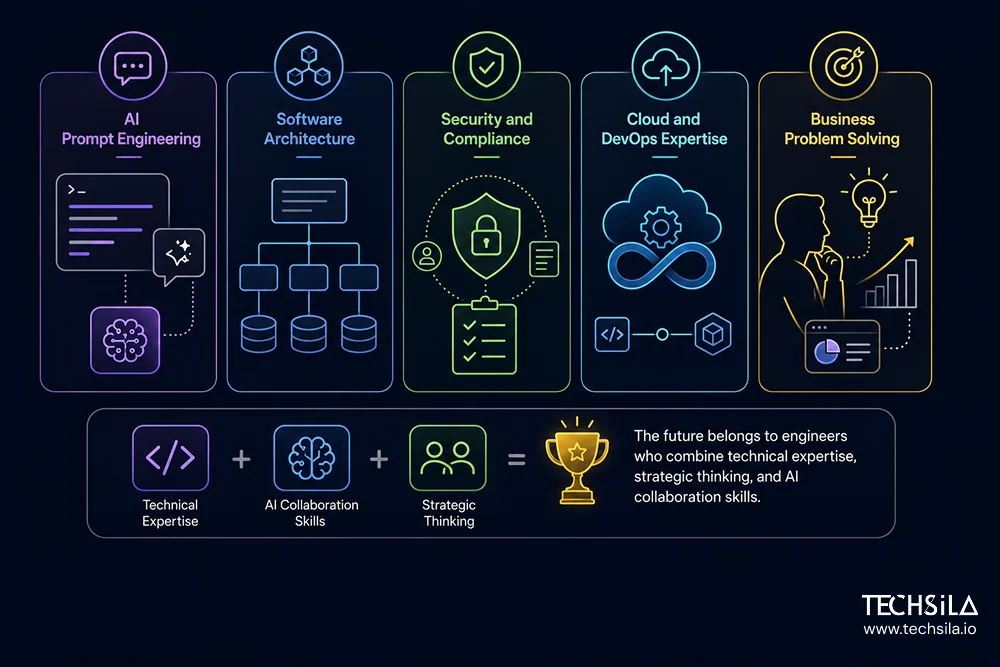
Skills Developers Need to Thrive During the AI Coding Revolution
The AI Coding Revolution is changing the types of skills that developers need to remain valuable in the marketplace.
While coding knowledge remains important, other capabilities are becoming even more critical.
AI Prompt Engineering
Developers increasingly need to know how to communicate effectively with AI systems.
Well-structured prompts often determine the quality of AI-generated outputs. As the AI Coding Revolution grows, prompt engineering is becoming an essential technical skill.
Software Architecture
AI can generate code, but it still struggles to make complex architectural decisions.
Developers who understand scalability, maintainability, performance optimization, and system design will continue to play a crucial role.
Security and Compliance
AI-generated code is not automatically secure.
Engineers must understand cybersecurity principles, data protection requirements, and regulatory compliance standards to ensure software remains safe and reliable.
Cloud and DevOps Expertise
Modern applications rely heavily on cloud infrastructure and automated deployment pipelines.
The AI Coding Revolution may simplify development tasks, but organizations still need experts who understand cloud architecture, infrastructure management, and DevOps best practices.
Business Problem Solving
Perhaps the most valuable skill in the era of the AI Coding Revolution is the ability to solve real business challenges.
Technology exists to serve business objectives. Developers who can connect technical solutions to measurable business outcomes will remain highly sought after regardless of how advanced AI becomes.
The future belongs to engineers who combine technical expertise, strategic thinking, and AI collaboration skills.
Expert Predictions About the AI Coding Revolution
Technology leaders across the industry agree that artificial intelligence will significantly reshape software development over the coming decade.
Satya Nadella has repeatedly emphasized that AI should be viewed as a tool that enhances human productivity rather than replaces human creativity. His vision suggests developers will increasingly act as orchestrators, guiding intelligent systems instead of performing every task manually.
Jensen Huang has predicted that future programming may become more accessible through natural language interactions, allowing users to describe what they want rather than writing every line of code themselves.
Meanwhile, Sam Altman has highlighted how rapidly AI capabilities are advancing and how software development workflows could evolve dramatically within the next few years.
Despite different perspectives, a common theme emerges from these expert predictions: the AI Coding Revolution is more likely to augment developers than eliminate them.
The developers who learn how to leverage AI effectively will gain a significant productivity advantage over those who resist technological change.
How Businesses Should Prepare for the AI Coding Revolution
The AI Coding Revolution presents enormous opportunities, but organizations need a clear strategy to maximize its benefits.
Invest in AI Literacy
Business leaders should ensure that development teams understand both the capabilities and limitations of AI coding tools.
Training and education will become increasingly important as AI adoption grows.
Establish Governance Policies
Organizations should define clear guidelines for how AI-generated code is reviewed, approved, and deployed.
Strong governance reduces the risk of security vulnerabilities and compliance issues.
Maintain Human Oversight
The AI Coding Revolution should not eliminate human review processes.
Developers must validate AI-generated outputs to ensure quality, accuracy, and alignment with business goals.
Focus on High-Value Work
As AI automates routine coding tasks, teams should shift their attention toward innovation, architecture, customer experience, and strategic problem-solving.
This is where businesses can create the greatest competitive advantage.
Start Small and Scale Gradually
Rather than attempting a complete transformation overnight, organizations should begin with pilot projects and gradually expand AI adoption based on measurable results.
Companies that take a structured approach to the AI Coding Revolution will be better positioned to improve productivity while maintaining software quality and reliability.
The Future of the AI Coding Revolution
The most likely outcome is not AI replacing developers.
Instead, we are moving toward AI-augmented engineering teams.
Developers who embrace AI tools will likely become more productive and valuable.
Developers who ignore the AI Coding Revolution may struggle to remain competitive in an increasingly AI-driven industry.
The future belongs to professionals who combine technical expertise, business understanding, creativity, and AI collaboration skills.
Conclusion
The AI Coding Revolution is transforming software development faster than many expected.
While fears of developer replacement continue to generate headlines, the reality is far more nuanced.
AI is changing how software is built, accelerating productivity, and automating repetitive tasks. However, human expertise remains essential for architecture, security, innovation, and strategic decision-making.
The developers most likely to succeed in the coming years will be those who learn how to work alongside AI rather than compete against it.
If your organization is exploring how AI can accelerate software development while maintaining quality and scalability, you can request expert guidance here
