

AI automation in enterprise software is no longer a futuristic concept—it has become essential for modern business operations. Organizations are leveraging AI not only to automate routine tasks and enhance decision-making but also to implement intelligent systems that improve efficiency and scalability.
From automating repetitive processes to deploying predictive systems that anticipate outcomes, AI-powered enterprise automation helps businesses reduce errors, improve productivity, and stay competitive in a rapidly evolving digital landscape.
In this blog, we explore how intelligent automation in enterprise systems is transforming operations, the technologies behind it, and how businesses can implement it effectively.
What is AI Automation in Enterprise Software?
AI automation in enterprise software refers to the integration of artificial intelligence technologies such as machine learning, natural language processing (NLP), and predictive analytics into business systems to streamline workflows and enable smarter decision-making.
Unlike traditional rule-based automation, AI-driven enterprise systems can:
- Learn from historical data
- Adapt to changing conditions
- Predict risks and recommend actions
This makes intelligent automation a strategic tool for scaling operations efficiently.
Key Benefits of AI Automation in Enterprise Software
- Enhanced Efficiency
AI automation reduces the time employees spend on repetitive tasks such as data entry, invoice processing, or report generation, freeing up resources for higher-value activities. - Improved Accuracy
AI systems minimize human error by analyzing large datasets and ensuring tasks are executed consistently and correctly. - Intelligent Decision-Making
By leveraging predictive analytics, AI systems can forecast trends, identify risks, and provide actionable insights for strategic decision-making. - Scalability
AI-driven enterprise software can handle growing data volumes and complex processes without significant additional resources, ensuring seamless scalability. - Enhanced Customer Experience
AI automation improves response times, personalizes interactions, and ensures faster resolution of customer issues across multiple channels.
Want to implement AI automation in your business?
Get a free AI audit from Techsila and discover where you can save 30% in costs.
AI Automation in Enterprise Software: From Task Automation to Intelligent Systems
The evolution of AI automation in enterprise software is creating significant IT consulting opportunities for firms that can guide organizations through different stages of transformation. As businesses move from basic automation to advanced intelligent systems, the demand for strategic consulting, implementation, and optimization continues to grow. Understanding this progression is essential for capturing high-value IT consulting opportunities in 2026.
1. Task Automation
The first stage of AI adoption focuses on automating repetitive, rule-based activities. This includes tasks such as data entry, appointment scheduling, report generation, and basic customer interactions.
By reducing manual effort, task automation improves efficiency and minimizes human error. It also allows employees to shift their focus toward higher-value, strategic work. For IT consultancies, implementing task automation solutions presents early-stage AI consulting services, particularly for clients beginning their digital transformation journey.
2. Process Automation
The next stage involves automating entire workflows across departments. Unlike task automation, which focuses on individual activities, process automation connects multiple steps into a seamless, end-to-end system.
Examples include automated invoice processing, HR onboarding workflows, and supply chain management systems. These solutions ensure faster execution, improved accuracy, and consistent performance across business operations.
For consultancies, process automation unlocks more complex IT consulting opportunities, requiring expertise in system integration, workflow design, and change management. Organizations increasingly rely on consultants to implement scalable automation strategies that align with business objectives.
3. Intelligent Systems
The most advanced stage of AI automation is the development of intelligent systems capable of learning, adapting, and making data-driven decisions. These systems integrate technologies like machine learning, predictive analytics, and cognitive computing to optimize operations continuously.
Intelligent systems can forecast demand, detect inefficiencies, recommend actions, and even automate decision-making processes. This level of automation transforms enterprises into data-driven organizations with enhanced agility and innovation capabilities.
For IT consultancies, this stage represents the most lucrative automation consulting, as clients require ongoing support for AI strategy, model optimization, governance, and scalability. Delivering intelligent systems positions consultancies as long-term strategic partners rather than short-term service providers.
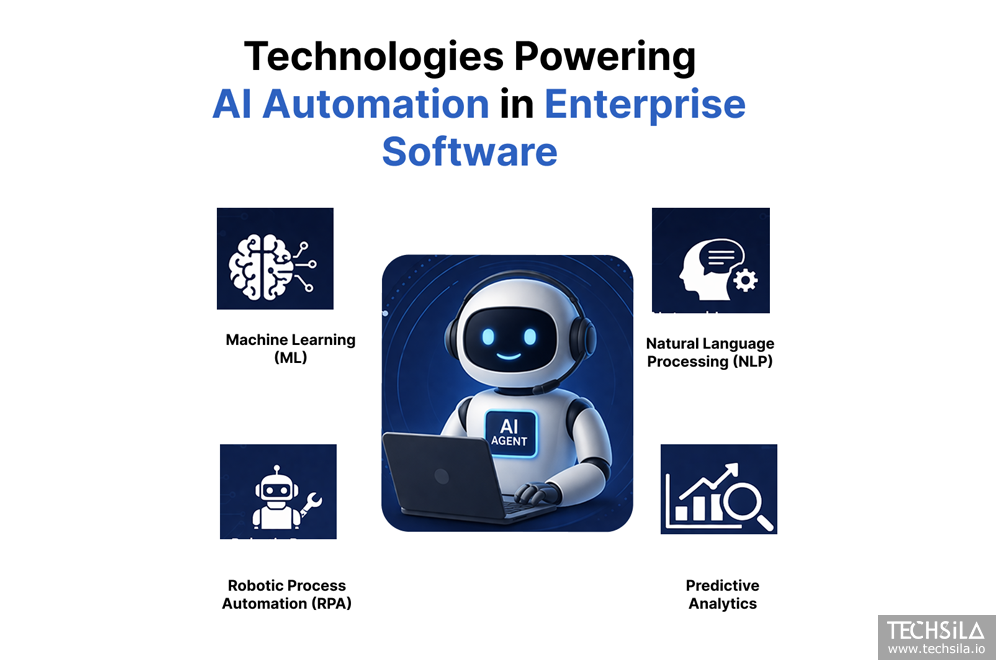
Technologies Powering AI Automation in Enterprise Software
AI automation in enterprise software is driven by a combination of advanced technologies that enable systems to analyze data, learn from patterns, and execute tasks with minimal human intervention. These technologies form the backbone of modern digital transformation strategies and are critical for delivering scalable, intelligent solutions.
1. Machine Learning (ML)
Machine Learning is a core component of AI automation that allows systems to learn from historical data and continuously improve their performance without explicit programming.
- Adaptive Learning: ML models identify patterns in data and refine their predictions over time, making systems more accurate and efficient.
- Use Cases: Fraud detection, recommendation engines, demand forecasting, and anomaly detection.
- Business Impact: Reduces manual intervention, improves decision-making, and enables predictive capabilities across enterprise applications.
By leveraging ML, organizations can transform raw data into actionable insights and automate complex decision-making processes.
2. Natural Language Processing (NLP)
Natural Language Processing enables software systems to understand, interpret, and generate human language, making interactions between humans and machines more seamless.
- Text and Speech Analysis: NLP processes emails, documents, chat conversations, and voice inputs to extract meaning and intent.
- Use Cases: Customer support chatbots, sentiment analysis, automated document review, and virtual assistants.
- Business Impact: Enhances customer experience, reduces response time, and improves communication efficiency.
NLP-powered automation allows enterprises to handle large volumes of unstructured data effectively.
3. Robotic Process Automation (RPA)
Robotic Process Automation focuses on automating repetitive, rule-based tasks by mimicking human actions within digital systems.
- Task Automation: RPA bots can handle data entry, invoice processing, report generation, and workflow management.
- Integration with AI: When combined with AI technologies like ML and NLP, RPA becomes more intelligent and capable of handling complex tasks.
- Business Impact: Increases efficiency, reduces errors, and lowers operational costs.
RPA is often the first step for organizations beginning their automation journey due to its ease of implementation and quick ROI.
4. Predictive Analytics
Predictive analytics uses statistical models, data mining, and AI techniques to forecast future outcomes based on historical data.
- Forecasting Capabilities: Helps businesses anticipate trends, customer behavior, and potential risks.
- Use Cases: Sales forecasting, risk management, supply chain optimization, and maintenance planning.
- Business Impact: Enables proactive decision-making, minimizes risks, and improves strategic planning.
With predictive analytics, organizations can move from reactive to proactive operations, gaining a competitive advantage.
5. Cognitive Computing
Cognitive computing simulates human thought processes in complex scenarios, enabling systems to make intelligent decisions and solve problems.
- Human-Like Reasoning: Systems analyze structured and unstructured data to understand context and provide insights.
- Use Cases: Healthcare diagnostics, financial advisory systems, and advanced customer support solutions.
- Business Impact: Supports high-level decision-making, improves accuracy, and enhances innovation capabilities.
Cognitive computing takes automation beyond routine tasks, enabling enterprises to handle complex, judgment-based processes.
ndustries Benefiting from AI Automation and IT Consulting Opportunities
AI-driven automation is reshaping multiple industries by enhancing efficiency, lowering operational costs, and enabling smarter, data-backed decision-making. As more organizations adopt intelligent systems, key sectors are experiencing major improvements in performance and scalability.
1. Finance & Banking
The finance and banking industry is among the earliest and most advanced adopters of intelligent automation technologies. Financial institutions are leveraging AI-powered systems to strengthen security, optimize operations, and improve overall decision-making processes.
Fraud Detection:
Advanced AI systems analyze large volumes of financial transactions in real time to detect unusual patterns and prevent fraudulent activities before they occur.
Automated Compliance Reporting:
Automation simplifies regulatory reporting by reducing manual effort, minimizing human error, and ensuring continuous compliance with evolving financial regulations.
Risk Analysis:
AI-based models evaluate credit risk, market behavior, and investment opportunities with greater speed and accuracy, enabling more informed financial decisions.
By integrating AI-powered enterprise automation solutions, financial organizations can significantly reduce operational risks, build stronger customer trust, and enhance overall efficiency.
2. Healthcare
Healthcare is undergoing a major transformation through AI-driven automation, improving both patient outcomes and operational workflows.
- Patient Data Management: Automation helps organize and process vast amounts of patient data, making it easily accessible for healthcare providers.
- Predictive Diagnostics: AI models analyze medical data to detect diseases early, enabling proactive treatment and better health outcomes.
- Appointment Scheduling: Automated systems streamline scheduling, reduce wait times, and enhance the overall patient experience.
These advancements allow healthcare providers to focus more on patient care while improving efficiency and accuracy in medical processes.
3. E-commerce & Retail
The e-commerce and retail industry is leveraging AI automation to deliver personalized experiences and optimize backend operations.
- Inventory Management: AI systems predict demand, track stock levels, and automate replenishment, reducing overstocking and shortages.
- Customer Support Chatbots: Intelligent chatbots handle customer queries 24/7, improving response times and reducing operational costs.
- Personalized Recommendations: AI analyzes customer behavior to suggest products, increasing engagement and boosting sales conversions.
Through automation, retailers can enhance customer satisfaction while optimizing supply chain and operational efficiency.
4. Manufacturing
Manufacturing is being revolutionized by AI automation, enabling smarter production processes and improved operational performance.
- Predictive Maintenance: AI monitors equipment performance and predicts potential failures, minimizing downtime and maintenance costs.
- Supply Chain Optimization: Automation improves demand forecasting, logistics planning, and inventory management, ensuring smooth operations.
- Production Planning: AI-driven insights help optimize production schedules, reduce waste, and increase overall efficiency.
By adopting AI Automation in Enterprise Software, manufacturers can achieve higher productivity, reduce costs, and maintain consistent product quality.
How Businesses Can Implement AI Automation in Enterprise Software to Unlock IT Consulting Opportunities
To successfully adopt AI automation and maximize strategic value, organizations need a structured and goal-driven approach. Implementing AI is not just a technical upgrade—it is about aligning intelligent systems with business objectives to achieve measurable outcomes and long-term growth.
Start Small with High-Impact Use Cases
Begin by identifying processes that can deliver quick and measurable value through automation, such as customer support, data entry, or reporting. Starting with small, high-impact use cases reduces implementation risks and helps organizations demonstrate ROI early while exploring broader consulting opportunities.
Integrate AI into Existing Systems
Instead of rebuilding infrastructure from scratch, businesses should embed AI capabilities into existing platforms such as ERP, CRM, or HR systems. This approach speeds up deployment, reduces disruption, and enables scalable adoption of intelligent automation across the organization, opening doors for advanced consulting engagement.
Monitor, Measure, and Optimize
AI systems require continuous monitoring to ensure optimal performance. Organizations should track key metrics such as efficiency improvements, cost reduction, and accuracy gains. Regular optimization not only enhances system performance but also strengthens long-term value creation through data-driven insights.
Invest in Talent and Training
Successful AI adoption depends on skilled teams who can manage, optimize, and scale intelligent systems. Investing in employee training ensures sustainable implementation while reducing over-reliance on external support. At the same time, businesses can collaborate with expert consultancies for strategic guidance and system enhancement.
Conclusion
AI automation is reshaping how enterprises operate by shifting them from manual processes to intelligent, data-driven systems. Businesses that adopt AI-powered enterprise solutions gain improved efficiency, reduced operational costs, and better decision-making capabilities.
As adoption grows, companies increasingly rely on expert consulting support to design and implement scalable automation strategies. This transformation is not just technological—it is a competitive necessity in the modern digital economy.
For businesses and consultancies looking to understand the latest trends and best practices in AI automation, Deloitte’s Insights on Intelligent Automation provides actionable guidance and case studies on successful deployments.
In 2026 and beyond, embracing AI automation not only enhances operational performance but also enables consultancies to capture high-value IT consulting opportunities, drive innovation, and secure a competitive advantage in a rapidly evolving market.
Ready to modernize your enterprise operations? Contact Techsila today to explore AI automation solutions tailored to your business needs.
FAQs
1. What is AI automation in enterprise software?
AI automation integrates artificial intelligence into enterprise software to automate tasks, optimize workflows, and support intelligent decision-making. This transformation creates significant IT consulting opportunities for firms that guide businesses in implementing AI solutions successfully. For more insights, see Forbes on AI in Enterprise Software.
2. How does AI automation differ from traditional automation?
Traditional automation executes pre-defined rules, whereas AI automation adapts, learns from data, and predicts outcomes. IT consultancies that help organizations transition from rule-based to AI-driven systems are well-positioned to capture high-value IT consulting opportunities.
3. Which industries benefit most from AI automation?
Industries such as finance, healthcare, retail, e-commerce, and manufacturing see the highest impact from AI automation. Implementing AI in these sectors opens new IT consulting opportunities, including workflow optimization, AI strategy development, and enterprise integration. Learn how we help businesses in these sectors through Techsila’s AI Advisory Services.
4. Can AI automation replace human employees?
AI handles repetitive, time-consuming tasks but complements human expertise, allowing employees to focus on strategic initiatives. Consultancies offering change management and workflow redesign services can capture additional IT consulting opportunities by helping businesses integrate AI without disrupting their workforce.
5. How can my organization implement AI automation?
Start with high-impact workflows, integrate AI into existing enterprise software, and continuously monitor performance for optimization.
